New Delhi, India | August 22, 2026 —
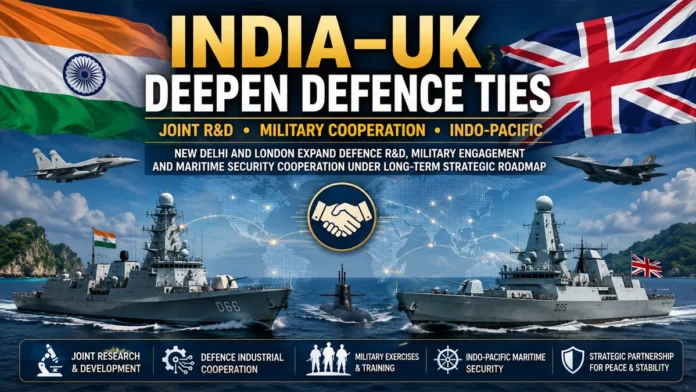
The India-UK defence partnership is entering a deeper phase, with the two countries agreeing to expand military engagement, strengthen joint research and development, and accelerate defence industrial cooperation while increasing their focus on maritime security in the Indo-Pacific
The push came during the 25th India-UK Defence Consultative Group meeting, held in New Delhi on August 21 and co-chaired by India’s Defence Secretary Rajesh Kumar Singh and UK Permanent Under Secretary for Defence Jeremy Pocklington.
Both sides reviewed ongoing defence industrial cooperation, with particular emphasis on research and development under the India-UK Vision 2035 and the 10-year Defence Industrial Roadmap.
The meeting also produced agreement on expanding joint exercises, training and capacity building between the Indian and British armed forces.
India and UK Put Defence R&D at Center of Partnership
Defence technology and industrial cooperation emerged as a major focus of the talks.
India and the UK reviewed progress under the India-UK Vision 2035 and the 10-year Defence Industrial Roadmap, frameworks designed to create a longer-term structure for cooperation between the two countries’ defence industries.
The roadmap provides a platform for deeper collaboration in areas ranging from advanced technology to co-development and industrial partnerships.
For India, such cooperation also fits into its broader objective of increasing domestic defence manufacturing and reducing dependence on imported military platforms and systems.
The shift is significant because the bilateral defence relationship is increasingly moving beyond traditional buyer-seller arrangements toward technology, research and industrial collaboration.
Also Read: US Rules Out Asia Retreat as Pentagon Demands Stronger Defense Spending From Regional Allies
Joint Military Exercises and Training to Expand
The two countries also agreed to widen engagement between their armed forces.
This will include joint exercises, military training and capacity-building initiatives.
Regular military interaction can improve interoperability between the two armed forces and allow personnel to exchange operational experience across land, maritime and air domains.
India and the UK already maintain multiple channels of defence engagement, and the latest agreement signals an intention to deepen those contacts.
Indo-Pacific Maritime Security Gets Major Focus
Maritime security in the Indo-Pacific was another key part of the discussions.
India and the UK acknowledged what they described as robust maritime security cooperation, including the establishment of the Regional Maritime Security Centre of Excellence, or RMSCE.
The center operates within the framework of the Indo-Pacific Oceans Initiative, an India-led initiative aimed at promoting cooperation across key maritime sectors.
The Indo-Pacific has become increasingly important to both countries because some of the world’s busiest shipping lanes and critical energy routes pass through the region.
Secure sea lanes are essential for international trade, energy supplies and regional economic stability.
Strategic Autonomy and Regional Security Discussed
Rajesh Kumar Singh and Jeremy Pocklington also exchanged views on regional peace and security.
Both sides reaffirmed their commitment to mutual security and strategic autonomy while emphasizing peace, stability, freedom and mutual respect as foundations of the India-UK Strategic Partnership.
The language surrounding strategic autonomy is particularly noteworthy as India continues to maintain independent relationships with multiple major powers.
New Delhi has consistently sought to expand partnerships without formally aligning its foreign and security policy with any single geopolitical bloc.
Pocklington Makes First India Visit in Current Role
The meeting also marked Jeremy Pocklington’s first visit to India in his capacity as the UK’s Permanent Under Secretary for Defence.
During the visit, Pocklington laid a wreath at the National War Memorial in New Delhi to pay tribute to Indian military personnel who made the supreme sacrifice.
He also visited Gandhi Smriti Museum and the National Defence College.
In addition, Pocklington held bilateral discussions with India’s Chief of Defence Staff General NS Raja Subramani.
These engagements underline the broader military and institutional relationship developing alongside government-to-government defence talks.
Defence Industrial Roadmap Could Shape Next Decade
The 10-year Defence Industrial Roadmap has become an important framework for the future of the India-UK defence partnership.
It is intended to provide continuity to cooperation in defence technologies, manufacturing and industrial collaboration.
Advanced technologies could become particularly important as India seeks greater access to sophisticated defence capabilities while simultaneously building a stronger domestic manufacturing ecosystem.
Co-development and co-production can also provide opportunities for Indian companies to participate more deeply in global defence supply chains.
For Britain, India represents one of the world’s largest defence markets as well as an increasingly important strategic partner in the Indo-Pacific.
India-UK Defence Relations Move Beyond Procurement
The broader significance of the latest talks lies in the changing nature of bilateral defence cooperation.
India has been seeking partnerships that provide technology, manufacturing opportunities and research collaboration rather than relying primarily on purchases of finished defence equipment.
The UK’s focus on industrial partnerships and joint R&D fits that strategy.
If projects under the Defence Industrial Roadmap progress as planned, the coming years could see deeper participation by companies and research organizations from both countries.
At the same time, expanded exercises and training could increase operational coordination between their armed forces.
Why the Indo-Pacific Dimension Matters
The maritime component gives the relationship an additional strategic dimension.
India sits at the heart of the Indian Ocean, while the UK has sought to maintain a meaningful security presence in the broader Indo-Pacific.
Both countries depend heavily on open maritime trade routes.
Cooperation on maritime domain awareness, capacity building and regional security can therefore serve both strategic and economic interests.
The Regional Maritime Security Centre of Excellence could become one mechanism through which the two countries expand that cooperation.
What Comes Next for India-UK Defence Cooperation
The 25th Defence Consultative Group meeting indicates that New Delhi and London want to turn their political and strategic relationship into more concrete defence cooperation.
The real test will be implementation.
Progress on joint research projects, technology cooperation, co-development, military exercises and the 10-year industrial roadmap will determine how far the partnership advances.
For now, the direction is clear: the India-UK defence partnership is increasingly centered on technology, industrial collaboration, military interoperability and Indo-Pacific maritime security.