New Delhi, India | August 21, 2026
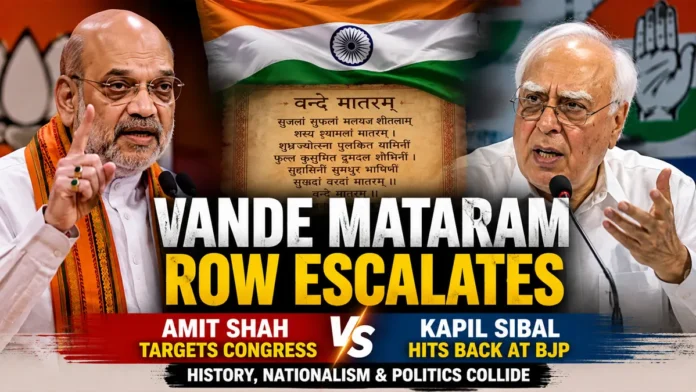
Vande Mataram row: A political confrontation between the BJP and Congress intensified Friday after Rajya Sabha MP Kapil Sibal hit back at Union Home Minister Amit Shah over his sharp criticism of the Congress Working Committee’s decision to sing only the first two stanzas of Vande Mataram at party events.
Sibal questioned whether the BJP itself had consistently sung every stanza of Vande Mataram at private and official functions since 1950. He also raised questions about the practice followed during Narendra Modi’s tenure as Gujarat chief minister and Atal Bihari Vajpayee’s tenure as prime minister.
His intervention came a day after Shah accused Congress of pursuing appeasement politics and described the CWC’s position as “anti-national,” sharply escalating a political dispute over the national song.
Amit Shah Targets Congress Over Vande Mataram
Shah launched a strong attack on Congress after the CWC decided to follow its historical position of singing the first two stanzas of Vande Mataram at party functions.
The home minister argued that the decision represented a return to what he described as Congress’ politics of appeasement.
He also linked the current controversy to the party’s position in the 1930s and alleged that Congress’ historical approach toward Vande Mataram had contributed to divisive politics before Partition.
These are political claims made by Shah and have been strongly challenged by his opponents.
Shah said the BJP would take the issue to the public as well as legislatures, indicating that the controversy could remain a significant political issue beyond the immediate exchange between the two parties.
Kapil Sibal Hits Back at Amit Shah
On Friday, Sibal entered the controversy with a series of questions directed at Shah and the BJP.
He asked whether BJP leaders had themselves sung all the stanzas of Vande Mataram at official or private functions since 1950.
Sibal specifically referred to Narendra Modi’s tenure as Gujarat chief minister and Vajpayee’s tenure as prime minister.
He also challenged the use of the “anti-national” label in the dispute, questioning whether the same description would apply to BJP leaders if they had not routinely sung the complete version.
The remarks broadened the controversy from Congress’ current decision to the historical practices followed by political parties and governments.
Congress Cites Its Historical Position
Congress has defended its decision by referring to its historical position dating back to the freedom movement.
The party maintains that singing the first two stanzas at national gatherings is consistent with the position adopted by Congress leaders in the 1930s.
Congress leaders have therefore rejected BJP allegations that the current decision represents disrespect toward the national song.
The BJP, however, argues that Vande Mataram should be honored in its entirety and has sought to frame the CWC decision as a larger question of national identity and respect for India’s freedom movement.
Why the 1937 Decision Is Back in Focus
The dispute has once again brought the historical debate surrounding Vande Mataram into contemporary politics.
Written by Bankim Chandra Chattopadhyay, Vande Mataram played an important role in India’s freedom movement and later received official recognition as India’s national song.
However, debates over which portions should be sung at public and political events have existed for decades.
Congress has invoked its 1937 position to defend the use of the first two stanzas, while BJP leaders are challenging that interpretation and calling for the complete song to receive greater prominence.
The disagreement has consequently moved beyond a procedural decision at party events and become a broader political battle over history, nationalism and the interpretation of national symbols.
BJP Plans to Take Issue to the Public
Shah has indicated that the BJP does not intend to allow the controversy to end with statements from senior leaders.
He said the party would take its campaign against Congress’ position to the public and legislatures.
That could turn the dispute into a wider political campaign, particularly if BJP leaders raise the issue in state legislatures and at public meetings.
Congress leaders, meanwhile, are expected to continue defending the historical basis for their position while challenging the BJP’s accusations.
Political Battle Intensifies
The exchange illustrates how national symbols continue to become flashpoints in political contests between India’s two largest national parties.
For the BJP, the controversy provides an opportunity to emphasize nationalism and its interpretation of India’s historical legacy.
For Congress, the response centers on defending a position it says is rooted in decisions made during the freedom movement while rejecting BJP accusations of appeasement.
Sibal’s intervention has added another dimension by questioning the BJP’s own historical practice.
The immediate political question is now whether the confrontation remains centered on statements by senior leaders or develops into a sustained nationwide campaign.
With Shah saying the BJP will take the issue to the public and legislatures, the Vande Mataram row appears set to remain a significant political confrontation between the ruling party and the opposition.