MOSCOW, Russia | August 21, 2026
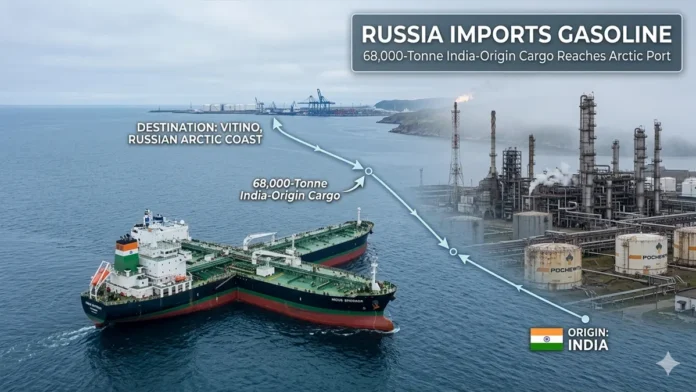
Russia gasoline imports have come into sharp focus after repeated Ukrainian attacks on refineries and fuel infrastructure disrupted domestic supplies, with a reported shipment of roughly 68,000 metric tons of India-origin gasoline arriving at the Arctic port of Vitino.
The development represents an unusual shift for Russia, one of the world’s largest oil producers and exporters, as Moscow moves to secure additional fuel supplies while attempting to stabilize its domestic market.
Russia has acknowledged importing gasoline amid supply pressures and has also taken steps to restrict fuel exports.
The India-linked cargo adds another dimension to the rapidly changing energy relationship surrounding the Russia-Ukraine war.
Why Is Russia Importing Gasoline?
Russia possesses enormous crude-oil reserves and a large refining industry, but producing crude oil and producing sufficient quantities of finished gasoline are not the same thing.
Refineries transform crude into gasoline, diesel, jet fuel and other petroleum products.
Repeated Ukrainian attacks on Russian refining and fuel-storage infrastructure have disrupted parts of that system.
When refinery capacity is temporarily unavailable, domestic supplies of finished petroleum products can tighten even if crude production remains substantial.
That helps explain why Russia can simultaneously be a major oil producer and still need to import gasoline.
India-Origin Gasoline Shipment Reaches Vitino
A shipment of approximately 68,000 metric tons of gasoline originating from India has reportedly reached Vitino, an Arctic port in Russia.
Additional cargoes have also been expected as Moscow attempts to strengthen domestic supplies.
The shipment is significant because India itself has become an important refining center in the global energy market.
Indian refiners import crude from multiple sources, process it into petroleum products and export fuels to markets around the world.
As a result, the international oil trade has become increasingly complex since the Russia-Ukraine war reshaped traditional energy flows.
Russia Also Looks to Belarus and Kazakhstan
India is not Russia’s only potential source of additional fuel.
Moscow has also looked to neighboring Belarus and Kazakhstan as it seeks to maintain adequate gasoline availability.
Both countries have close economic links with Russia and established energy infrastructure.
The broader import effort demonstrates the pressure being placed on Russia’s downstream petroleum system.
Russia has also restricted gasoline exports in an effort to prioritize domestic consumers.
Such measures are intended to prevent shortages and contain price pressure inside the country.
Ukraine Targets Russia’s Energy Infrastructure
Ukraine has increasingly focused on Russian oil refineries, storage facilities and other energy infrastructure.
Kyiv argues that energy facilities contribute to Russia’s ability to finance and sustain its military operations.
Russia, meanwhile, has repeatedly condemned attacks on its territory and infrastructure.
The energy campaign has transformed refineries into an increasingly important part of the wider war.
Unlike attacks on crude production itself, refinery disruptions can have an immediate impact on supplies of finished products required by households, transportation networks, agriculture and industry.
Why Refineries Are Strategically Important
Russia’s economy depends heavily on its energy sector.
Crude-oil exports generate substantial revenue, but domestic refining is equally important because the country’s economy and transportation system require reliable supplies of gasoline and diesel.
Refineries are complex industrial facilities.
Even when damage is limited to a particular unit, repairs can take time because specialized equipment and replacement components may be required.
A series of disruptions across multiple facilities can therefore reduce effective refining capacity even when individual refineries eventually return to operation.
India’s Changing Role in Global Oil Trade
The India connection makes the development especially significant for Asian energy markets.
Since the Russia-Ukraine war began, global crude flows have been substantially reorganized.
India emerged as a major buyer of discounted Russian crude while simultaneously remaining a significant exporter of refined petroleum products.
That means crude oil can travel from one country to an Indian refinery and subsequently enter the international market as gasoline, diesel or another refined product.
The latest reported cargo illustrates how global energy trade cannot always be understood simply by looking at bilateral crude-oil flows.
Refining, shipping, sanctions and market economics all influence where finished fuels eventually travel.
Does the Shipment Violate Western Sanctions?
The existence of an India-origin gasoline shipment to Russia does not by itself establish a sanctions violation.
The legal status of an individual cargo can depend on several factors, including ownership, financing, shipping arrangements, the companies involved and applicable sanctions regimes.
India has maintained economic relations with Russia while also engaging closely with the United States and European countries.
New Delhi has repeatedly emphasized its energy-security interests when discussing its oil trade.
Any assessment of a particular shipment would therefore require specific evidence about the transaction rather than assumptions based solely on its destination.
Russia Restricts Fuel Exports
Moscow’s decision to restrict fuel exports is another indication that domestic supply stability has become a priority.
Export restrictions can keep more gasoline inside the country and reduce pressure on domestic prices.
However, they can also affect international petroleum-product markets by reducing the amount of Russian fuel available to overseas buyers.
If refinery disruptions persist, traders will watch whether Russia extends restrictions, increases imports or redirects additional production toward its domestic market.
Could Russia’s Fuel Problem Affect Global Prices?
Russia remains an important participant in global energy markets.
Significant disruption to its petroleum-product exports could influence regional gasoline and diesel prices, particularly in markets that traditionally purchase Russian supplies.
The impact would depend on how long refinery outages last and whether other producers can replace missing volumes.
Global energy markets are already dealing with uncertainty surrounding Iran and the Strait of Hormuz, making another supply-side disruption particularly important.
What Happens Next?
The key question is whether Russia’s gasoline imports are a temporary response to refinery maintenance and war-related disruptions or the beginning of a longer period of dependence on foreign fuel supplies.
Further Ukrainian attacks could increase pressure on refining capacity.
Conversely, successful repairs and higher refinery utilization could reduce Moscow’s need for imported gasoline.
For India, the development highlights the increasingly important role of its refining industry in global petroleum trade.
For Russia, however, the symbolism is striking: one of the world’s leading crude-oil powers is importing finished gasoline while attacks continue to test the resilience of its domestic refining network.