
Mumbai, India — August 20, 2026
RBI Personal Loan Rules 2026 have given borrowers greater freedom to repay certain loans ahead of schedule without being hit by foreclosure or prepayment penalties. But the relief does not mean borrowers no longer have to repay their loans, and it does not automatically make every personal or home loan penalty-free.
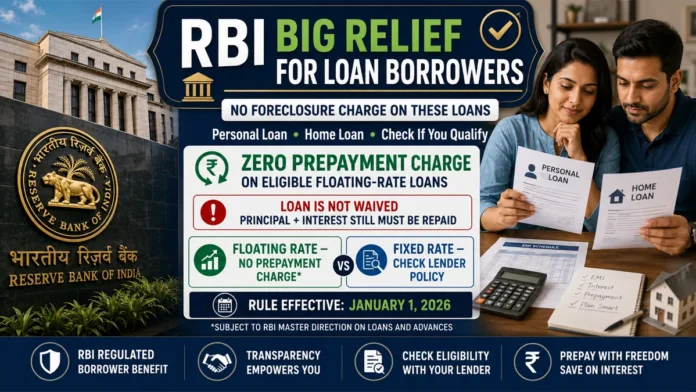
Under the Reserve Bank of India’s Pre-payment Charges on Loans Directions, 2025, which apply to loans and advances sanctioned or renewed on or after January 1, 2026, regulated lenders cannot impose prepayment charges on floating-rate loans given to individuals for purposes other than business. The protection applies whether the borrower repays part of the loan or closes it completely.
The rules cover commercial banks other than payment banks, cooperative banks, non-banking financial companies and All India Financial Institutions.
That means borrowers with qualifying floating-rate personal or home loans could save thousands of rupees when they decide to pay off debt early or move to a cheaper lender.
Does RBI’s New Rule Mean You Do Not Have to Repay Your Loan?
No. Absolutely not.
This is the most important clarification.
RBI has not waived personal loans, home loans or EMIs. Borrowers are still legally required to repay the outstanding principal and applicable interest according to their loan agreement.
What RBI has restricted is the extra prepayment or foreclosure charge that eligible borrowers could otherwise face when paying a loan ahead of schedule.
So a headline claiming “you no longer need to repay your loan” would be misleading.
The actual benefit is:
You may be able to repay an eligible loan early without paying an additional foreclosure penalty.
Which Loans Get Zero Prepayment Charges?
The biggest protection applies to floating-rate loans taken by individuals for non-business purposes.
For qualifying loans sanctioned or renewed from January 1, 2026, RBI says regulated entities cannot levy prepayment charges.
This can potentially include floating-rate:
- home loans,
- personal loans,
- vehicle loans, and
- other individual non-business loans,
provided the loan structure falls within the RBI directions.
The restriction applies whether there is a co-borrower or not.
Is There Any Lock-In Period?
For qualifying floating-rate loans covered by the new directions, RBI says the protection applies without any minimum lock-in period.
That is significant.
A lender cannot say that the borrower must first complete a certain number of months or years solely to qualify for the RBI-mandated exemption where the directions apply.
The rule also applies to part-prepayment as well as full prepayment.
Does It Matter Where the Prepayment Money Comes From?
No, for eligible loans covered by the rule.
The RBI directions say the exemption applies irrespective of the source of funds used for prepayment.
For example, a borrower might use:
- salary savings,
- a bonus,
- maturity proceeds,
- investment withdrawals,
- inheritance, or
- refinancing from another lender.
For loans qualifying under the rule, the lender cannot impose a prepayment charge merely because the money came from a particular source.
What About Fixed-Rate Personal Loans?
This is where borrowers need to be careful.
The RBI’s blanket protection is specifically centered on floating-rate loans.
A fixed-rate personal loan does not automatically become foreclosure-charge-free simply because the new rules took effect in 2026.
Many unsecured personal loans in India are offered at fixed rates.
For such loans, borrowers should check:
- the sanction letter,
- loan agreement,
- Key Facts Statement,
- lender’s foreclosure policy, and
- applicable prepayment schedule.
The lender may still be allowed to impose a charge where the RBI prohibition does not apply, subject to applicable regulations and transparent disclosure.
Floating Rate vs Fixed Rate: What Is the Difference?
A floating-rate loan has an interest rate that can change during the loan period depending on a benchmark or the lender’s applicable rate-setting mechanism.
A fixed-rate loan generally keeps the agreed interest rate fixed according to the terms of the contract.
This difference is crucial when discussing foreclosure charges.
For borrowers, the first question before deciding to prepay should therefore be:
“Is my loan currently fixed or floating?”
For dual- or special-rate loans that switch between fixed and floating rates, RBI’s 2025 directions say applicability depends on whether the loan is on a floating rate at the time of prepayment.
What Is the Relief for Home Loan Borrowers?
Floating-rate home-loan borrowers have had significant protection against foreclosure charges for years.
RBI had previously prohibited banks from imposing foreclosure or prepayment penalties on floating-rate home loans and also extended restrictions more broadly to floating-rate term loans to individual borrowers.
The 2025 directions, effective for loans sanctioned or renewed from January 1, 2026, create a more uniform framework across regulated lenders and extend clarity over when charges can and cannot be imposed.
For home-loan customers, removing a foreclosure barrier can make it easier to refinance with another lender if a substantially better interest rate becomes available.
Personal Loan Borrowers Need to Check One Important Detail
For personal loans, the relief can be valuable—but many borrowers may discover their loan is fixed-rate, rather than floating-rate.
Therefore, do not assume that every personal loan can now be closed without a fee.
Check the interest-rate type first.
If your agreement says floating rate and your loan qualifies under the RBI directions, prepayment charges should not be levied.
If it says fixed rate, read the foreclosure clause carefully.
Lenders Must Disclose Charges Clearly
RBI has also strengthened transparency requirements through its Key Facts Statement, or KFS, framework.
For retail and MSME term loans, the KFS must clearly disclose important costs associated with the loan, including the annual percentage rate and applicable fees.
RBI says a fee or charge that is not mentioned in the KFS generally cannot later be imposed without the borrower’s explicit consent.
This makes the KFS one of the most important documents borrowers should examine before signing a loan agreement.
Should You Immediately Close a Personal Loan After Receiving a Bonus?
Not necessarily.
A foreclosure penalty being removed does not automatically mean using every available rupee to repay a loan is the best financial decision.
Before making a large prepayment, borrowers should examine:
Emergency savings: Paying off a loan should not leave you without cash for medical emergencies, job loss or unexpected expenses.
Loan interest rate: High-interest debt is generally more expensive to carry than low-interest secured borrowing.
Remaining tenure: Prepayment usually saves more interest when significant time remains on the loan.
Investment consequences: Selling investments could involve taxes, exit loads or loss of long-term investment opportunities.
Other debt: Credit-card or other very high-interest debt may deserve priority.
The right decision depends on the borrower’s finances rather than on the RBI rule alone.
When Does Prepaying a Loan Save the Most Money?
Loans typically have a larger interest component during their earlier years.
As a result, prepaying a loan relatively early can sometimes produce substantial interest savings.
Consider a borrower who has a long home-loan tenure remaining.
Reducing principal now means future interest is calculated on a smaller outstanding balance.
By contrast, when only a short period remains before final repayment, the interest savings from foreclosure may be much smaller.
Borrowers should ask their lender for an updated amortization schedule and foreclosure statement before deciding.
Can You Transfer the Loan to Another Bank?
Yes, subject to eligibility and the new lender’s approval.
One of the reasons RBI has focused on foreclosure charges is that such charges can discourage borrowers from moving their loans to lenders offering better terms.
If an eligible floating-rate loan carries no foreclosure penalty, borrowers have greater flexibility to consider a balance transfer.
But a lower advertised rate alone is not enough.
Before transferring, calculate:
- processing charges,
- legal or valuation fees,
- insurance costs,
- remaining loan tenure, and
- total interest savings.
A small interest-rate difference may not justify switching if transaction costs are high.
Why Choosing the Right Lender Still Matters
Even with stronger RBI consumer protections, lenders can differ substantially.
Borrowers should compare more than the headline interest rate.
Look at:
Annual Percentage Rate (APR) — this provides a broader view of borrowing cost.
Processing fee — a low rate with a high upfront fee may not be attractive.
Interest type — fixed or floating can directly affect prepayment treatment.
Reset conditions — important for floating-rate loans.
Prepayment rules — especially for fixed-rate products.
Customer service — critical if refinancing or closing the loan later.
Digital and branch support — useful when requesting statements, NOCs and account closure documents.
What Should You Check Before Foreclosing a Loan?
Before transferring a large sum to close your loan, obtain written confirmation of the exact outstanding amount and foreclosure conditions from your lender.
Also verify whether the quoted amount includes interest up to the payment date.
Once the account is closed, collect the loan closure confirmation or No Objection Certificate, and ensure that any collateral documents or security interests are released where applicable.
Later, check your credit report to make sure the account is correctly shown as closed.
RBI Rule Applies From January 1, 2026
One important limitation must not be overlooked.
The Reserve Bank of India (Pre-payment Charges on Loans) Directions, 2025 apply to loans and advances sanctioned or renewed on or after January 1, 2026.
Borrowers with older loans should not automatically assume that every provision applies retrospectively.
Older RBI rules may already protect some categories, particularly floating-rate loans to individual borrowers, but the exact treatment can depend on lender type, loan type and the terms applicable when the loan was sanctioned.
RBI Personal Loan Rules 2026: The Bottom Line
The RBI Personal Loan Rules 2026 are good news for many borrowers, but they need to be understood correctly.
The RBI has not canceled loans or EMIs.
Instead, its rules strengthen the ability of eligible borrowers to part-prepay or fully close floating-rate loans without foreclosure charges.
For an individual with a qualifying non-business floating-rate loan:
No prepayment charge.
No minimum lock-in for the exemption.
Part or full repayment can qualify.
The source of repayment funds does not change the protection.
But borrowers with fixed-rate personal loans should not assume that foreclosure is free.
The best step before paying off any loan is simple: check whether it is fixed or floating, read the Key Facts Statement, obtain the lender’s written foreclosure quote and calculate how much interest you would actually save.
Official RBI Links
RBI’s official website lists the Reserve Bank of India (Pre-payment Charges on Loans) Directions, 2025, which took effect for relevant loans sanctioned or renewed from January 1, 2026.