Cambridge, United States — August 20, 2026
Moderna Merck mRNA Cancer Vaccine research has reached a major milestone after a personalized experimental treatment used with Keytruda succeeded in a large Phase 3 trial involving patients with high-risk melanoma whose tumors had been surgically removed.
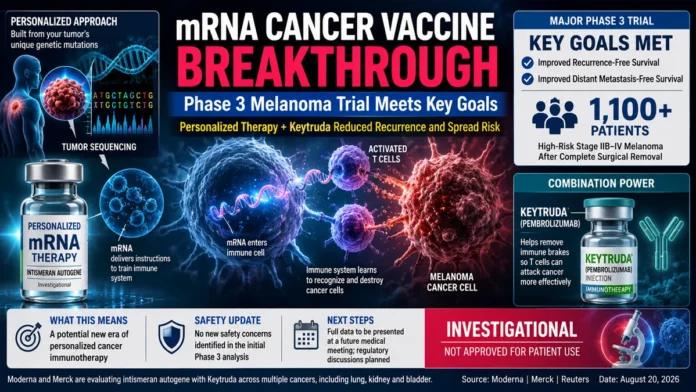
The investigational therapy, called intismeran autogene, met the study’s primary goal of improving recurrence-free survival when combined with Merck’s Keytruda compared with Keytruda alone. It also met a key secondary goal by improving distant metastasis-free survival — the length of time patients remained free from cancer spreading to distant parts of the body.
More than 1,100 patients with completely resected Stage IIB through Stage IV melanoma participated in the pivotal INTerpath-001 study. No new safety concerns were identified in the initial Phase 3 analysis.
The result represents one of the most important tests yet of whether mRNA technology can move beyond infectious-disease vaccines and become a viable platform for highly individualized cancer treatment.
Importantly, however, the treatment remains investigational and is not yet an approved melanoma vaccine. Moderna and Merck have also not yet publicly released the detailed Phase 3 recurrence rates, hazard ratios or overall-survival results. Those data are expected to be presented at a future medical meeting.
What Did the Phase 3 Melanoma Trial Find?
The INTerpath-001 study tested whether adding intismeran autogene to pembrolizumab, sold under the brand name Keytruda, could reduce the chances of melanoma returning after surgery.
The study was designed as a randomized Phase 3 trial involving patients with high-risk Stage IIB, IIC, III or IV melanoma after complete tumor removal. Its primary endpoint was recurrence-free survival, while important secondary endpoints included distant metastasis-free survival and overall survival.
At a pre-specified interim analysis, the combination produced statistically significant and clinically meaningful improvements in both recurrence-free survival and distant metastasis-free survival compared with Keytruda-based treatment without the individualized mRNA therapy.
That means patients receiving the combination went longer without their melanoma returning and longer without the disease spreading to distant organs.
Why This Is a Major Cancer Vaccine Milestone
Cancer vaccines have been researched for decades, but developing one capable of demonstrating clear benefit in a large randomized late-stage trial has been difficult.
Intismeran is different from a preventive vaccine such as a flu or measles shot.
It is designed after a patient develops cancer and is customized using mutations found in that individual’s tumor.
Moderna and Merck describe the approach as an individualized neoantigen therapy.
The Phase 3 success is particularly important because it provides late-stage evidence that a vaccine designed specifically around one patient’s tumor mutations can add benefit to an established cancer immunotherapy.
How Does the Personalized mRNA Cancer Vaccine Work?
The process begins with genetic information from a patient’s tumor.
Researchers identify mutations that may create abnormal proteins — known as neoantigens — that distinguish cancer cells from normal cells.
A customized mRNA treatment is then designed to encode selected neoantigens from that particular tumor.
Intismeran can encode up to 34 tumor-specific neoantigens, according to Merck’s description of the technology. Once administered, the goal is to train the immune system to recognize those abnormal targets and generate T-cell responses against cancer cells carrying them.
In simple terms, the treatment attempts to give the immune system a personalized “wanted list” based on the genetic fingerprint of an individual patient’s cancer.
What Role Does Keytruda Play?
Keytruda, or pembrolizumab, is an anti-PD-1 immunotherapy.
Cancer cells can exploit immune checkpoints such as PD-1 to make it harder for the immune system to attack them. Keytruda blocks that pathway, helping immune cells recognize and fight tumor cells more effectively.
The scientific strategy behind the combination is complementary.
Intismeran is designed to teach immune cells which tumor-specific targets to attack, while Keytruda helps remove an immune-system brake that can prevent those activated cells from working effectively.
That combination had already shown encouraging results in smaller studies before moving into Phase 3.
Earlier Study Found 49% Lower Risk of Recurrence or Death
The strongest detailed figures currently available come from the earlier Phase 2b KEYNOTE-942 study, not the newly announced Phase 3 trial.
At a median follow-up of about five years, intismeran plus Keytruda reduced the risk of melanoma recurrence or death by 49% compared with Keytruda alone.
The combination also reduced the risk of distant metastasis or death by 59% in that smaller study.
Those results helped justify the much larger Phase 3 program.
However, the 49% and 59% figures should not be presented as the new Phase 3 results. Moderna and Merck have not yet disclosed comparable detailed percentages from INTerpath-001.
That distinction is important for accurate medical reporting.
More Than 1,100 Patients Tested in Pivotal Trial
The Phase 3 trial dramatically expanded the evidence base.
Current reporting on the completed enrollment places participation at 1,137 patients, while the original clinical-trial registry had planned enrollment of about 1,089. The study included people with surgically removed high-risk melanoma from Stage IIB through Stage IV.
Patients were randomly assigned to receive the individualized therapy plus Keytruda or the comparison regimen.
Because the trial was conducted after complete surgical resection, the objective was not to shrink a visible tumor. Instead, researchers were trying to prevent microscopic cancer cells left behind after surgery from causing the disease to return.
What Is Melanoma?
Melanoma is a cancer that begins in pigment-producing cells called melanocytes.
Although it accounts for a smaller proportion of skin-cancer cases than some other forms, melanoma is particularly dangerous because it can spread to other organs.
Surgery can remove localized tumors, but people with higher-risk disease can still face recurrence afterward.
That is why adjuvant therapy — treatment given following surgery — is important in melanoma care.
The Moderna-Merck strategy is designed specifically for that post-surgery period, when no visible tumor may remain but the risk of recurrence can still be significant.
Is This a Cancer Cure?
No.
The Phase 3 result should not be described as a cure for melanoma or cancer.
The study found that the investigational combination improved how long patients remained free from recurrence and distant spread compared with the control treatment.
Whether it ultimately improves overall survival — how long patients live regardless of recurrence — remains an important question.
The Phase 3 study is continuing so researchers can evaluate additional endpoints, including overall survival.
Full data will also be needed to understand the magnitude of benefit across different patient groups and the detailed safety profile.
Has the mRNA Cancer Vaccine Been Approved?
Not yet.
Intismeran autogene remains an investigational treatment.
Moderna and Merck plan to discuss the Phase 3 results with regulatory authorities and pursue potential filing submissions.
Regulators will review the full efficacy and safety data before deciding whether the combination should be approved for routine patient use.
Even after positive Phase 3 results, approval is not automatic.
Manufacturing consistency, benefit-risk balance, safety, treatment logistics and other factors all form part of the regulatory process.
No New Safety Signal Reported So Far
The companies said the Phase 3 analysis identified no new safety concerns.
Earlier studies found that the combination’s safety profile was generally manageable and consistent with previously observed effects.
In prior Phase 2 data, commonly reported effects associated with the individualized mRNA treatment included fatigue, injection-site pain and chills. Most were mild or moderate.
Keytruda itself can cause immune-related side effects because it activates the immune system, and patients receiving checkpoint inhibitors require appropriate clinical monitoring.
Detailed Phase 3 safety data will therefore be important when the complete results are released.
Why the Result Matters Beyond Melanoma
Perhaps the biggest long-term implication is that the technology may not be limited to one form of cancer.
Moderna and Merck have built a broader clinical-development program evaluating intismeran with Keytruda across multiple tumor types.
Studies include non-small cell lung cancer, renal cell carcinoma and bladder cancer, among others.
The fundamental concept is potentially adaptable because each treatment is created from the genetic mutations found in an individual patient’s tumor rather than using one fixed cancer antigen for everyone.
Success in melanoma does not prove the therapy will work in other cancers, but it provides stronger evidence that the underlying personalized mRNA strategy can work in a large Phase 3 trial.
Why mRNA Technology Is Suited to Personalized Cancer Vaccines
One advantage of mRNA is its programmability.
Instead of manufacturing a completely different type of biological drug whenever a new tumor target is selected, researchers can alter the genetic instructions encoded in the mRNA.
That makes the platform attractive for personalized medicine, where each patient may need a different set of tumor targets.
The challenge is that individualized treatment is significantly more complex than manufacturing millions of identical vaccine doses.
A tumor must be sampled and sequenced, relevant mutations selected and an individual treatment manufactured for each patient.
If approved, cost, manufacturing speed and access could therefore become major practical issues.
What Happens Next?
The most important next step will be the publication and presentation of the full Phase 3 data.
Researchers and regulators will want to see the actual recurrence-free survival curves, distant metastasis results, adverse-event data, subgroup analyses and eventually overall survival.
Those numbers will determine how substantial the benefit is and how the treatment could fit into existing melanoma care.
Moderna and Merck have said they intend to engage regulators regarding potential submissions.
Why the Phase 3 Result Is Significant
The Moderna Merck mRNA Cancer Vaccine result does not mean medicine has produced a universal cancer vaccine.
What it does show is potentially just as important: a treatment designed around the mutations in an individual patient’s tumor has succeeded in a pivotal late-stage trial when added to an established immunotherapy.
That represents a major validation of personalized neoantigen therapy and of mRNA as a cancer-treatment platform.
The result is especially compelling because it builds on five-year Phase 2b findings showing durable reductions in melanoma recurrence and distant spread.
Still, the most important details remain ahead.
Until the full Phase 3 results are presented and regulators complete their reviews, intismeran should be described as a promising investigational personalized cancer therapy — not an approved vaccine or a cure for melanoma.
Official Research and Clinical Trial Links
Readers can review the underlying INTerpath-001 Phase 3 melanoma study (NCT05933577) through the official U.S. clinical-trial registry maintained by the National Library of Medicine:
Official ClinicalTrials.gov Research Record:
INTerpath-001 Phase 3 Melanoma Trial — NCT05933577
The study is officially titled “A Phase 3, Randomized, Double-Blind, Placebo- and Active-Comparator-Controlled Clinical Study of Adjuvant V940 (mRNA-4157) Plus Pembrolizumab Versus Adjuvant Placebo Plus Pembrolizumab in Participants With High-Risk Stage II-IV Melanoma (INTerpath-001).”
The trial compares intismeran autogene (V940/mRNA-4157) plus pembrolizumab (Keytruda) with placebo plus pembrolizumab in patients with completely resected high-risk melanoma.
Official Merck/MSD Clinical Trial Page:
Merck/MSD INTerpath-001 Study Record
Clinical Trial Identifier: NCT05933577
Study: INTerpath-001 / V940-001
Phase: Phase 3
Condition: High-risk melanoma
Investigational Therapy: Intismeran autogene (V940/mRNA-4157)
Combination Therapy: Pembrolizumab (Keytruda)
Editor’s Note: Intismeran autogene remains investigational. The positive Phase 3 announcement does not mean the therapy has received regulatory approval or that it should be described as a cure for melanoma.