NEW DELHI, August 20, 2026
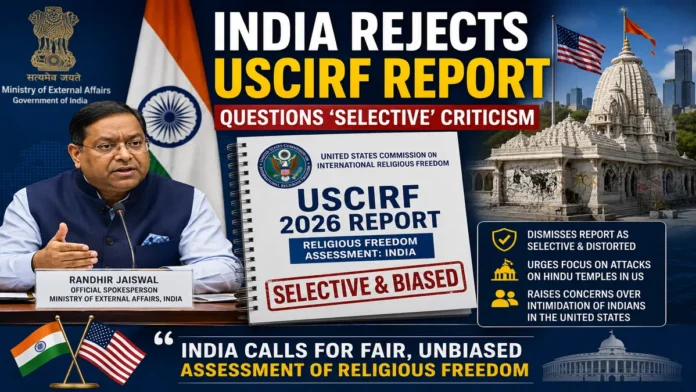
India has firmly rejected the USCIRF 2026 Annual Report, accusing the U.S. religious-freedom commission of presenting what New Delhi describes as a selective and distorted picture of the country.
In a statement issued on March 16, 2026, Ministry of External Affairs spokesperson Randhir Jaiswal said India “categorically” rejected USCIRF’s characterization of religious-freedom conditions in the country. New Delhi has maintained that the commission’s assessments rely on selective narratives and fail to adequately reflect India’s constitutional framework, democratic institutions and religious diversity.
Jaiswal also urged USCIRF to pay greater attention to what India described as disturbing incidents involving vandalism and attacks on Hindu temples in the United States. He argued that such incidents deserved serious scrutiny rather than what India views as disproportionate criticism directed at New Delhi.
India has also raised broader concerns over incidents of intimidation and intolerance affecting members of the Indian-origin community in the United States, saying these developments require serious attention from American authorities.
The Indian response highlights the sharply contrasting positions at the center of the dispute. USCIRF says its assessments are based on international religious-freedom standards and has recommended that India be designated a Country of Particular Concern.
New Delhi, however, rejects that characterization and argues that USCIRF repeatedly offers an unbalanced assessment of India while overlooking religious-freedom concerns within the United States itself.
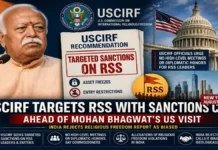
The disagreement has gained renewed significance ahead of RSS chief Mohan Bhagwat’s planned U.S. visit, as USCIRF commissioners call for targeted sanctions and reduced official engagement with RSS leaders.
Importantly, USCIRF is an independent bipartisan U.S. federal commission that makes policy recommendations to the president, secretary of state and Congress. Its recommendations do not automatically become U.S. government policy or sanctions.