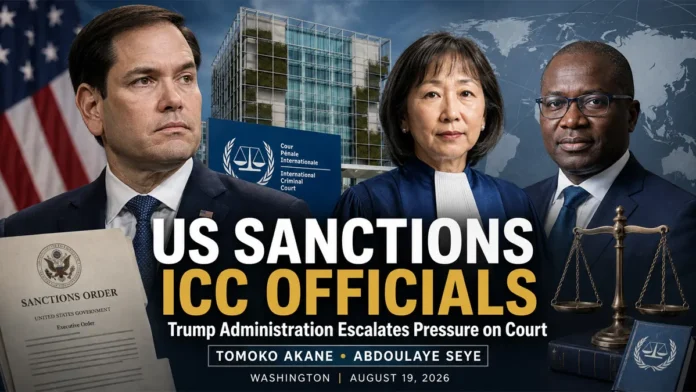
Washington, United States, August 19, 2026
US ICC Sanctions 2026 escalated sharply Wednesday as the Trump administration imposed sanctions on International Criminal Court President Judge Tomoko Akane and senior ICC trial lawyer Abdoulaye Seye, expanding Washington’s campaign against the Hague-based tribunal.
Secretary of State Marco Rubio announced that Akane, a Japanese national, and Seye, a Senegalese national, were designated under Executive Order 14203, “Imposing Sanctions on the International Criminal Court.”
The State Department said the two officials were directly involved in ICC efforts concerning nationals of countries that have not accepted the court’s jurisdiction.
Washington argues that such actions infringe on national sovereignty. The ICC, by contrast, operates under the Rome Statute and maintains that its jurisdiction can apply in circumstances defined by that treaty, including certain crimes committed on the territory of member states.
Who Has the US Sanctioned?
The latest U.S. action targets two senior figures at the International Criminal Court.
Judge Tomoko Akane
Akane is a Japanese judge who currently serves as President of the International Criminal Court.
The ICC’s official profile confirms that she is from Japan, began serving as an ICC judge in 2018 and currently holds the presidency of the court.
Abdoulaye Seye
Seye is a Senegalese legal official identified by the U.S. State Department as an ICC Senior Trial Lawyer.
The State Department included him alongside Akane in the latest sanctions announcement.
Why Did the US Impose the Sanctions?
According to Rubio, both officials were involved in ICC actions directed at officials or citizens of governments that have not accepted the court’s jurisdiction.
The State Department said the sanctions were imposed pursuant to Section 1(a)(ii)(A) of Executive Order 14203.
The Trump administration’s core objection is that the ICC has attempted to exercise authority over nationals of countries that are not parties to the Rome Statute.
The United States is not a party to the Rome Statute.
Washington therefore rejects the idea that the court should be able to exercise jurisdiction over U.S. nationals without U.S. consent.
Rubio Accuses ICC of Overreach
Rubio used unusually strong language in announcing the action.
He characterized the ICC as politicized and accused it of abusing its authority.
Those claims represent the U.S. administration’s position and are disputed by supporters of the court, who argue that the ICC provides a legal forum for prosecuting genocide, crimes against humanity and war crimes when domestic systems are unable or unwilling to act.
The administration says the court’s actions create a dangerous precedent for states that have chosen not to join the Rome Statute system.
Executive Order 14203 Is the Legal Basis
The sanctions originate from Executive Order 14203, signed by President Donald Trump on February 6, 2025.
The order authorizes financial and other sanctions against individuals involved in certain ICC investigations or prosecutions concerning nationals of the United States or allied countries that have not consented to the court’s jurisdiction.
The White House argued when issuing the order that ICC actions posed what it described as an unusual and extraordinary threat to U.S. national security and foreign policy.
The order created a framework that allows the administration to designate ICC personnel and others considered to have materially assisted such actions.
Sanctions Intensify US-ICC Confrontation
Wednesday’s announcement represents another significant escalation in the long-running confrontation between Washington and the International Criminal Court.
The Trump administration has sought to weaken the court’s ability to pursue cases involving U.S. citizens and citizens of non-member countries.
It has also encouraged other governments to reconsider financial and political support for the tribunal.
The administration argues that international courts should not be permitted to exercise criminal jurisdiction over citizens of sovereign states without those governments’ consent.
Rubio Signals More Measures Could Follow
The latest sanctions may not be the end of Washington’s campaign.
Rubio said the administration intends to pursue a broader government-wide effort aimed at limiting the ICC’s ability to act against Americans and nationals of other countries that are not members of the Rome Statute system.
He also urged other countries to reconsider their financial and political involvement with the court.
The language suggests the administration could consider further sanctions or diplomatic pressure if the ICC continues proceedings Washington opposes.
What Do ICC Sanctions Actually Do?
Sanctions issued under the executive order can have serious financial consequences.
Depending on the designation, property and interests in property under U.S. jurisdiction may be blocked, and U.S. persons can face restrictions on conducting transactions with sanctioned individuals.
The sanctions can also complicate access to international financial systems because many banks and companies maintain substantial exposure to U.S. markets.
The practical impact can therefore extend beyond the United States itself.
Why Washington Rejects ICC Jurisdiction
The central legal dispute concerns jurisdiction.
The United States signed the Rome Statute in 2000 but later stated that it did not intend to become a party to the treaty.
Washington has repeatedly argued that American citizens should not be subject to ICC authority without U.S. consent.
ICC supporters respond that the court may exercise jurisdiction when crimes are alleged to have occurred on the territory of a Rome Statute member state, even if the accused person comes from a non-member country.
This disagreement has produced recurring tensions between Washington and the court.
What Is the International Criminal Court?
The International Criminal Court is a permanent international criminal tribunal headquartered in The Hague, Netherlands.
It was established under the Rome Statute, which entered into force in 2002.
The ICC prosecutes individuals accused of the gravest international crimes, including:
- genocide;
- crimes against humanity;
- war crimes; and
- the crime of aggression.
The court is intended to act as a court of last resort.
Under the principle of complementarity, the ICC generally becomes involved when national authorities are unwilling or genuinely unable to investigate or prosecute serious crimes within the scope of its jurisdiction.
ICC Is Different From the International Court of Justice
The ICC should not be confused with the International Court of Justice.
The International Criminal Court prosecutes individuals, while the International Court of Justice hears disputes between states.
Both institutions are based in The Hague but operate under different legal frameworks.
The ICC is governed by the Rome Statute and is institutionally separate from the United Nations, although it maintains a relationship with the UN.
Tomoko Akane Has Previously Defended ICC Independence
Akane has previously defended the court’s independence in response to U.S. pressure.
After Trump issued Executive Order 14203 in February 2025, she issued a statement emphasizing the ICC’s judicial independence and the importance of protecting its ability to carry out its mandate.
Her designation now puts the sitting president of the institution directly under U.S. sanctions.
That makes the latest action especially significant symbolically as well as practically.
Japan Connection Adds Diplomatic Sensitivity
Sanctioning Akane may also create diplomatic sensitivities because she is a citizen of Japan, one of Washington’s closest allies.
Japan is a member of the International Criminal Court and has historically supported the Rome Statute system.
Akane recently sought continued Japanese support for the institution amid mounting political pressure on the court.
The sanctions therefore highlight how Washington’s confrontation with the ICC can intersect with relationships involving close U.S. partners.
US Wants Other Countries to Reduce Support
The administration is not limiting its strategy to sanctions against individual officials.
Rubio has called on other countries to stop or reduce funding and political participation in the ICC, portraying the court as unaccountable and politically motivated.
That position places Washington at odds with many ICC member states that continue to argue that the institution is essential to combating impunity for serious international crimes.
How many governments respond to the U.S. pressure could significantly influence the court’s future resources and international standing.
ICC Faces Wider Institutional Pressure
The latest U.S. measures come at a difficult period for the court.
The ICC has faced political criticism from multiple governments, disputes over arrest warrants, funding pressures and challenges surrounding cooperation with member states.
Because the court lacks its own police force, it depends heavily on states to arrest suspects and enforce judicial orders.
Political and financial pressure from a major economy such as the United States can therefore create substantial operational challenges.
Sanctions Could Affect Court Operations
If sanctions expand to additional ICC personnel or entities connected with the court, routine operations could become more difficult.
Banks, technology providers and international businesses may act cautiously when dealing with sanctioned individuals because of concerns about U.S. penalties.
Human rights organizations and ICC supporters have previously warned that broad sanctions against judicial personnel could undermine the functioning of international justice institutions.
The Trump administration, however, argues that such pressure is necessary to protect U.S. sovereignty.
Fundamental Dispute Over Sovereignty and International Justice
At the heart of the US ICC Sanctions 2026 dispute are two competing legal and political principles.
The Trump administration emphasizes state sovereignty and argues that international institutions should not prosecute citizens of countries that never accepted their jurisdiction.
The ICC system emphasizes accountability for the most serious international crimes and allows jurisdiction in circumstances established under the Rome Statute.
Those positions have proved difficult to reconcile.
What Happens Next?
The sanctions against Tomoko Akane and Abdoulaye Seye are unlikely to end the confrontation.
Rubio has signaled that Washington is prepared to consider additional measures, while the ICC has historically maintained that political pressure should not interfere with independent judicial proceedings.
The next stage will depend partly on whether the United States expands its sanctions list and whether other countries respond to Washington’s appeal to distance themselves from the tribunal.
For now, the latest US ICC Sanctions 2026 mark one of the clearest signs yet that the Trump administration intends to intensify its effort to restrict the International Criminal Court’s reach.