NEW YORK, August 18, 2026
Wall Street Falls as Oil Rally Revives Inflation Concerns
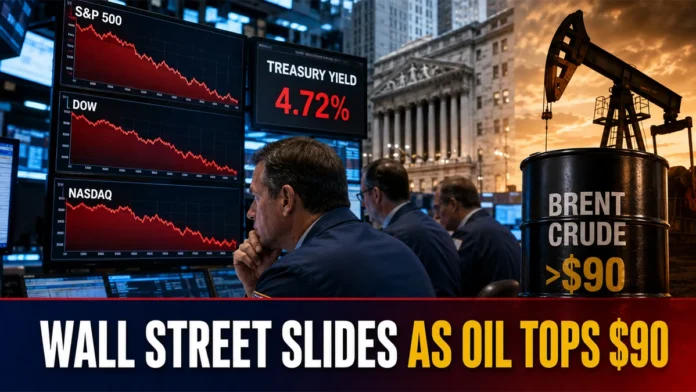
US stock market decline accelerated Monday as a sharp rise in crude oil prices pushed Treasury yields higher and renewed concerns that persistent inflation could keep interest rates elevated.
The S&P 500 fell 40.70 points, or 0.5%, to close at 7,745.06, moving further below the record high it set Thursday.
The Dow Jones Industrial Average dropped 272.63 points, or 0.5%, to 53,459.78. The technology-heavy Nasdaq Composite declined 0.3% to 26,644.91.
Small-company stocks also weakened, with the Russell 2000 losing 0.4% to finish at 3,057.54.
The declines remained moderate, and the major indexes stayed close to historically high levels. However, the combination of expensive oil, rising borrowing costs and uncertainty surrounding monetary policy prompted investors to reduce risk.
US Stock Market Closing Levels
| Index | Closing Level | Change |
|---|---|---|
| S&P 500 | 7,745.06 | -0.5% |
| Dow Jones | 53,459.78 | -272.63 points |
| Nasdaq Composite | 26,644.91 | -0.3% |
| Russell 2000 | 3,057.54 | -0.4% |
The S&P 500 remains up approximately 13.1% in 2026. The Dow has gained about 11.2%, while the Nasdaq is roughly 14.6% higher for the year.
The Russell 2000 has outperformed the large-cap indexes with a year-to-date increase of approximately 23.2%.
Why Did Wall Street’s Losses Increase?
The market’s decline intensified during afternoon trading as crude prices moved higher.
Brent crude, the international oil benchmark, rose 2.7% to approximately $90.87 a barrel. Oil has experienced unusually large price swings because of uncertainty over how the US-Iran conflict could affect production, shipping routes and global energy supplies.
Brent has traded between approximately $72 and $102 a barrel during the past month, illustrating the scale of uncertainty confronting energy markets.
Higher oil prices can raise costs across the economy. Transportation, manufacturing, logistics and food companies can face higher operating expenses, while consumers may pay more for gasoline and other energy-intensive goods.
That creates a difficult combination for financial markets: stronger energy prices can support oil producers’ earnings but simultaneously increase inflation pressure and weaken household purchasing power.
Treasury Yields Rise as Investors Reassess Interest Rates
The 10-year US Treasury yield increased to approximately 4.72%, up from 4.68% late Friday. It stood near 3.97% before the escalation of the conflict with Iran.
The 30-year Treasury yield climbed to about 5.31%, reaching its highest level in nearly two decades.
Bond yields tend to rise when investors expect inflation to remain elevated or believe the Federal Reserve may keep interest rates higher for longer.
Higher Treasury yields can make stocks less attractive because government securities begin offering more competitive returns with less risk. They can also increase the discount rate used to value companies’ future earnings, placing particular pressure on expensive growth stocks.
Rising yields affect the economy more broadly by increasing borrowing costs for mortgages, auto loans, credit cards and corporate financing.
Will Higher Oil Prices Force the Fed to Raise Rates?
Higher crude prices increase the risk that inflation will remain above the Federal Reserve’s target. However, a renewed increase in interest rates is not automatic.
The Fed will have to determine whether the oil-price surge is temporary or likely to create sustained price increases across the economy.
Interest-rate increases can reduce inflation by discouraging borrowing and slowing consumer and business spending. The tradeoff is that tighter policy can weaken economic growth and increase pressure on employment.
Federal Reserve Chairman Kevin Warsh is expected to speak at the annual economic policy symposium in Jackson Hole, Wyoming, later in August. Investors will watch for clues about whether policymakers are becoming more concerned about energy-driven inflation.
Warsh offered little advance guidance following the Fed’s July meeting, saying he had not yet decided what his Jackson Hole address would contain. The Federal Reserve’s July press-conference transcript indicated that the speech remained under development.
Strong Corporate Earnings Continue to Support Stocks
Wall Street has remained near record territory partly because corporate earnings have grown more rapidly than analysts expected.
S&P 500 companies are on track to report blended year-over-year earnings-per-share growth of approximately 50.4% for the second quarter, according to FactSet’s latest Earnings Insight report.
That would represent the strongest earnings growth rate in five years, when the economy was recovering from the disruption caused by the COVID-19 pandemic.
However, the headline figure requires context. Alphabet’s quarterly results included a large unrealized investment gain, while Amazon also recorded substantial investment-related income.
FactSet estimated that excluding Alphabet would reduce total S&P 500 earnings growth to 38.8%. Removing Amazon would bring it down further, although the overall growth rate would remain strong.
Energy companies have also benefited from higher year-over-year oil prices, helping lift the index’s earnings and revenue growth.
Walmart, Target and Home Depot Results in Focus
Investors are now preparing for quarterly reports from major US retailers, including Home Depot, Target and Walmart.
The results could provide new information about the financial condition of American households.
Retailers face several competing forces:
- Higher energy and transportation costs.
- Persistent inflation in essential goods.
- Elevated credit-card and mortgage rates.
- A softer employment environment.
- Pressure on discretionary consumer spending.
Walmart’s results will be closely watched for trends among cost-conscious shoppers. Target could provide insight into discretionary spending, while Home Depot’s performance may reveal how high mortgage rates are affecting housing-related purchases and renovation activity.
Strong earnings or upbeat forecasts could ease concerns that consumers are pulling back. Weak guidance could reinforce fears that inflation and expensive borrowing are beginning to slow the economy.
L3Harris Falls After CEO’s Sudden Departure
L3Harris Technologies shares dropped 4.6% after the defense contractor announced the immediate departure of Chairman and CEO Christopher Kubasik.
The company said its board conducted an investigation and concluded that Kubasik had engaged in conduct inconsistent with its code of conduct.
L3Harris said the matter was unrelated to financial reporting, internal controls, operations or customer relationships. The company appointed Sam Mehta as president and CEO and named Lewis Hay III independent chairman.
Despite the management change, L3Harris reaffirmed its financial outlook for 2026.
A company filing with the US Securities and Exchange Commission confirmed that Kubasik’s employment ended immediately and that he resigned from the company’s board.
Alphabet and Constellation Brands Move After Berkshire Filing
Alphabet shares declined 0.5% despite Berkshire Hathaway reporting an increased investment in Google’s parent company.
Constellation Brands fell 6.2% after Berkshire disclosed that it had exited its position in the producer and distributor of Modelo beer and Robert Mondavi wine.
Institutional investment filings generally reflect holdings at the end of a previous quarter. They do not necessarily reveal exactly when securities were purchased or sold, and they may not represent an investor’s current position.
The market reaction nonetheless demonstrated how closely investors monitor Berkshire’s portfolio decisions.
Asian Markets Rise While European Shares Decline
Global market performance was mixed.
Japan’s Nikkei 225 gained 0.7%, while Hong Kong’s benchmark index advanced 1.3%. The Shanghai Composite rose 1.4%.
European indexes moved lower after the stronger Asian close, reflecting concerns about energy costs, inflation and weakening economic data.
The conflicting moves showed that investors were balancing support from corporate earnings and technology spending against risks from expensive oil and tighter financial conditions.
What Investors Will Watch Next
Wall Street’s immediate direction is likely to depend on several factors:
- Whether Brent crude remains above $90.
- Upcoming earnings from major retailers.
- Federal Reserve communications.
- Inflation and employment data.
- Developments affecting global oil supplies.
The latest decline does not yet represent a major market reversal. The S&P 500, Dow and Nasdaq remain close to record levels and have delivered double-digit gains in 2026.
Nevertheless, the rise in oil prices and Treasury yields has introduced a more difficult backdrop. If energy costs continue climbing, investors may have to reassess expectations for inflation, interest rates, consumer spending and corporate profitability.