NEW DELHI, August 18, 2026
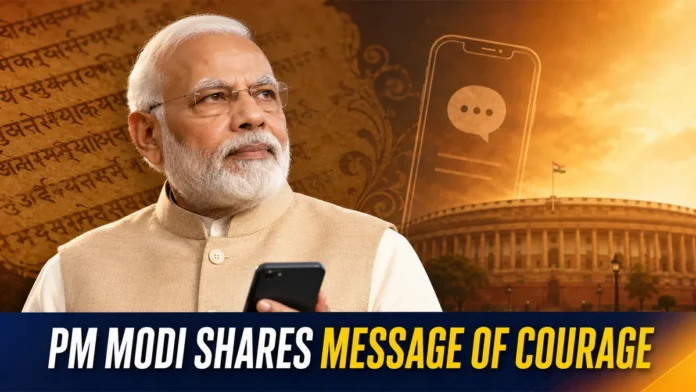
PM Modi Sanskrit verse shared on Tuesday delivered a message of courage, sustained effort and personal dignity, urging people to remain firm in their principles even when confronted by difficult circumstances.
Prime Minister Narendra Modi posted the Sanskrit Subhashitam on the social media platform X as part of a continuing series highlighting lessons from India’s classical literature.
Transliterated into the Roman alphabet, the verse reads:
“Udyachchhedeva na namedudyamo hyeva paurusham; apyaparvani bhajyeta na nametveva kasyachit.”
The verse says that a person should rise and make a determined effort rather than submit. It presents courage as the willingness to remain steadfast, even when circumstances become difficult.
In its more literal imagery, the verse suggests that one may break at a place without a joint but should not bend before anyone. The message is commonly interpreted as an appeal to preserve dignity, confidence and resolve without abandoning one’s principles under pressure.
What Does PM Modi’s Sanskrit Verse Mean?
The central theme of the verse is that genuine human strength lies in action, courage and steadfastness.
A person should continue making an effort rather than surrendering to fear or unfavorable conditions. The verse also places importance on self-respect, suggesting that individuals should not compromise their values merely to avoid hardship.
Its message can be summarized through four ideas:
- Stand firmly by one’s principles.
- Continue working despite obstacles.
- Preserve dignity in difficult circumstances.
- Do not surrender simply because the path has become challenging.
The verse is associated with the Mahabharata, although its chapter and verse numbering differs across editions of the ancient text.
PM Modi did not attach a contemporary political explanation to the post. The message was presented as a general reflection on courage, dignity and human effort.
Monday’s Message Focused on National Unity
The latest post followed another Sanskrit verse shared by the prime minister on Monday, August 17.
In that message, PM Modi said a country advances through the power of collective resolve and unity. He described shared purpose as a strong foundation for India’s progress and prosperity.
The verse he shared was transliterated as:
“Samani va akutih samana hridayani vah; samanam astu vo mano yatha vah susahasati.”
The passage comes from the concluding hymn of the Rig Veda and calls for harmony in thought, intention and collective action.
Its meaning emphasizes that people should share common aspirations, connect their minds through a spirit of unity and cooperate continuously for society’s advancement.
The Prime Minister’s Office described the message as highlighting the role of collective resolve, unity and mutual cooperation in promoting national progress and social well-being.
The official release said the verse encouraged people to align their aspirations and work together with a shared sense of responsibility.
From Individual Courage to Collective Resolve
The two consecutive messages offer complementary ideas.
Monday’s verse concentrated on collective strength: a society progresses when people unite their minds, intentions and efforts. Tuesday’s verse shifted the focus toward individual character, emphasizing the courage required to remain firm when confronted by adversity.
Together, the posts connect personal discipline with national progress. The first presents unity as a foundation for social advancement, while the second stresses the inner confidence needed to uphold values and continue working toward a goal.
PM Modi has frequently used verses from Sanskrit literature to present broader messages about leadership, public service, education, perseverance and social responsibility.
Independence Day Period Posts Stressed Action Over Fate
On August 14, ahead of India’s Independence Day, PM Modi shared another Sanskrit verse emphasizing effort, enterprise and human initiative.
The verse explained that art, scientific understanding, technical abilities, craftsmanship and innovation develop through work and sustained effort. Its message discouraged people from waiting passively for fate to determine their future.
The prime minister connected the thought with Partition Horrors Remembrance Day, paying tribute to those who endured displacement and suffering during the 1947 Partition but subsequently contributed to India’s development.
He said their lives demonstrated how courage and determination can help people overcome extreme adversity. He also appealed for the country’s spirit of harmony and unity to be strengthened.
That verse, transliterated into English, reads:
“Udyamasya prasadena drishyante vividhah kalah; katara eva jalpanti yad bhavyam tad bhavishyati.”
Its meaning is that diverse skills and achievements emerge through effort. Only the fearful or inactive surrender everything to fate by saying that whatever is destined will happen.
A Continuing Series of Classical Messages
The latest Sanskrit posts form part of PM Modi’s broader effort to connect traditional Indian literature with contemporary public messages.
The themes have included perseverance, responsible action, social cooperation, national unity and confidence during adversity.
The August 18 verse stands out for its uncompromising metaphor. It does not simply ask people to endure hardship; it defines strength as the refusal to surrender one’s dignity or principles when facing pressure.
At the same time, the verse’s literal “break rather than bend” formulation is best understood as classical moral imagery—not as an instruction to reject compromise in every social or political situation.
In contemporary terms, its message is one of resilience: make an honest effort, remain confident and do not abandon core values merely because circumstances become difficult.
The series also reflects PM Modi’s continuing use of social media to bring Sanskrit expressions and classical Indian ideas into wider public discussion.