NEW DELHI, August 14, 2026
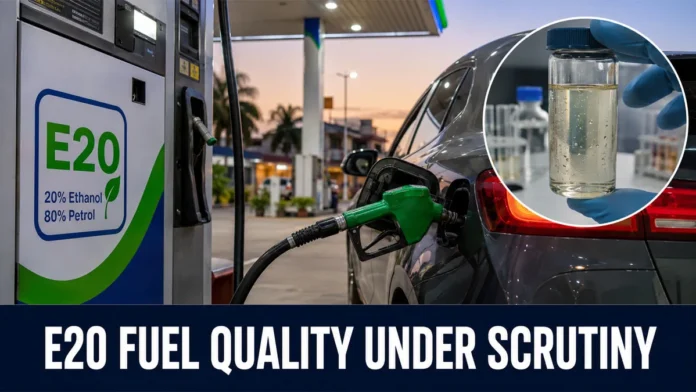
E20 petrol controversy has intensified in India after internal communications reportedly revealed that leading automakers had raised concerns about elevated chloride and moisture in samples of petrol blended with 20% ethanol.
Executives associated with Tata Motors, Maruti Suzuki and Mahindra discussed preliminary fuel-testing data that appeared to show possible contamination at some retail outlets. The concerns centered on whether excessive chloride and moisture could corrode fuel-system components, reduce performance or cause vehicles to stop working after refueling.
However, the findings have not established that E20 petrol sold across India is generally contaminated or unsafe. The Society of Indian Automobile Manufacturers, or SIAM, later withdrew its communication to the government, saying the underlying figures required further authentication and scientific validation.
State-owned oil companies have separately said that their nationwide testing found no widespread quality problem with E20 petrol.
What Did Automakers’ Internal Tests Find?
Several automakers collected more than 250 fuel samples from filling stations across 21 states and territories over approximately one year, according to internal correspondence and testing information reviewed as part of the report.
The industry data reportedly flagged elevated chloride and moisture levels in samples collected across 18 states. These findings became the basis of discussions among automobile manufacturers and a July 28 communication sent by SIAM to the Ministry of Petroleum and Natural Gas.
The reported testing was conducted by a limited number of manufacturers and was not presented as a nationally representative scientific study. SIAM subsequently said the sample size and testing methodology were insufficient to support a definitive industry-wide conclusion.
The organization said it intends to undertake a more comprehensive scientific assessment before drawing firm conclusions about E20 contamination.
Why Did Chloride and Moisture Cause Concern?
The automakers’ concerns were not solely about the percentage of ethanol blended into petrol. Instead, the discussions focused on contaminants that may enter the fuel during production, transportation, storage or dispensing.
Elevated chloride can contribute to corrosion and premature wear in components that come into direct contact with fuel or engine emissions. These components can include fuel injectors, pumps and parts of the exhaust-gas recirculation system.
High moisture levels can also affect ethanol-blended petrol because ethanol attracts and absorbs water. Excessive water can cause the petrol and ethanol mixture to separate, potentially creating performance problems or immobilizing a vehicle soon after refueling.
Some samples reportedly contained moisture levels substantially above the prescribed limit. Nevertheless, the origin of the readings has not been conclusively established.
Possible factors discussed by industry representatives included the condition of underground storage tanks, pipelines and fuel-handling systems at retail outlets. Further testing would be necessary to identify whether contamination occurred during ethanol production, blending, transportation or storage.
SIAM Withdrew Its Communication
SIAM withdrew its initial communication after questions emerged about the figures used to support its concerns.
The industry body said the data was collected for internal discussion and validation by a small group of automobile manufacturers. It maintained that the information required authentication before it could be used to support conclusions covering the entire country.
The withdrawal does not prove that the preliminary findings were incorrect. Equally, the original figures do not demonstrate that E20 petrol nationwide is causing vehicle damage.
The competing positions underline the need for transparent testing conducted through a uniform sampling process, accredited laboratories and clearly defined chloride and moisture standards.
Government and Oil Companies Reject Widespread Contamination Claims
The Indian government and state-owned oil marketing companies have said their testing found no evidence of a widespread E20 fuel-quality problem.
Petroleum and Natural Gas Minister Hardeep Singh Puri said oil companies had started rigorous testing at retail outlets about two weeks before SIAM submitted its communication. He said only four contamination cases were detected during the broader inspection exercise.
Indian Oil, Bharat Petroleum and Hindustan Petroleum reported that more than 100 petrol samples collected at refineries had chloride levels of one part per million or lower.
Testing of ethanol obtained from 80 distilleries and E20 samples collected from more than 80 depots and terminals reportedly found chloride readings below three parts per million. The companies also said inspections of underground tanks at approximately 90,000 fuel stations found no evidence of widespread water ingress.
The Petroleum Ministry maintains that E20 is a scientifically tested fuel that complies with prescribed safety and quality requirements. It says the program can lower emissions, reduce crude-oil imports and improve India’s energy security. The government’s E20 policy explanation outlines its stated environmental and economic objectives.
Why Has India Expanded E20 Petrol?
E20 contains 20% ethanol and 80% petrol. Ethanol can be produced from sugarcane, maize, damaged food grains and other agricultural sources.
India accelerated the ethanol-blending program to reduce its dependence on imported crude oil, support domestic agriculture and lower certain vehicle emissions. E20 became the primary petrol grade available nationwide as the government expanded the program across approximately 90,000 fuel stations.
The rollout has nevertheless generated concerns among some owners of older vehicles that were not originally designed or certified for E20. These concerns include possible reductions in fuel economy, compatibility with older fuel-system components and the long-term cost of maintenance.
The current contamination debate is a separate issue from basic E20 compatibility. A vehicle designed to operate on E20 could still experience problems if the fuel contains excessive water, chloride or another contaminant.
No Evidence Yet of a Nationwide E20 Failure
The available information does not support the conclusion that all E20 petrol is contaminated or that the fuel is universally damaging vehicles.
Automakers’ preliminary testing raises questions that require independent examination. At the same time, the broader tests reported by oil companies suggest that contamination may be limited rather than systemic.
A scientifically credible assessment would need to use identical sampling procedures across refineries, terminals, transport systems and retail outlets. It would also need to examine affected vehicles and determine whether any component failure was caused by ethanol content, contamination, maintenance or another mechanical issue.
Until that work is completed, motorists should treat claims of universal engine damage with caution. Drivers experiencing problems soon after refueling should retain their receipt, document warning lights or performance changes and have the vehicle and fuel inspected through authorized channels.