BENGALURU, August 14, 2026 —
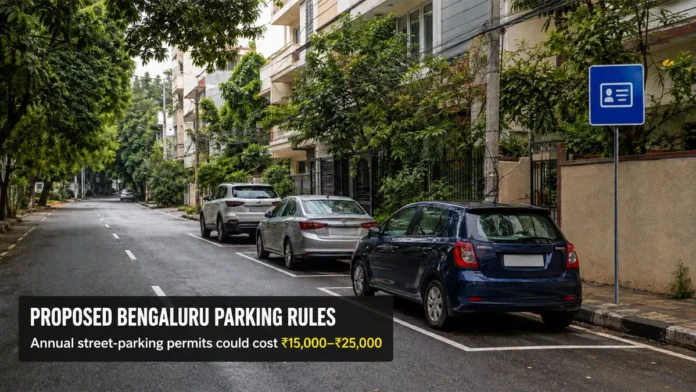
Bengaluru Parking Rules 2026 could require residents to pay as much as ₹25,000 annually to park a car on a designated public road near their home. The proposed charges form part of the draft Greater Bengaluru Area (Parking) Rules, 2026, released by the Karnataka government.
Under the proposal, annual residential parking-permit fees would vary according to the type of vehicle. A permit would cost at least ₹15,000 for a small car or hatchback, ₹20,000 for a sedan and ₹25,000 for a sport utility vehicle.
However, the new charges have not yet taken effect. The document contains draft rules that will be considered after the public consultation period. Residents and other stakeholders have been invited to submit objections and suggestions before the government finalizes the regulations.
The Urban Development Department issued the draft notification on August 11. It was published in the Karnataka Gazette on August 12, opening a 30-day consultation period reportedly ending on September 11.
Proposed Residential Parking Fees
| Vehicle category | Proposed annual permit fee |
|---|---|
| Small car or hatchback | ₹15,000 |
| Sedan | ₹20,000 |
| SUV or MUV | ₹25,000 |
| Administrative charge | To be determined separately |
The amount would purchase a residential parking permit, not ownership or permanent reservation of the road space. A permit would only authorize the registered vehicle to use eligible designated parking areas near the resident’s home.
Will Every Bengaluru Resident Be Required to Pay?
No. The proposed charge would apply to residents seeking permission to park private vehicles on designated public streets.
Vehicle owners with sufficient lawful parking inside their property would be expected to use that space. A permit would not automatically allow residents to park anywhere outside their homes.
Residential parking would generally be excluded from arterial and sub-arterial roads. Each municipal corporation would identify the streets and spaces on which permit-based residential parking could be allowed.
Parking would also depend on adequate road width, pedestrian space, traffic movement and compliance with other safety requirements.
Building Compliance Would Affect Permit Eligibility
The draft says residential permits would be issued only to eligible occupants of buildings that comply with minimum parking requirements prescribed under applicable building bylaws.
This provision could make residents of noncompliant buildings ineligible for a street-parking permit. Applicants may therefore have to demonstrate that their property meets the relevant construction and parking standards.
The proposed requirement is intended to prevent buildings from converting required internal parking areas to other uses and then shifting their vehicles onto public roads.
Permit Would Be Linked to a Person and Vehicle
Each residential parking permit would be issued for a particular vehicle and in the name of the person under whose name that vehicle is registered.
The permit would remain valid for one year. Annual renewal would be allowed only after confirming that the applicant still lives in the relevant neighborhood.
An additional administrative fee could also be charged for issuing or renewing the permit. The Greater Bengaluru Authority’s chief commissioner would determine that amount.
The permit would only be valid on designated residential streets located within walking distance of the registered address. Parking the vehicle outside the approved zone would not be protected by the permit.
Road-Width Requirements for Residential Parking
The draft contains specific space requirements to prevent parked vehicles from blocking traffic or pedestrian movement.
On collector or non-arterial roads, residential parking could be permitted only when:
- At least six meters of unobstructed carriageway remains available for moving traffic.
- A clear pedestrian path measuring at least 1.8 meters remains available on both sides.
On local streets, parking could be permitted when:
- At least four meters of road space remains clear for traffic.
- A pedestrian path of at least 1.8 meters remains available on one side.
If a road cannot meet these conditions after vehicles are parked, it may not qualify as a residential parking street.
What Happens if a Vehicle Is Parked Without a Permit?
Parking a vehicle on a designated permit-only residential road without valid authorization could be treated as illegal parking.
Authorized marshals may inspect permits and report violations to the police. Bengaluru Traffic Police would enforce no-parking restrictions and ensure that only vehicles with valid permits use the designated residential spaces.
Vehicles parked outside approved zones, on footpaths or in a manner that obstructs traffic could face penalties or towing action under applicable regulations.
Possessing a permit would not exempt a vehicle owner from ordinary traffic and parking restrictions.
Hourly Parking Charges Also Proposed
The draft extends beyond residential streets and proposes paid public parking across the Greater Bengaluru Area.
Minimum on-street charges for cars could range from ₹40 to ₹80 an hour, depending on the road category:
| Road category | Cars and other LMVs | Two-wheelers |
|---|---|---|
| Category A | ₹80 per hour | ₹40 per hour |
| Category B | ₹60 per hour | ₹30 per hour |
| Category C | ₹40 per hour | ₹20 per hour |
Off-street parking would be cheaper, with hourly car-parking rates ranging from ₹20 to ₹40. Monthly charges could range from ₹1,000 to ₹4,000, depending on the location and vehicle category.
The proposal would also allow higher charges for vehicles left on public roads for more than two hours, particularly where organized off-street parking is available.
Restrictions Proposed Near Metro Stations
On-street parking could initially be prohibited within 150 meters of Metro and suburban railway stations. That restriction could later be extended to 500 meters after sufficient off-street facilities become available.
Parking would also be prohibited within 25 meters of bus stops and access points to public-transport stations.
These measures are intended to prevent roadside parking from obstructing buses, pedestrians and passengers entering or leaving mass-transit facilities.
Why Bengaluru Wants to Regulate Roadside Parking
Bengaluru has experienced rapid growth in its vehicle population, while its available road space has remained limited. Cars parked along residential and commercial streets can reduce usable carriageway width, block footpaths and create bottlenecks.
The proposed rules treat public roads as shared urban space rather than free long-term vehicle-storage areas. Authorities hope that higher on-street charges will encourage residents to use private parking, organized lots and public transportation.
The rules also seek to encourage the development of off-street and multilevel parking facilities.
Rules Remain Open to Public Objections
The charges are proposals and should not be described as an existing citywide parking tax. The government must consider objections and suggestions received during the statutory consultation period before issuing final rules.
The final notification could retain, modify or remove provisions contained in the current draft. A legal summary of the notification identifies it as UDD 230 MNU 2026 (P), published in Karnataka Gazette Part IV-A, No. 704. Review the draft-rules summary