MUMBAI | August 8, 2026
Indian Stock Market Falls as Rising Oil Prices and Hormuz Strait Concerns Weigh on Investor Sentiment
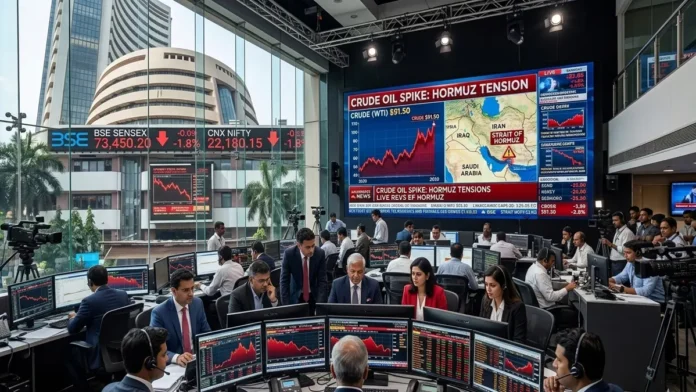
MUMBAI — The Indian Stock Market opened in negative territory on Friday, with benchmark indices declining sharply as investors reacted to higher crude oil prices and renewed geopolitical concerns surrounding the Strait of Hormuz, one of the world’s most critical energy shipping routes.
At 9:30 a.m. IST, the BSE Sensex was down 249.00 points (0.31%) at 78,705.76, while the NSE Nifty 50 slipped 35.00 points (0.14%) to 24,601.00. During early trade, both benchmark indices had fallen by as much as 0.6%, reflecting weak global market sentiment.
The Indian rupee also weakened, falling 6 paise against the U.S. dollar to 95.28 in early trading.
Rising Oil Prices Trigger Market Weakness
The primary driver behind Friday’s market decline was a renewed surge in crude oil prices following fresh geopolitical uncertainty in the Middle East.
Investor sentiment deteriorated after reports that Iran has proposed restricting the passage of vessels it considers “hostile” through the Strait of Hormuz and imposing substantial penalties on ships that violate the proposed rules.
Although the proposal has not been implemented, it has heightened concerns over potential disruptions to global oil supplies, pushing energy prices higher and weighing on equity markets.
Why the Strait of Hormuz Matters
The Strait of Hormuz is one of the world’s most strategically important maritime chokepoints, connecting the Persian Gulf with the Gulf of Oman and the Arabian Sea.
A significant share of global seaborne crude oil exports passes through this narrow waterway. Any disruption to shipping traffic could tighten global energy supplies and drive oil prices even higher.
Because India imports more than 80% of its crude oil requirements, sustained increases in oil prices could raise inflationary pressures and negatively affect corporate earnings.
Banking Stocks Lead the Decline
Selling pressure was particularly visible in heavyweight financial stocks.
Shares of Bajaj Finance, Bajaj Finserv, and ICICI Bank came under pressure during early trade, contributing significantly to the decline in the benchmark indices.
Asian equity markets also traded lower as investors assessed the implications of rising geopolitical tensions and volatile energy markets.
Investors Turn Cautious
Market participants shifted toward a risk-off approach amid growing uncertainty over global energy supplies and geopolitical developments.
Analysts noted that escalating tensions around the Strait of Hormuz have increased volatility across global financial markets, prompting investors to reduce exposure to risk assets until greater clarity emerges.
The direction of crude oil prices, global geopolitical developments, and institutional investment flows are expected to remain key factors influencing market sentiment in the coming sessions.