MUMBAI, India | August 25, 2026 —
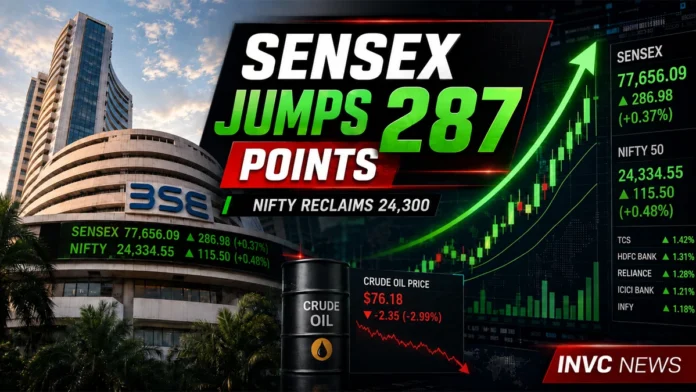
Stock Market Today: Indian equities staged a sharp late-session recovery on Tuesday, with the BSE Sensex jumping 286.98 points, or 0.37%, to close at 77,656.09, while the Nifty 50 gained 115.50 points, or 0.48%, to settle at 24,334.55.
The benchmarks had traded under pressure earlier in the session as investors remained cautious about geopolitical tensions and global market risks. However, a sharp retreat in crude oil prices, a stronger rupee and buying across health care, pharmaceutical, IT and select financial stocks helped the market erase its losses and finish firmly in positive territory.
The session was also significant because it marked the first monthly Nifty 50 derivatives expiry under the new Closing Auction Session, or CAS, framework, contributing to unusually sharp swings during the final phase of trading.
Why Sensex and Nifty Recovered Today
The biggest immediate relief came from crude oil.
International oil prices dropped sharply, with crude slipping toward a one-week low. For India, which depends heavily on imported energy, lower crude prices can ease concerns over inflation, the trade deficit and pressure on the rupee.
That shift in oil sentiment helped investors return to equities after a cautious start.
The recovery also highlighted how quickly crude has become a dominant trigger for Indian markets. Just days earlier, elevated oil prices near $94 had kept investors cautious. INVC NEWS had tracked that pressure in its earlier report on Sensex, Nifty and crude oil prices.
The rupee also strengthened against the U.S. dollar during Tuesday’s session, adding another layer of support to domestic market sentiment.
Adani Enterprises, Max Healthcare Lead Nifty Gainers
Buying was visible across several heavyweight and defensive stocks.
Among the strongest Nifty 50 performers:
- Adani Enterprises gained about 3.7%
- Max Healthcare Institute advanced around 2.6%
- Apollo Hospitals Enterprise rose more than 2%
- InterGlobe Aviation gained about 2%
- Adani Ports and Special Economic Zone climbed nearly 1.8%
Health care and pharmaceutical stocks were among the strongest sectors of the day, while public-sector banks also attracted buying interest.
Information technology and financial stocks, which had been under pressure earlier, recovered during the final hour.
Overall, 12 of the 16 major sector indexes ended higher, showing that the rebound was broader than a rally driven by only a handful of heavyweight stocks.
Midcaps Rise, Smallcaps Finish Slightly Lower
The broader market delivered a mixed performance.
The Nifty Midcap 100 rose about 0.54%, showing continued buying interest in selected mid-sized companies.
However, the Nifty Smallcap 100 slipped around 0.1%, suggesting that risk appetite remained selective despite the recovery in benchmark indexes.
Vodafone Idea, One 97 Communications, IREDA and several other midcap stocks recorded strong gains during the session.
The movement comes during a busy period for Indian capital markets, with multiple companies currently raising funds through public issues. Investors can also track INVC NEWS’ latest guide to the IPOs opening on August 25.
Hindustan Copper Falls Sharply
Not every stock participated in Tuesday’s rebound.
Hindustan Copper shares fell more than 7% after the government moved ahead with plans to sell up to a 6% stake in the company through an offer for sale.
HDFC Life, Cipla, ONGC, Coal India and Hindalco were also among the weaker Nifty constituents.
The weakness in ONGC and some commodity-linked stocks came as falling crude prices created different implications across sectors.
Lower oil prices can help India’s broader economy and oil-consuming industries, but they can simultaneously weigh on earnings expectations for some energy producers.
New Closing Auction System Adds Volatility
Tuesday’s market action was particularly volatile because of the monthly derivatives expiry.
It was the first monthly Nifty 50 expiry after implementation of the new Closing Auction Session.
The framework is designed to determine closing prices through an auction mechanism, but expiry-day positioning and rollover activity contributed to sharper-than-normal swings during the final hour.
As a result, investors saw the unusual combination of weak intraday trading followed by a strong closing recovery.
What Investors Should Watch Next
Crude oil remains one of the most important near-term triggers for Indian equities.
If oil prices remain below recent highs, pressure on India’s import bill, inflation expectations and the rupee could moderate. However, renewed escalation in the Middle East could quickly reverse that relief.
The relationship between crude and the currency is particularly important. INVC NEWS recently explained how prolonged expensive oil could affect the Indian rupee and its medium-term outlook.
Investors will also watch upcoming inflation indicators, global bond yields, U.S. Federal Reserve signals and developments involving Iran.
For now, Tuesday’s close sends an encouraging signal: despite geopolitical uncertainty and a weak start, domestic equities were able to attract enough late buying to push the Nifty decisively back above 24,300.
However, volatility is unlikely to disappear while oil prices and global geopolitical risks remain elevated.
This article is for informational purposes only and does not constitute investment advice.