NEW DELHI, INDIA | AUGUST 24, 2026
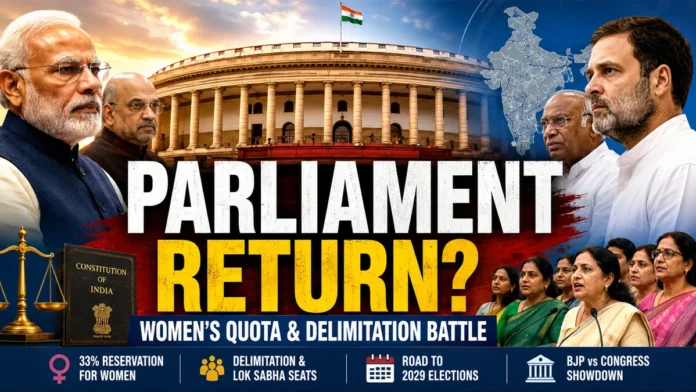
Parliament special session 2026 speculation has returned to the center of Indian politics after an unusually long gap between the adjournment of the Monsoon Session and its formal prorogation, reviving questions over whether the government could bring lawmakers back at short notice to revisit the politically sensitive issues of women’s reservation and delimitation.
Both the Lok Sabha and Rajya Sabha were adjourned sine die on August 13. The Monsoon Session had begun on July 20 and included 19 sittings spread across 25 days.
However, as of August 23, a formal prorogation notification had still not been issued. That procedural gap has triggered a fresh BJP-Congress political confrontation.
Importantly, no Parliament special session has been officially announced as of August 24. Therefore, reports of an imminent sitting remain speculation unless the government or Parliament issues a formal notification.
Why Parliament Special Session 2026 Speculation Is Growing
Adjournment sine die and prorogation are two different parliamentary procedures.
When a House is adjourned sine die, its current sitting ends without a date being fixed for the next sitting. Prorogation formally terminates the session.
As long as a session has not been prorogued, Parliament can, under established procedure, be called back without starting an entirely new session.
That possibility has become politically significant because the government’s earlier attempt to change the constitutional framework governing delimitation and women’s reservation did not secure the required majority.
The latest controversy comes soon after a turbulent Monsoon Session in which opposition protests repeatedly interrupted proceedings. INVC previously reported how Lok Sabha proceedings were disrupted amid a government-Opposition confrontation, highlighting the broader political tensions that surrounded the session.
Congress Questions Delay in Parliament Prorogation
Congress has publicly questioned why the Monsoon Session has remained unprorogued for longer than usual.
Congress general secretary Jairam Ramesh linked the delay to speculation that the government may still be trying to secure the parliamentary numbers required to move a constitutional amendment connected with delimitation.
That allegation remains a political claim rather than confirmation of the government’s intentions.
Nevertheless, the numbers matter.
A constitutional amendment must satisfy the special-majority requirements under Article 368 of the Constitution. The government therefore needs substantially broader parliamentary support than it would need to pass an ordinary bill.
This arithmetic is one reason the Parliament special session 2026 debate has attracted so much political attention.
What Happened to the Delimitation Bills in April 2026?
The current controversy goes back to April.
The government introduced three connected pieces of legislation in the Lok Sabha:
- The Constitution (One Hundred and Thirty-First Amendment) Bill, 2026
- The Delimitation Bill, 2026
- The Union Territories Laws (Amendment) Bill, 2026
The package sought to change the constitutional and legal framework for delimitation while creating a pathway for women’s reservation to take effect earlier.
However, the Constitution Amendment Bill did not receive the special majority required under Article 368(2).
As a result, the two dependent bills were not taken forward.
That setback left one of the government’s biggest political commitments unresolved.
Why Women’s Reservation Is Linked to Delimitation
The Constitution (106th Amendment) Act, 2023, popularly associated with the Nari Shakti Vandan Adhiniyam, provides for reservation of roughly one-third of seats for women in the Lok Sabha and state legislative assemblies.
However, the reservation is linked to a future delimitation exercise conducted after the relevant census.
That condition is crucial.
Without completing the required census and delimitation process, the women’s quota cannot simply be applied to the existing constituency map under the framework created in 2023.
This is why census policy, constituency boundaries and women’s political representation have become part of the same constitutional debate.
INVC has already covered preparations for India’s 2026-27 Census and the nationwide house-listing exercise, which is particularly relevant because future population data could have major consequences for the next delimitation process.
Could Women’s Reservation Be Implemented in the 2029 Election?
The 2029 Lok Sabha election has become the central political deadline in this debate.
The government has emphasized early implementation of women’s reservation. However, the existing constitutional structure links implementation to delimitation after the census.
The 2026 legislative package attempted to provide a route that could accelerate the process.
According to the proposed framework, Parliament would gain greater flexibility over which published census figures would be used for delimitation.
The accompanying legislation also proposed increasing the constitutional ceiling on Lok Sabha membership.
Could Lok Sabha Expand to 850 Seats?
One of the most significant provisions in the Constitution (131st Amendment) Bill proposed increasing the maximum strength of the Lok Sabha from 550 to 850 members.
Under the proposal, up to 815 members could represent states and up to 35 could represent Union Territories.
That does not mean India has already decided to create an 850-member Lok Sabha.
The proposal did not secure the constitutional majority required for passage.
Still, the scale of the proposed expansion explains why the issue has implications far beyond women’s reservation.
A larger Lok Sabha could reshape political representation between states and influence electoral politics for decades.
Why Southern States Are Watching Delimitation Closely
Delimitation is especially sensitive in southern India.
States that achieved lower population growth over several decades have repeatedly expressed concern that a population-based redistribution of parliamentary seats could reduce their relative political influence compared with faster-growing states.
The debate therefore involves competing constitutional and federal considerations.
One side emphasizes the democratic principle that representation should broadly reflect population.
The other argues that states should not effectively be penalized for successfully implementing population-control and development policies.
This disagreement makes any future delimitation legislation politically difficult.
BJP and Congress Clash Over Women’s Reservation
The BJP has sought to portray early implementation of the women’s quota as a major step toward expanding women’s political representation.
The Opposition, meanwhile, has questioned the delimitation mechanism, timing and potential impact on the federal balance.
That distinction is important.
The political battle is not simply about whether women should receive greater representation. Much of the disagreement concerns how and when the quota should be implemented and how constituency redistribution should be handled.
The confrontation also comes amid a wider series of legislative battles between the government and Opposition. For example, INVC earlier examined the government-Opposition clash over the FCRA Amendment Bill 2026, another issue where proposed legislation became a major political flashpoint.
Can Parliament Be Called Back Without a New Session?
The delayed prorogation is what makes the present situation unusual and politically interesting.
If Parliament were formally prorogued, a new session would need to be summoned.
However, while the existing session remains technically alive, the Houses can potentially be reconvened.
That does not establish that the government intends to do so.
It only explains why the absence of a prorogation notification has generated political speculation.
Until an official parliamentary bulletin, government notification or other formal announcement is issued, claims about exact dates for a special sitting should be treated cautiously.
What Happens Next?
Several developments could determine whether the Parliament special session 2026 speculation turns into an actual political event.
First, attention will remain on whether a formal prorogation notification is issued.
Second, political parties will watch for signs that the government is rebuilding support for the constitutional amendment rejected earlier this year.
Third, any revised delimitation formula will face scrutiny over the proposed distribution of Lok Sabha seats among states.
Finally, the government will have to explain how it intends to reconcile its goal of implementing women’s reservation with concerns raised over census timing, delimitation and federal representation.
For now, there is no officially announced special session.
Yet the unresolved combination of women’s reservation, delimitation, Lok Sabha expansion and the approaching 2029 election ensures that the issue is unlikely to disappear from India’s political agenda.
If Parliament is called back, the development could rapidly become one of the biggest legislative and political battles of 2026.