
By Team INVC | INVC NEWS
Published: August 29, 2026 | 11 : 21 AM IST
NEW YORK, UNITED STATES | August 29, 2026 —
A kindergarten fight over Oreo cookies has somehow become one of Instagram’s strangest viral mysteries—and now millions of viewers are asking whether they were following a real parent-group meltdown or an extremely clever advertisement for artificial intelligence.
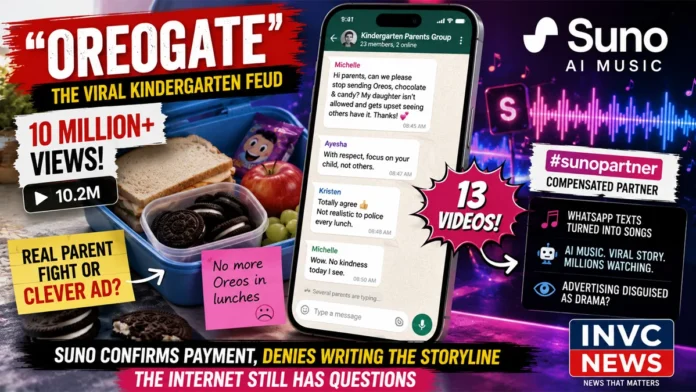
The viral Oreogate Instagram drama exploded through a series of 13 videos posted by creator @ashleighjamz, turning an apparently ordinary school WhatsApp dispute into a social-media soap opera watched more than 10 million times.
The premise was perfectly designed for internet outrage.
One mother, identified in the posts as “Michelle,” allegedly asked other kindergarten parents to stop putting Oreos, chocolate and candy in their children’s lunches because her own daughter was not allowed to eat them and became upset after seeing classmates with sweets.
Then came replies.
Then side chats.
Then arguments.
Then songs.
And eventually one huge question:
Was everyone watching a real WhatsApp fight—or marketing dressed up as mom-group chaos?
The Plot Twist: Every Video Was Connected to Suno
Look closely at the posts and there is a clue hiding in plain sight:
#sunopartner
The conversations in the Oreogate series were transformed into songs using Suno, the generative-AI music platform that can turn prompts and lyrics into complete tracks.
Suno has confirmed that the creator behind Oreogate is a compensated partner who produces social-media content involving its product.
That confirms one important fact:
Oreogate was being used as paid promotional content for an AI company.
But that still does not answer the internet’s biggest question.
Was the underlying kindergarten drama itself real?
Suno Says: We Paid the Creator, We Didn’t Write the Story
Suno says its involvement has limits.
The company confirmed the paid relationship but said creator partners have freedom over what they make and that Suno did not devise the Oreogate storyline.
In other words:
Suno confirms the sponsorship.
Suno does not claim it invented the Oreo fight.
And the creator herself has stopped short of publicly proving whether the messages and people behind the saga were authentic.
That uncertainty is what has transformed a funny parenting argument into a much larger debate over social-media advertising.
The Creator Won’t Fully Answer the Question
When asked whether Oreogate actually happened, @ashleighjamz said she was deliberately avoiding details about the people and messages behind the story while it was still attracting huge public attention.
Follow-up questions reportedly went unanswered.
That has only fed online suspicion.
The account itself is relatively new and largely consists of similarly styled social-conflict stories turned into Suno-generated songs.
For skeptical viewers, that looks less like a personal Instagram diary and more like a purpose-built content format.
Still, without confirmation from the creator, it would be inaccurate to declare the entire story fabricated.
Paid promotion is confirmed.
Fiction is not.
Even Oreo Says It Wasn’t Involved
There is another amusing twist.
The company behind Oreo was reportedly asked whether it had anything to do with the viral drama.
Its answer: no.
So the cookie at the center of Oreogate appears to have gone viral without Oreo itself orchestrating the stunt.
That may be the perfect summary of modern internet culture:
A cookie brand gets millions of impressions.
An AI company gets embedded promotion.
A creator gets a viral series.
And viewers spend days arguing over whether any of it happened.
Why Oreogate Worked So Well
The story hits several internet pressure points simultaneously.
Every parent who has experienced a chaotic school group chat recognizes the format.
Every social-media user understands the temptation to take sides.
And every algorithm loves:
- Conflict
- Parenting arguments
- Food debates
- Screenshots
- Short episodes
- Cliffhangers
- Music
- Outrage
Oreogate packaged all of them together.
Instead of running a conventional advertisement saying, “Use Suno to make AI songs,” the creator demonstrated Suno by turning increasingly ridiculous WhatsApp exchanges into music.
That makes the product part of the entertainment rather than an interruption to it.
Also Read – : TikTok Trends Show How Food Virality, Nostalgia and Cinematic Edits Are Reshaping Social Media
Is This Where Influencer Advertising Is Going?
Oreogate points toward a much bigger shift.
Traditional influencer marketing is usually easy to recognize:
Creator holds product.
Creator praises product.
Creator posts link.
But the new model can look completely different.
The advertisement may be:
a story.
a feud.
a meme.
a serialized mystery.
The audience may become emotionally invested before realizing a company is involved at all.
Disclosure tags such as #sunopartner are designed to make commercial relationships clear, but viewers scrolling quickly may still focus far more on the drama than the disclosure.
That creates a fascinating challenge for the creator economy.
If an advertisement is entertaining enough to feel like reality television, does the audience still perceive it as advertising?
Also Read – : AI Privacy Test: 4 Prompts That Reveal What ChatGPT and Gemini May Have Inferred About You
Suno Is Already at the Center of a Bigger AI-Music Debate
The viral episode arrives while Suno is rapidly expanding—and facing intense scrutiny over AI-generated music.
The company recently announced measures including audio watermarking and fingerprinting designed to make AI-generated music easier to identify and reduce misuse.
Suno has also been signing major music-industry partnerships, including a recently announced global agreement with BMG.
Oreogate therefore lands at exactly the moment AI music is moving from a niche technology into mainstream internet culture.
10 Million Views Later, Nobody Knows What to Believe
That may be why Oreogate is such a perfect 2026 viral story.
The cookies are real.
The Instagram posts are real.
The millions of views are real.
The Suno partnership is real.
The kindergarten feud?
That remains the mystery.
And perhaps that uncertainty was the most viral ingredient of all.
Because on today’s internet, getting users to ask “Wait… was this whole thing an ad?” may be far more valuable than simply showing them one.