By Team INVC | INVC NEWS
MUMBAI, India | September 18, 2026 —
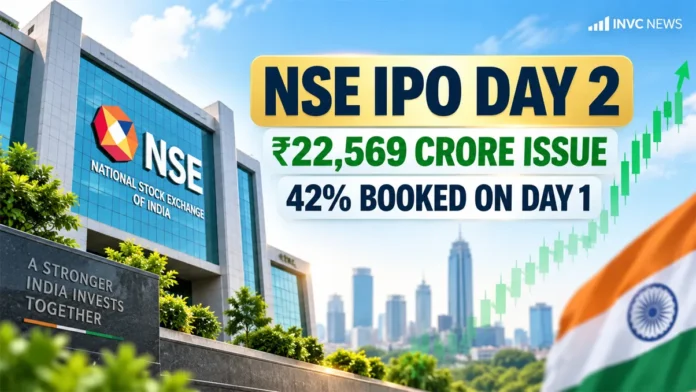
NSE IPO Day 2 begins in focus on Friday after the National Stock Exchange of India’s much-awaited public offer received about 42% subscription on its opening day. The nearly ₹22,569 crore issue will remain open until September 21, giving investors two more bidding sessions after Friday before the subscription window closes.
Demand on the first day came primarily from non-institutional and retail investors, while qualified institutional buyers remained relatively cautious early in the bidding period.
The IPO carries a price band of ₹1,700 to ₹1,785 per share, while the minimum lot size for retail investors is eight shares.
At the upper end of the price band, one lot requires an investment of ₹14,280.
NSE IPO Day 1 Subscription Reaches About 42%
The NSE IPO received bids for roughly 3.70 crore shares against about 8.86 crore shares available for public bidding by the end of September 17.
That translated into an overall subscription of approximately 42%.
Non-institutional investors led the demand with their reserved portion subscribed around 70%.
Retail investors subscribed roughly 42% of their quota, while the qualified institutional buyer category stood at about 19%.
Institutional participation often increases toward the later stages of large public offerings, making Friday and the final bidding day particularly important for the overall subscription picture.
NSE Raised ₹6,746 Crore From Anchor Investors
NSE had already secured approximately ₹6,746.2 crore from anchor investors before opening the public issue.
The exchange allocated around 3.77 crore shares to 189 anchor investors at the upper end of the price band.
The anchor book included major domestic and international institutional investors.
That large anchor allocation brought additional attention to an IPO that has been awaited by Indian market participants for years.
NSE IPO Is Entirely an Offer for Sale
One of the most important details investors should understand is that the NSE IPO does not contain a fresh issue of shares.
It is entirely an offer for sale, or OFS, involving approximately 12.64 crore equity shares.
Existing shareholders are selling their stakes through the IPO.
Therefore, NSE itself will not receive the proceeds generated through the public offer, apart from the transaction changing its shareholder structure and bringing the company’s shares to the public market.
NSE IPO Price Band and Lot Size
The company has fixed the IPO price band at ₹1,700 to ₹1,785 per share.
Retail investors can bid in multiples of eight shares.
At the upper price of ₹1,785, the minimum application size works out to ₹14,280.
NSE is seeking a valuation of approximately ₹4.42 lakh crore at the top end of the price band.
The size of that valuation makes the IPO one of the most closely watched capital-market events of 2026.
NSE IPO GMP Ahead of Day 2
The grey market is also attracting attention.
The latest available unofficial indication on September 17 placed the NSE IPO grey market premium around ₹140 per share, equivalent to roughly 8% over the upper issue price.
However, GMP can change rapidly.
Grey market trading takes place outside official stock exchanges and does not guarantee the eventual listing price.
Investors should therefore treat GMP as an unofficial sentiment indicator rather than a prediction of returns.
Why NSE’s Business Attracts Attention
NSE dominates several major segments of India’s securities market.
Its market share remained above 93% in the cash segment and close to 100% in equity futures during the period disclosed in its IPO documents.
The exchange also remains a major force in equity options.
This scale gives NSE a powerful position across India’s trading ecosystem, including equities, derivatives, currencies, clearing, market data and related services.
Millions of Indian investors and traders interact with NSE-linked infrastructure either directly or through brokers and other financial intermediaries.
Derivatives Dependence Is a Key Risk
The strength of NSE’s derivatives franchise also creates one of its major business risks.
Transaction charges generated a large majority of the company’s operating revenue in FY26.
Options trading alone accounted for a significant part of this revenue.
That means regulatory changes affecting derivatives, falling trading volumes or changes in investor participation can directly influence NSE’s earnings.
Recent regulatory measures aimed at derivatives trading have already placed pressure on volumes.
Competition from BSE has also increased in the index-options market.
These factors explain why investors may closely examine the exchange’s future earnings mix rather than focusing only on its market share.
NSE FY26 Profit and Revenue Face Pressure
NSE remains highly profitable, although FY26 reflected some pressure from lower trading activity and regulatory changes.
Its financial performance remains closely tied to transaction volumes, especially in derivatives.
The exchange has been trying to broaden its income base through data services, indices, new financial products and other market infrastructure businesses.
Future growth will therefore depend not only on trading volumes but also on NSE’s ability to expand these additional revenue streams.
NSE IPO Allotment and Listing Date
The IPO closes on September 21, 2026.
The company is expected to finalize the share allotment around September 22.
Shares are expected to reach successful applicants’ demat accounts shortly afterward.
The tentative listing is scheduled for September 24, 2026, with NSE shares expected to trade on the BSE.
That listing will mark an important moment for India’s capital markets because the country’s dominant stock exchange will itself become a publicly traded company.
What to Watch on NSE IPO Day 2
Friday’s key number will be the pace of institutional participation.
Day 1 demand from retail and non-institutional investors provided an initial base, but QIB activity could ultimately play a major role in determining overall subscription levels.
The unofficial GMP will also remain closely watched.
However, the more important indicators will be the category-wise subscription numbers, institutional demand and the final valuation investors are willing to accept.
Because the issue remains open until Monday, September 21, today’s numbers will not represent the final demand for the IPO.
INVC NEWS will track the subscription throughout the bidding period and update the same story as fresh verified figures become available.
Disclaimer: IPO investments involve market risk. Grey market premiums are unofficial and can change sharply. This report provides factual information and does not constitute investment advice.