Nagpur, India | August 22, 2026 —
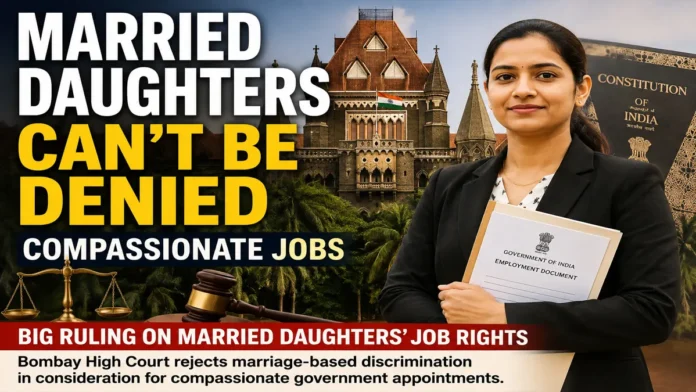
Married daughters compassionate appointment rights have received another major judicial boost after the Bombay High Court struck down a rule that excluded married daughters from consideration for government jobs on compassionate grounds, holding that marital status cannot become the basis for discriminatory treatment.
The ruling reinforces the constitutional principle that a daughter does not cease to be part of her parental family merely because she gets married. The court found that excluding married daughters while allowing other eligible family members to seek compassionate employment could not withstand constitutional scrutiny.
The decision could have wider implications for government employment policies that continue to distinguish between sons and daughters on the basis of marriage.
Bombay High Court Rejects Marriage-Based Exclusion
Compassionate appointments are generally intended to provide immediate financial support to the dependent family of a government employee who dies while in service.
However, eligibility is governed by the applicable rules and policies of the government or public authority concerned.
The issue before the court centered on whether a daughter could be excluded from consideration simply because she was married.
The Bombay High Court rejected such a distinction, finding that marital status alone cannot justify denying a daughter consideration for compassionate employment.
The ruling places equality and actual dependency ahead of traditional assumptions about a woman’s relationship with her parental family after marriage.
Why the Judgment Matters for Married Daughters
The significance of the decision goes beyond one employment dispute.
For years, several compassionate appointment policies across India have contained provisions that distinguish between married and unmarried daughters.
Such classifications have increasingly faced judicial scrutiny because comparable restrictions are generally not imposed on married sons.
The central constitutional question is therefore straightforward: if marriage does not end a son’s relationship with his parents, can the same marriage legally be treated as ending a daughter’s relationship with hers?
Recent judicial decisions have increasingly rejected that distinction.
Supreme Court Has Also Questioned Similar Discrimination
The Bombay High Court ruling comes against the backdrop of an important Supreme Court judgment delivered in July 2026.
The Supreme Court struck down a provision in Bihar’s compassionate appointment policy that restricted eligibility among daughters largely to those who were divorced or deserted.
The apex court held that a classification differentiating between a son and a daughter merely because of the daughter’s marital status could not be constitutionally sustained.
The Supreme Court also rejected the presumption that marriage automatically severs a daughter’s ties with her parental family.
That principle provides important national context to the latest Bombay High Court development.
Compassionate Appointment Is Not an Automatic Right
The judgment should not, however, be interpreted to mean that every married daughter automatically becomes entitled to a government job.
Compassionate appointment remains an exception to the ordinary process of public recruitment.
An applicant must still satisfy the eligibility requirements, dependency conditions, financial criteria and other provisions contained in the applicable compassionate appointment scheme.
The key difference is that a woman’s marriage cannot, by itself, become an automatic disqualification where such exclusion violates constitutional equality.
Therefore, the ruling concerns the right to fair consideration, rather than an unconditional right to appointment.
Equality Before Law at the Center of the Debate
Article 14 of the Indian Constitution guarantees equality before the law and equal protection of the laws.
Rules that treat similarly situated people differently must have a constitutionally sustainable basis.
Marriage-based distinctions between sons and daughters have increasingly struggled to meet that test.
A married son ordinarily continues to be recognized as part of his parental family. Courts have therefore questioned policies under which a daughter, solely because she marries, is presumed to have permanently severed her relationship or dependency on her parents.
Such assumptions can be particularly problematic in cases where the daughter was financially dependent on the deceased employee or continues to support other members of the parental family.
A Broader Shift in Women’s Family Rights
The latest ruling also reflects a broader evolution in Indian jurisprudence concerning women’s rights within their parental families.
Courts have repeatedly examined traditional rules through the constitutional principles of equality and non-discrimination.
The legal position increasingly recognizes that marriage does not erase the parent-child relationship.
A daughter remains a daughter before and after marriage, just as a son remains a son after his marriage.
That principle has implications extending beyond compassionate employment to other welfare and dependency-based government schemes.
What the Ruling Means for Government Employees’ Families
For families of deceased government employees, the judgment could become particularly significant where a married daughter is the principal dependent or the family member best positioned to provide financial support.
Government departments and public authorities may also need to ensure that their compassionate appointment policies comply with evolving constitutional jurisprudence.
However, individual cases will continue to depend on the specific rules governing the employer, the applicant’s dependency status, the family’s financial circumstances and other eligibility conditions.
The Bombay High Court’s ruling nevertheless sends a clear message: marriage alone cannot be used as a blanket reason to push a daughter outside the zone of consideration for compassionate employment.