New Delhi | August 3, 2026
India Rainfall Deficit 2026: El Niño Weakens Monsoon, Punjab Records 38% Rainfall Shortfall
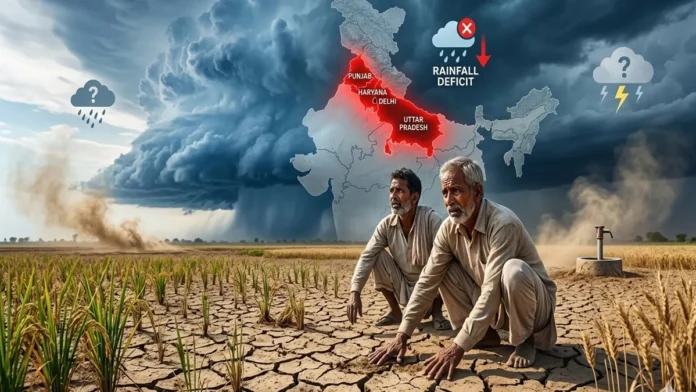
India Rainfall Deficit 2026 has deepened during the first two months of the southwest monsoon, with El Niño significantly weakening rainfall across several northern states. According to the India Meteorological Department (IMD), the country received 13% below-normal rainfall during June and July, while northwestern India experienced far steeper deficits, raising concerns for agriculture and water availability.
Punjab recorded the sharpest decline among major states with a 38% rainfall deficit, followed by Haryana (31%) and Uttar Pradesh (28%). The below-normal rainfall has also affected Delhi and reduced the pace of kharif crop sowing across the country.
June Among the Driest in More Than a Century
The IMD said June 2026 was exceptionally dry after the southwest monsoon arrived late and stalled for nearly two weeks.
During June:
- India received 99.5 mm of rainfall.
- The long-period average (LPA) for June is 165.3 mm.
- Rainfall was nearly 40% below normal.
- It was the fifth driest June since 1901 and the driest June in more than a decade.
The prolonged dry spell significantly impacted rainfall accumulation across northern and central India during the early monsoon season.
July Rainfall Helped Reduce the Overall Deficit
Weather conditions improved during July as several low-pressure systems developed over the Bay of Bengal, bringing widespread rainfall.
The IMD reported:
- 283.3 mm average rainfall during July.
- Normal July rainfall stands at 280.5 mm.
The improved precipitation narrowed India’s cumulative monsoon deficit from much higher levels to 13% below normal by the end of July.
Punjab, Haryana and Uttar Pradesh Among Worst-Hit States
Northwestern India continues to face the greatest rainfall shortage.
Punjab
- Rainfall deficit: 38% below normal
Haryana
- Rainfall deficit: 31% below normal
Uttar Pradesh
Between June 1 and August 2:
- Total rainfall: 261.4 mm
- Normal rainfall: 357.6 mm
- Overall deficit: 28%
Regional breakup:
- Eastern Uttar Pradesh: 34% below normal (254.2 mm)
- Western Uttar Pradesh: 15% below normal (271.7 mm)
The significant rainfall shortage has increased concerns for rain-fed agriculture across the region.
Delhi Also Records Below-Normal Rainfall
The national capital has also experienced weaker-than-normal monsoon activity.
According to IMD data:
- Normal June–July rainfall: 268 mm
- Actual rainfall received: 240.2 mm
- Rainfall deficit: 10%
The city has witnessed alternating periods of humidity, brief showers, and prolonged dry spells instead of sustained monsoon rainfall.
Mountain States Show Mixed Pattern
Among Himalayan states, Jammu & Kashmir was the only region to record above-normal rainfall.
Rainfall performance:
- Jammu & Kashmir: 329.1 mm (16% above normal)
- Himachal Pradesh: 6% below normal
- Uttarakhand: 6% below normal
Indian Ocean Dipole May Ease El Niño Impact
The World Meteorological Organization (WMO) has indicated that the developing Indian Ocean Dipole (IOD) could help offset some of El Niño’s influence during the remaining monsoon season.
Meteorologists believe the evolving oceanic pattern may improve rainfall over parts of southern India and several other regions during August and September.
However, weather experts caution that localized rainfall improvements may not fully compensate for deficits already recorded in many northern agricultural states.
Kharif Sowing Declines as Rainfall Weakens
The rainfall shortage has already begun affecting agriculture.
According to the Ministry of Agriculture & Farmers Welfare, as of July 24, 2026:
- Total kharif sowing area: 787.37 lakh hectares
- Same period last year: 826.19 lakh hectares
This represents a 4.70% decline in cultivated area compared with the previous year, reflecting the impact of delayed and insufficient monsoon rainfall on farmers’ planting schedules.
Outlook
Meteorologists will closely monitor rainfall patterns during August and September, which are crucial months for replenishing reservoirs, supporting kharif crops, and improving overall seasonal rainfall.
While the developing Indian Ocean Dipole offers hope for better precipitation, continued rainfall deficits in key agricultural states remain a major concern for India’s food production and water security.
This report is based on rainfall data released by the India Meteorological Department (IMD), agricultural statistics from the Ministry of Agriculture & Farmers Welfare, and climate assessments published by the World Meteorological Organization (WMO). Rainfall figures are subject to periodic updates as additional observations are compiled.
Reference Links
- India Meteorological Department (IMD): https://mausam.imd.gov.in/
- Ministry of Agriculture & Farmers Welfare: https://agricoop.gov.in/
- World Meteorological Organization (WMO): https://wmo.int/
- India Ministry of Earth Sciences: https://www.moes.gov.in/