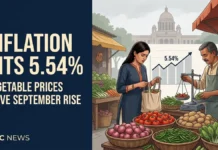

By Team INVC | INVC NEWS
New Delhi, India | October 12, 2026 — India could face a fresh wave of inflationary pressure in the coming quarters, potentially pushing the annual rate to 6%–7% and forcing the Reserve Bank of India (RBI) to raise interest rates further, according to a warning from Systematix Institutional Equities.
The report argues that rising production costs, elevated household inflation expectations, and persistent supply-side disruptions could create greater price pressures than the central bank currently anticipates. Systematix estimates that the RBI may eventually need to raise its benchmark repo rate to between 6.5% and 7%, up from 5.5% following its latest 25-basis-point increase.
The forecast is not a certainty. It represents the research firm’s assessment of the risks facing India’s economy, rather than an official RBI projection.
September Inflation Rises to 5.54%
India’s retail inflation climbed to 5.54% in September 2026, compared with 4.83% in August, according to provisional government data released on October 12. Food inflation rose to 7.74%, adding to pressure on household budgets. Rural inflation reached 6.08%, while urban inflation stood at 4.88%.
The latest figures bring inflation closer to the upper end of the RBI’s 2%–6% tolerance band and reinforce concerns about the outlook for food, energy, and other essential expenses.
Systematix says the RBI’s inflation assessment may not fully capture the combined impact of rising input costs, consumers’ expectations of further price increases, and price pressures spreading across multiple categories.
According to the report, households surveyed in September expected inflation to average 9.1%. Such expectations can influence wage demands, spending decisions, and the prices businesses set, although survey expectations do not necessarily translate directly into actual inflation.
Corporate Costs Could Squeeze Profit Margins
The report highlights mounting cost pressures on Indian businesses, particularly manufacturers.
Systematix estimates that input costs for nonfinancial companies rose approximately 40% year over year in the first quarter of fiscal 2027. It also points to a roughly 45% increase in crude oil prices over the period and a contraction of 650–800 basis points in corporate gross margins.
Companies have reportedly been able to pass only part of their higher costs on to customers. If that pattern continues, businesses may have to absorb more of the increase, potentially limiting profitability. If companies raise prices to protect margins, consumers could face additional inflationary pressure.
The report also warns that government support for food, energy, and fertilizer costs has helped cushion some of the impact of the conflict in West Asia. If that support diminishes while input costs remain elevated, inflationary pressure could become more visible in the months ahead.
Could the RBI Raise the Repo Rate to 6.5%–7%?
The RBI raised the repo rate by 25 basis points to 5.50% in October, marking a shift toward tighter monetary policy. Systematix views the move as the start of a potential rate-hiking cycle rather than an isolated adjustment.
The firm argues that the latest increase may not be enough if inflation rises faster than expected. Its analysis suggests that the RBI could need another 100–150 basis points of tightening to bring the policy rate to 6.5%–7%.
That is the firm’s estimate of the rate level that might be needed under its inflation scenario—not a confirmed RBI decision or a commitment to future increases.
Higher interest rates generally raise borrowing costs for households and businesses. Home loans, vehicle financing, business credit, and other forms of borrowing could become more expensive if banks pass on higher funding costs. The eventual impact would depend on lenders’ pricing decisions, loan terms, and the timing and size of any future RBI moves.
Growth Remains Strong, but Inflation Complicates the Outlook
The RBI has raised its fiscal 2027 GDP growth forecast to 7.1%, from 6.7%, following stronger-than-expected first-quarter growth of 7.8%, according to the figures cited in the Systematix report.
At the same time, the central bank has revised its inflation outlook upward, with inflation projected to reach 6% in the third quarter of fiscal 2027, compared with its previous estimate of 5.9%.
The combination presents a policy challenge. The RBI must contain inflation without unnecessarily weakening economic activity, investment, or consumer demand. Strong domestic consumption can support growth, but persistent demand alongside supply disruptions may make it harder for price pressures to ease.
The Systematix report questions whether the RBI’s assessment adequately accounts for these overlapping risks.
Stock Markets and Government Bonds Face Potential Pressure
Systematix warns that sustained inflation and additional monetary tightening could create a double challenge for financial markets.
Higher interest rates can put pressure on stock valuations by increasing the discount rate investors apply to future earnings. Meanwhile, rising production expenses and borrowing costs could weigh on corporate profits, particularly if companies cannot pass the full increase on to customers.
The report also flags the possibility that India’s benchmark 10-year government bond yield could climb above 7.5%, from approximately 7.24% at the time of its assessment, if inflation exceeds expectations and the RBI continues raising rates.
A rise in government bond yields generally means lower market prices for existing fixed-rate bonds. It can also influence borrowing costs across the economy, although the effects vary by borrower and financial product.
What Consumers and Investors Should Watch
The coming months will be important for determining whether September’s inflation increase is temporary or signals more persistent price pressures. Food prices, crude oil, the monsoon outlook, corporate input costs, household inflation expectations, and the RBI’s policy decisions will all be important indicators.
For consumers, sustained inflation could mean continued pressure on everyday expenses. For borrowers, additional rate increases could make new loans and floating-rate debt more expensive. Investors will need to monitor how inflation, bond yields, interest rates, and corporate earnings evolve together.
For now, the forecast of 6%–7% inflation remains a risk scenario highlighted by Systematix—not a confirmed outcome. The direction of prices and the RBI’s response will depend on incoming economic data and how persistent the current pressures prove to be.