By Team INVC | INVC NEWS
NEW DELHI, India | September 11, 2026 —
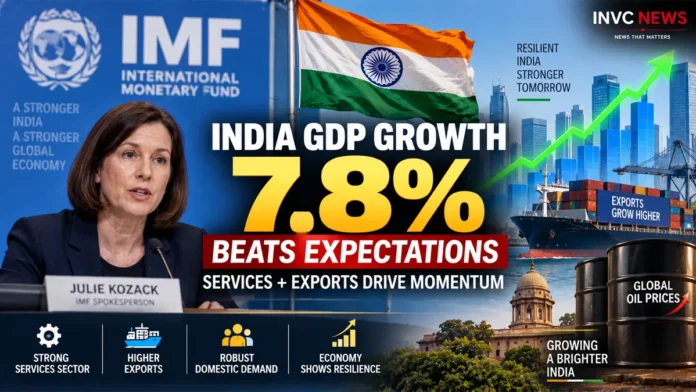
India GDP Growth has delivered a stronger-than-expected surprise, with the International Monetary Fund saying the economy expanded by 7.8% in real terms in the latest April-June quarter.
IMF Communications Director Julie Kozack said the growth rate came in above both IMF staff expectations and the broader consensus among economic observers.
Stronger activity in the services sector and exports played a major role in the upside surprise.
The IMF said the performance also highlights the resilience of the Indian economy despite the global energy price shock.
That assessment gives fresh support to India’s growth story at a time when expensive oil and geopolitical tensions continue to pressure energy-importing economies.
IMF Says India’s 7.8% Growth Beat Expectations
India’s real GDP grew 7.8% year-on-year in the April-June 2026 quarter, according to the latest official data.
The number exceeded the Reserve Bank of India’s earlier estimate of around 7%.
It also came in above the IMF’s internal assumptions.
Kozack said the latest outcome was stronger than expected.
She pointed to services and exports as key drivers behind the surprise.
Official data also showed strong activity across several parts of the economy.
The services sector expanded by around 10%.
Financial, real estate, IT and professional services grew even faster at about 12.1%.
Manufacturing also showed strong momentum, expanding by around 9.2%.
Exports rose by about 12% in real terms during the quarter.
Services Sector Becomes a Major Growth Engine
Services provided one of the strongest supports to the economy.
This matters because the sector contributes a large share of India’s overall output.
Financial services, technology, real estate and professional activities all contributed to the expansion.
Trade, hotels, transport and related services also recorded healthy growth.
The strength of services helped offset pressure coming from the global energy environment.
That balance is important for India because the country remains a major importer of crude oil and other energy products.
Exports Add Another Layer of Support
Exports also surprised on the upside.
Real exports increased by around 12% in the latest quarter.
That helped support overall GDP growth despite weak conditions in parts of the global economy.
India has also benefited from stronger electronics exports.
The IMF said earlier this year that India’s electronics exports had risen by around 24% in FY2025-26.
Smartphones have become one of the country’s major export products.
The IMF also noted that supply-chain diversification is creating opportunities for India, particularly in electronics.
Energy Shock Remains a Major Risk
The IMF’s positive assessment does not mean India is insulated from global risks.
Energy prices remain one of the biggest threats.
India imports a large share of its oil requirements.
That makes the economy sensitive to any sustained rise in crude prices.
The IMF has already warned that the global energy shock has increased import costs for India.
Higher energy prices can also place pressure on inflation, the current account and government finances.
However, Kozack said India entered the latest shock from a position of relative strength.
Strong growth momentum, low inflation, a modest current account deficit and large foreign-exchange reserves provided important buffers.
What Helped India Absorb the Oil Shock?
Several factors helped cushion the impact.
First, domestic demand remained strong.
Household consumption continued to grow.
Private consumption expanded by around 7.1% in real terms during the quarter.
Second, investment remained robust.
Gross fixed capital formation rose by around 11.9%.
That suggests businesses and the government continued to invest despite global uncertainty.
Third, exports remained strong.
Finally, India’s large foreign-exchange reserves have provided an additional buffer against external pressure.
IMF Welcomes India’s New GDP Data Framework
The IMF also welcomed India’s efforts to modernize its statistical system.
The latest GDP estimates use an updated framework that incorporates new industrial production and producer price indicators.
Kozack said the new Index of Industrial Production and Producer Price Index series should help improve the accuracy of GDP estimates.
The IMF encouraged India to continue strengthening data quality and its statistical framework.
The comments are significant because India’s GDP methodology has recently attracted debate.
Some economists and opposition figures have questioned parts of the new calculations.
Government officials, however, argue that the revised framework uses better data sources and more modern methods.
India Remains a Key Global Growth Engine
The IMF continues to describe India as one of the world’s fastest-growing major economies.
Earlier projections put India’s FY2026-27 growth at around 6.4%.
However, the stronger-than-expected first-quarter performance indicates that underlying momentum remains solid.
The IMF has repeatedly described India as an important engine of global growth.
That position becomes more important when the broader world economy is facing pressure from expensive energy, geopolitical conflict and high borrowing costs.
Can India Maintain 7.8% Growth?
The latest number is encouraging, but maintaining growth near 7.8% will not be easy.
Oil prices remain a key risk.
Global interest rates could also create pressure on capital flows.
A weaker global economy could affect exports.
Domestic consumption and investment will therefore remain important.
India may also need continued growth in manufacturing and services to maintain momentum.
Long-term expansion will depend on productivity, infrastructure, employment, skills and investment.
Why the IMF Comment Matters
The IMF assessment gives international validation to the latest growth numbers.
More importantly, it explains why the economy performed better than expected.
Services provided strong domestic momentum.
Exports added external demand.
Investment remained healthy.
Foreign-exchange reserves offered protection against global shocks.
Together, these factors helped India absorb some of the impact from higher energy prices.
The key test now is whether that resilience can continue if oil remains expensive for a prolonged period.
For the moment, however, the 7.8% GDP growth rate has placed India among the strongest-performing major economies despite a difficult global environment.