By Team INVC | INVC NEWS
WASHINGTON, United States | September 11, 2026 —
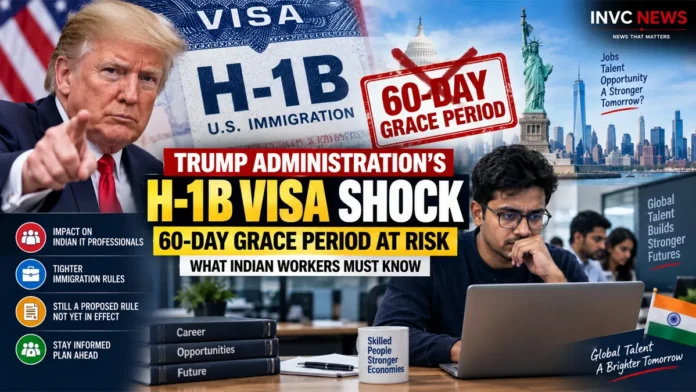
H-1B Visa Grace Period rules could undergo a major change under a new Trump administration proposal that would remove the up-to-60-day window available to many foreign workers after they lose their jobs.
The Department of Homeland Security has proposed deleting the existing provision that allows eligible H-1B and several other employment-based visa holders to remain in the United States for up to 60 days after employment ends.
The proposal could have a major impact on Indian technology professionals, who make up a large share of the H-1B workforce.
However, one point is critical.
The 60-day grace period has not ended yet.
The rule is still at the proposal stage and must go through the federal rulemaking process before it can take effect.
What Is the Current H-1B 60-Day Grace Period?
Under current U.S. immigration rules, an H-1B worker who loses a job before the end of the authorized visa period may receive a discretionary grace period of up to 60 consecutive days.
The period can also end earlier if the worker’s authorized stay expires before those 60 days.
During this window, a worker may try to:
find a new employer,
have a new employer file an H-1B petition,
apply for a change of immigration status,
or prepare to leave the United States.
The grace period does not itself provide permission to work.
Instead, it gives a worker time to address immigration status after employment ends.
What Has the Trump Administration Proposed?
The Department of Homeland Security has proposed removing the regulation that provides the up-to-60-day grace period.
The Federal Register proposal would remove 8 CFR 214.1(l)(2), the provision governing this post-employment buffer.
If the proposal becomes final in its current form, workers in affected visa categories could lose the automatic regulatory window they currently use after employment ends.
DHS argues that employment-based nonimmigrant status is tied directly to the activity or employment for which that status was granted.
The department says removing the grace period would restore an earlier policy under which a worker’s status was more directly connected to continuing qualifying employment.
Is the New Rule Already in Effect?
No.
This is the most important point for H-1B workers.
The proposal has not yet become final law or policy.
The existing 60-day grace period remains available under current regulations.
The Department of Homeland Security must first complete the federal rulemaking process.
That process includes a public-comment period.
The proposal provides for 60 days of public comments after publication.
Only after reviewing those comments can DHS move toward a final rule.
Therefore, H-1B workers should not assume that the grace period disappeared on September 11.
Who Could Be Affected?
The proposed change is broader than H-1B visas alone.
It would affect workers in several employment-based nonimmigrant classifications, including:
H-1B
H-1B1
L-1
O-1
TN
E-1
E-2
E-3
Some dependents whose immigration status is linked to the primary worker could also face consequences.
DHS specifically notes that working dependent spouses in categories such as H-4 and L-2 could experience indirect effects if the principal visa holder loses status following a job loss.
Why Indian IT Professionals Could Feel the Biggest Impact
The proposal has particular significance for Indian professionals working in the U.S. technology sector.
H-1B visas are widely used by technology companies, consulting firms, financial institutions, engineering companies and research organizations.
A worker who is laid off currently has a limited window to look for another employer willing to sponsor an H-1B transfer.
Removing that window could sharply increase the pressure following a layoff.
Workers might have far less time to arrange another lawful immigration path.
That could be especially difficult during periods of technology-sector job cuts.
What Could Happen After a Job Loss?
Under the proposed framework, losing qualifying employment could create immigration consequences much sooner.
A worker may need to take rapid action.
Possible options could still include obtaining a new sponsoring employer, seeking another eligible immigration status or departing the United States.
However, the legal details would depend on the final rule and each person’s individual circumstances.
Workers should therefore avoid assuming that every job loss would automatically require departure on the same day.
Immigration status can depend on petition filings, authorized stay, I-94 validity and other legal factors.
Could Workers Simply Find Another Employer?
H-1B portability rules can allow eligible workers to begin employment with a new employer after the new company files a qualifying petition.
That system would remain extremely important if the grace-period proposal becomes final.
However, finding an employer and completing the required filing can take time.
The current 60-day period gives workers a buffer to handle that process.
Removing it could make layoffs considerably more disruptive.
Families Could Also Be Affected
The impact would not stop with the primary worker.
Many H-1B holders live in the United States with spouses and children.
Their dependent immigration status may be linked to the principal visa holder.
Some spouses also have employment authorization.
DHS acknowledges that removal of the grace period could therefore affect dependent family members and, in some cases, their employers as well.
Why Is the Trump Administration Making This Change?
The administration says employment-based visa status should remain directly connected to qualifying employment.
It argues that the current grace period separates lawful immigration status from the employment activity that formed the basis for admission.
The proposal fits within a broader Trump administration effort to tighten employment-based immigration rules and emphasize hiring of U.S. workers.
The administration has already introduced other restrictions affecting H-1B petitions and legal immigration pathways.
Technology Companies Could Also Face Pressure
Employers may also feel the impact.
Technology companies often recruit H-1B workers already living in the United States.
The current grace period gives those professionals time to move between employers.
Without it, companies could have less flexibility to recruit workers after layoffs.
The change could also increase urgency around petition filings.
Reuters reports that technology and outsourcing companies that rely heavily on foreign workers could face significant effects if the proposal becomes final.
What Happens Next?
The proposal now enters the public-comment process.
Individuals, companies, immigration lawyers, industry groups and other organizations can submit feedback.
DHS will then review the comments.
The department may keep the proposal unchanged.
It could also modify parts of the rule.
Alternatively, implementation could face legal challenges.
Until a final rule is published and takes effect, the existing regulation remains in place.
What Should H-1B Holders Do Now?
H-1B workers should not panic.
The current grace period has not been cancelled.
However, the proposal deserves close attention.
Workers may want to keep their immigration records current.
They should also understand the expiration date on their I-94 and visa-related documents.
People facing an actual layoff should consider getting advice based on their individual immigration situation.
The rules can differ depending on employment history, petition status and authorized stay.
Why This Proposal Matters
For thousands of foreign professionals, the 60-day grace period serves as an important safety buffer.
It can provide time to find another employer after an unexpected layoff.
Removing it could significantly increase uncertainty for workers and their families.
Indian technology professionals would be among the groups watching the proposal most closely.
For now, though, the key distinction remains clear:
The Trump administration has proposed ending the H-1B 60-day grace period. It has not abolished it yet.