HUNTSVILLE, Alabama, August 12, 2026 —
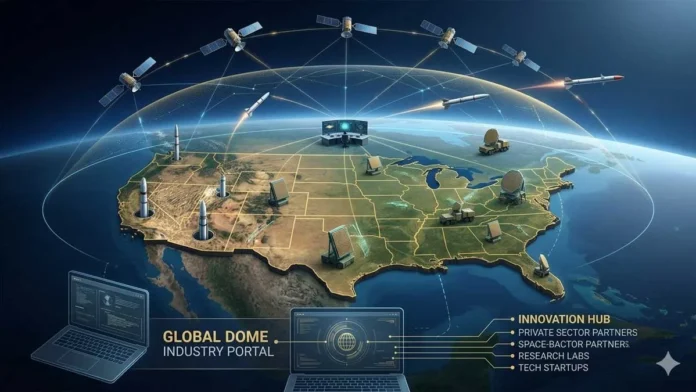
The Golden Dome for America Hub has officially gone live, creating a new digital gateway for defense contractors, technology startups, investors, universities and researchers seeking to participate in the United States’ proposed $185 billion next-generation homeland missile defense system.
Gen. Mike Guetlein, director of Golden Dome for America, announced the platform Tuesday at the annual Space and Missile Defense Symposium in Huntsville, Alabama, describing it as a way to break down traditional barriers between government procurement and commercial innovation. The US government says the portal is designed to give both established defense companies and nontraditional technology firms more direct access to Golden Dome decision-makers.
The initiative could be particularly significant for startups and smaller technology companies that have traditionally found it difficult to navigate lengthy defense procurement systems. Through the Hub, companies will be able to register, submit capability concepts and present designs for consideration without relying solely on conventional contracting pathways.
What Is the Golden Dome for America Hub?
The Golden Dome for America Ecosystem Hub is a centralized online platform intended to connect the program’s leadership with companies, investors and researchers developing technologies that could contribute to the missile defense architecture.
According to the US government, the platform is designed to serve as a single entry point for traditional defense contractors, commercial technology companies, venture capital firms, universities, research laboratories and nontraditional entrepreneurs.
Rather than requiring every potential participant to work through multiple government channels, the Hub is intended to bring these groups into a shared digital environment.
The government says registered participants will be able to submit concepts and capability descriptions directly to authorized program officials.
That could make the Hub especially attractive to emerging companies working in areas such as space technology, sensors, artificial intelligence, communications, missile tracking, command-and-control systems, advanced manufacturing and interception technologies.
Startups Could Get More Direct Access to Golden Dome
One of the most important elements of the Golden Dome portal is its focus on companies outside the traditional defense-industrial establishment.
For decades, major military acquisition programs have frequently been dominated by large contractors with extensive experience navigating federal procurement requirements.
Golden Dome’s new approach seeks to expand that pool.
The government says both traditional and nontraditional innovators will be able to register, upload concepts and submit designs directly to program decision-makers, potentially avoiding administrative delays that can otherwise stretch for months.
For startups, this could create an opportunity to demonstrate technologies before building the kind of large contracting infrastructure traditionally required to compete for major defense programs.
It could also encourage companies with commercially developed products to consider adapting them for national-security applications.
Investors and Venture Capital Firms Also Part of the Strategy
The portal is not designed solely for manufacturers.
Venture capital investors are being brought into the Golden Dome ecosystem as Washington seeks to connect private capital with technologies that may have defense applications.
This is significant because many emerging technologies now originate in commercial markets before being adapted for military use.
Artificial intelligence, satellite communications, autonomous systems, advanced computing, cybersecurity and commercial space systems are among the areas where private-sector investment has accelerated technological development.
By giving investors greater visibility into Golden Dome’s needs, the government hopes private capital can be directed toward companies working on relevant technologies.
The Hub will provide real-time, unclassified information about immediate capability gaps, allowing companies and investors to align research, product development and investment strategies with the program’s requirements.
Golden Dome Wants to Reduce the Defense ‘Valley of Death’
Guetlein said the new approach is intended to eliminate barriers that can prevent promising technologies from making the transition from laboratory development to operational deployment.
The problem is often referred to within defense innovation circles as the “Valley of Death” — the stage where a technology may have demonstrated potential but struggles to secure the funding, acquisition pathway or government customer needed to move into production.
Guetlein said Golden Dome aims to narrow the divide between commercial innovation and national defense by reducing bureaucracy and encouraging partnerships.
The wider objective is speed.
US defense planners argue that rapidly evolving missile and aerial threats require technology development and deployment cycles that move faster than traditional acquisition timelines.
What Threats Is Golden Dome Designed to Counter?
Golden Dome is being developed as an integrated, multi-layered homeland defense architecture capable of detecting, tracking and potentially intercepting multiple types of incoming threats.
US officials say the system is intended to address ballistic missiles, hypersonic weapons, cruise missiles and other advanced aerial threats.
Rather than relying on one interceptor or radar, the architecture is expected to combine multiple technologies into an integrated network.
The government has described the concept as incorporating a persistent space-based sensor network, advanced interceptors and an integrated command-and-control system capable of processing threat information rapidly.
In practical terms, sensors would detect and track a threat, command systems would process that information and determine how to respond, while interceptors or other defensive systems would be used to attempt to neutralize the incoming weapon.
Why Space Technology Will Be Critical to Golden Dome
Space-based capabilities are expected to play a central role in the Golden Dome architecture.
Modern ballistic and hypersonic weapons can travel enormous distances at high speeds, while maneuverable hypersonic systems can make tracking and interception more challenging.
Satellites can potentially provide persistent coverage across large geographic areas and help detect launches or track threats during different stages of flight.
Golden Dome’s architecture therefore places significant emphasis on integrating space-based sensors with terrestrial systems and command networks.
The project is not starting entirely from scratch. US officials have said Golden Dome will combine existing defense capabilities with newly developed systems as the architecture evolves.
$185 Billion Golden Dome Cost Puts Focus on Competition
The scale of the program also raises major questions about cost.
Guetlein said the government is working with a figure of approximately $185 billion needed to deliver Golden Dome and emphasized that officials intend to manage those resources carefully.
One of the cost-control strategies is to make greater use of commercial-off-the-shelf technology where possible rather than developing every system exclusively for the government.
The program also plans to encourage competition among suppliers.
Greater competition could potentially give the government more alternatives when selecting technology and reduce reliance on one contractor for critical components.
It may also create more opportunities for smaller firms capable of supplying specialized systems or components.
Golden Dome Hub Could Strengthen US Defense Supply Chains
The portal is also being presented as an industrial-base initiative.
US defense planners have become increasingly concerned about fragile supply chains and dependence on a limited number of suppliers for strategically important components.
The Golden Dome Hub is intended to support multi-vendor participation, connect qualified suppliers with new forms of capital and help identify companies capable of increasing production when required.
A larger supplier network could help reduce bottlenecks if production needs rise rapidly.
It could also reduce what defense officials call vendor lock-in, where the government becomes overly dependent on a single supplier because alternatives are limited or systems are difficult to integrate with competing products.
Golden Dome is pursuing a modular and open-system approach intended to make it easier to incorporate new capabilities over time.
Universities and Research Laboratories Can Join the Ecosystem
The initiative also extends beyond commercial companies.
Universities and research laboratories will be able to participate in the ecosystem, potentially linking basic and applied research with specific Golden Dome capability needs.
Academic institutions can play an important role in areas such as advanced materials, physics, artificial intelligence, aerospace engineering, propulsion, computing, sensors and communications.
By giving researchers greater visibility into unclassified program gaps, the government hopes some research efforts can be directed toward challenges that have immediate defense applications.
The model is designed to create a more continuous connection between research, private investment, commercial product development and military deployment.
Golden Dome Represents a New Approach to Defense Procurement
The launch of the Hub is significant because it reflects a broader attempt to change how the United States develops major defense systems.
Traditional procurement can involve lengthy requirements processes, competitive solicitations, testing cycles, contract negotiations and regulatory reviews.
Those safeguards remain important, but Golden Dome officials argue that the pace of technological change requires faster ways to identify promising solutions.
The Hub attempts to create an early-stage engagement mechanism where companies can demonstrate what they have before a traditional procurement process necessarily begins.
It does not mean that registering on the portal automatically results in a defense contract.
Instead, it creates a route for industry participants to bring capabilities to the attention of Golden Dome program officials and better understand areas where the government sees technological gaps.
Golden Dome Architecture Already Moving Forward
Golden Dome has progressed beyond the initial concept phase.
In April, US officials said the program had completed an initial architecture blueprint, established a command-and-control consortium and awarded contracts for critical elements of the system.
The government has described the system as layered, integrated and increasingly automated.
A key objective is to allow sensors, data networks and defensive weapons to work together rather than operate as disconnected systems.
This integration will be critical because incoming threats may need to be detected and assessed within extremely short timeframes.
Command-and-control technology could therefore become one of the most important areas for companies seeking Golden Dome opportunities.
Why Competition Between Multiple Suppliers Matters
The US government says it wants several suppliers competing across the Golden Dome ecosystem rather than allowing critical technologies to become concentrated in one company.
That approach has several potential advantages.
First, multiple vendors can create pricing pressure and potentially control costs.
Second, alternative suppliers can provide resilience if one company’s production encounters problems.
Third, competition can encourage faster technological innovation.
Finally, maintaining several suppliers can make it easier to rapidly scale production during periods of increased military demand.
The Golden Dome office says the Hub is intended to reduce sub-tier supply chain vulnerabilities while creating a stronger foundation for large-scale production.
Golden Dome Portal Is Now Live
The Golden Dome for America Hub was officially launched on August 11, 2026, and the government says the platform is available immediately to interested organizations.
Defense contractors, technology companies, research laboratories and other eligible participants are being encouraged to register and submit information about their capabilities.
The launch represents an important shift in the Golden Dome program’s relationship with the private sector.
Instead of relying exclusively on major established defense contractors, the United States is signaling that commercial technology firms, startups, venture investors, universities and smaller suppliers could all play a role in building the future missile defense architecture.
For companies developing technologies relevant to space, sensing, missile tracking, artificial intelligence, communications and advanced defense systems, the portal could provide a new route into one of the most ambitious US military technology programs now under development.
The ultimate success of the initiative will depend on whether the government can turn that wider industry participation into deployable technology while controlling cost, maintaining security and integrating potentially thousands of components into a reliable defensive architecture.
For now, however, the launch of the Golden Dome for America Hub makes clear that Washington wants a much broader section of the American technology and investment ecosystem involved in building its next generation of homeland missile defense.