
NEW DELHI, August 14, 2026
Supreme Court Presses FSSAI for Clear Food Warnings as Obesity and Diabetes Rise
FSSAI front-of-pack labeling is facing renewed Supreme Court scrutiny as India confronts a growing burden of obesity, diabetes and other diet-related illnesses linked to changing food habits.
The Supreme Court has given the Union government another opportunity to finalize its position on prominent warnings for packaged foods containing high levels of sugar, sodium and saturated fat. The court has emphasized that public health, particularly the health of children, must take priority when designing the labeling system.
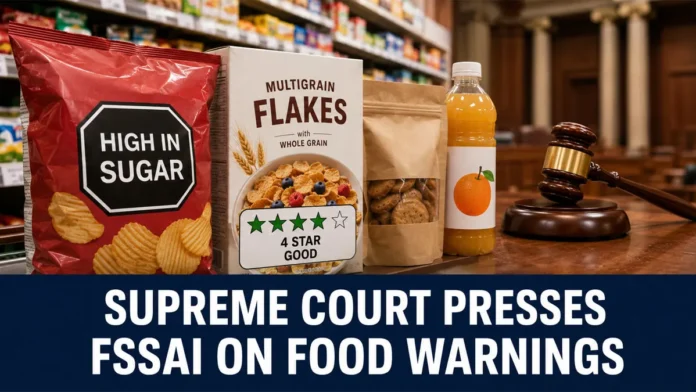
At the center of the debate is whether India should introduce direct warning labels or adopt the Indian Nutrition Rating proposed by the Food Safety and Standards Authority of India. The proposed rating would assign packaged foods between half a star and five stars based on their overall nutritional profile.
Public-health specialists argue that an overall star rating may obscure dangerously high quantities of sugar, salt or saturated fat. They favor direct warnings that identify each nutrient of concern separately.
Supreme Court Gives Government Two Weeks
During a hearing on August 13, a Supreme Court bench comprising Justices J.B. Pardiwala and K. Vinod Chandran expressed dissatisfaction over the delay in finalizing front-of-package nutrition-labeling regulations.
The court gave the Union government two weeks to place its final decision on record. It warned that additional judicial directions could follow if the authorities failed to act.
The case was brought by 3S and Our Health Society, which has argued that consumers need prominent and easily understood warnings on food products containing excessive sugar, salt and saturated fat.
In February, the court had asked FSSAI to consider mandatory front-of-package warnings. It described the matter as an important component of citizens’ right to health. The Supreme Court’s February order records the labeling proposals and FSSAI’s Indian Nutrition Rating model.
The latest hearing further narrowed the regulator’s room for delay, with the court demanding a clear policy decision rather than another extended consultation process.
What Is the Indian Nutrition Rating?
FSSAI’s proposed Indian Nutrition Rating would assign packaged food products a score ranging from half a star to five stars. A higher number of stars would indicate that the product is considered healthier overall.
The calculation would take account of nutrients that should be limited, including:
- Total sugar
- Sodium
- Saturated fat
- Total energy
It would also consider beneficial components such as:
- Protein
- Dietary fiber
- Fruits and vegetables
- Nuts and legumes
- Certain vitamins and minerals
FSSAI says the combined system would allow consumers to compare the overall nutritional value of similar products quickly.
The regulator has also said that caps could prevent an unhealthy product from obtaining a disproportionately high score merely because it contains a small amount of protein, fiber or another beneficial ingredient.
Why Do Health Experts Oppose Star Ratings?
Public-health specialists argue that combining positive and negative nutrients into one score may confuse consumers.
For example, a product containing excessive sugar or sodium could still receive a relatively favorable rating if it also contains enough protein, fiber or other positive ingredients. A shopper looking only at the stars may not realize that the product contains a high level of a specific nutrient associated with health risks.
Warning labels work differently. They display clear messages such as:
- High in sugar
- High in sodium
- High in saturated fat
Supporters say this approach allows consumers to identify the exact concern without interpreting a combined rating or studying a detailed nutrition panel.
Warning Labels Performed Better in Consumer Study
A randomized field experiment involving 2,869 Indian adults compared different front-of-package labeling systems.
Researchers showed participants packaged foods carrying warning labels, traffic-light labels, guideline daily amount labels, health-star ratings or standard control labels.
About 60.8% of participants shown warning labels correctly identified products containing high levels of nutrients of concern. The corresponding figure for the health-star model was approximately 45%.
Traffic-light and guideline daily amount labels also performed better than the star-rating model in helping participants recognize products high in sugar, sodium or saturated fat.
The study concluded that warning labels were the most effective format for helping Indian consumers identify unhealthy packaged foods. However, none of the tested labels produced a statistically significant reduction in participants’ stated intention to purchase the products—a limitation that should also be considered. The complete peer-reviewed labeling study is publicly available.
Several countries use direct warnings, traffic-light symbols or other prominent nutritional indicators based on their domestic public-health objectives.
India’s Obesity and Diabetes Burden
The labeling case comes amid concern about India’s growing prevalence of metabolic diseases.
The nationwide ICMR–INDIAB study estimated that:
- 11.4% of Indian adults had diabetes.
- 15.3% had prediabetes.
- 28.6% had generalized obesity.
- 39.5% had abdominal obesity.
The 11.4% diabetes prevalence translated to approximately 101 million people at the time of the study. Prediabetes affected an estimated 136 million people, indicating the possibility of a further increase in diabetes unless preventive measures are strengthened.
The 28.6% figure specifically represents generalized obesity—not a combined estimate of everyone who is overweight or obese. This distinction is important when presenting the data accurately.
The study was conducted across India and included more than 113,000 participants, making it one of the country’s most comprehensive assessments of metabolic noncommunicable diseases. The national ICMR–INDIAB findings are available through PubMed.
Petitioners Call Warning Labels a Health Right
The organization behind the public-interest petition argues that warning labels should not be treated as an optional consumer-information initiative.
It maintains that clear nutritional warnings are connected to the constitutional right to health because they allow people to make informed decisions before purchasing packaged food.
Dr. Arun Gupta, convener of the Nutrition Advocacy in Public Interest, said the court had placed public health ahead of commercial interests. He called on FSSAI to implement the judicial directions without further delay.
Supporters of warning labels also argue that children are particularly vulnerable to attractive packaging and the aggressive marketing of foods high in sugar, salt and saturated fat.
Food Samples Fail Quality Tests in Several Regions
Concerns about packaged-food labeling have emerged alongside broader questions about the quality and accuracy of food products sold in different parts of India.
Data cited in a parliamentary committee report showed that 10,804 food samples were tested in Punjab during 2024–25. Of those, 748 failed to meet at least one applicable standard, while 108 were classified as unsafe.
The term “failed” can include samples considered substandard, misbranded or unsafe. It does not mean that every failed sample was unfit for consumption.
The reported regional figures included:
| Region | Samples tested | Samples failed | Unsafe samples |
|---|---|---|---|
| Punjab | 10,804 | 748 | 108 |
| Haryana | 4,763 | 500 | 89 |
| Chandigarh | 1,906 | 65 | Not specified |
| Himachal Pradesh | 4,353 | 293 | 36 |
| Jammu and Kashmir | 23,037 | 651 | 24 |
The testing covered categories that included children’s foods, health drinks and dietary supplements. Some cases reportedly involved differences between information printed on packaging and the product’s actual composition.
These food-safety results are separate from the front-of-package nutrition-rating debate. However, both issues demonstrate the importance of accurate labeling, effective testing and regulatory enforcement.
What Happens Next?
The Union government must now place its final position before the Supreme Court within the period granted at the August 13 hearing.
FSSAI could retain the Indian Nutrition Rating, modify it to include separate nutrient warnings or adopt a more direct warning-label system.
The final model will need to balance several considerations:
- Consumer understanding
- Nutritional accuracy
- Children’s health
- Traditional Indian foods
- Compliance costs for smaller businesses
- International labeling practices
- India’s growing burden of metabolic disease
The central question is whether consumers can immediately recognize when a packaged food contains excessive sugar, sodium or saturated fat.
Research indicates that direct warning labels communicate those risks more effectively than an overall star rating. The Supreme Court’s intervention has now increased pressure on the government and FSSAI to translate that evidence into a clear national policy.