By Team INVC | INVC NEWS
Published: September 18, 2026 | 06 : 37 PM IST
MUMBAI, India | September 18, 2026 — Imagine hearing that four men accused of a horrific crime have been killed by police.
Before anybody asks another question, relief arrives.
Anger finds an outlet.
Television debates begin.
People say justice has been served.
Then somebody asks a seemingly inconvenient question:
What if the police were wrong?
That question is the real beginning of Meghna Gulzar’s Daayra.
Everything else—the investigation, the police officers, the encounter and the competing versions of events—exists around it.
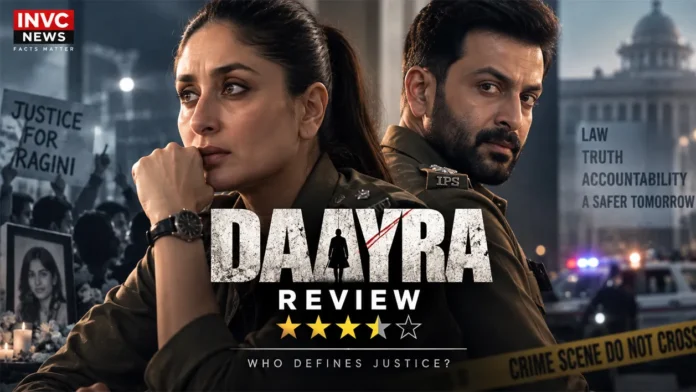
The film stars Prithviraj Sukumaran and Kareena Kapoor Khan as two senior police officers who never need to spend much screen time together to feel as though they are engaged in a continuous argument.
One believes justice sometimes requires decisive action.
The other believes justice ceases to be justice when evidence and accountability become optional.
Daayra is strongest when it refuses to make that conflict comfortable.
INVC NEWS Rating: ★★★½☆ — 3.5/5
This Is Not a Whodunit
The crime at the centre of Daayra is horrifying.
Ragini Poojari, a young woman, has been assaulted and killed.
Public anger is immediate.
Four accused men later die in a police encounter connected to DCP Raman Kumar, played by Prithviraj Sukumaran.
To many people, the equation is complete.
Crime.
Accused.
Punishment.
Closure.
DCP Ajooni Kohli sees a problem.
She begins examining the encounter itself.
The movie therefore does something interesting.
Instead of asking viewers to wait for a criminal to be identified, it asks them to reconsider something they may already have accepted as justice.
That makes the investigation uncomfortable by design.
Prithviraj Plays Certainty, Not Cruelty
Raman Kumar could easily have become a simplistic character.
Make him aggressive enough, arrogant enough or visibly compromised enough, and the audience immediately knows what to think.
Prithviraj refuses that route.
His Raman possesses moral certainty.
That is much more unsettling.
He does not behave like somebody who secretly knows he crossed a line.
He behaves like somebody who has spent years watching institutions fail and has decided that crossing the line may sometimes be necessary.
The performance never needs to beg for sympathy.
Instead, Prithviraj creates something harder:
Understanding.
You can reject Raman’s worldview while recognising the frustration that helped produce it.
That complexity gives Daayra its tension.
Kareena’s Ajooni Has to Defend Something Nobody Wants to Wait For
Ajooni’s job is more difficult.
She represents procedure.
Procedure is rarely cinematic.
Evidence takes time.
Investigation requires patience.
Legal safeguards can appear infuriating when the crime is brutal and emotions are raw.
Kareena Kapoor Khan understands that Ajooni cannot simply walk into the movie and declare herself morally superior.
She gives the character control.
Ajooni watches more than she announces.
She listens.
She questions what other people have already accepted.
Her strength is persistence rather than spectacle.
Most importantly, she does not appear blind to the failures of the system she is defending.
She simply understands the danger of replacing an imperfect system with one person’s certainty.
Daayra’s Best Trick Is Keeping Raman and Ajooni Apart
Most star-driven thrillers would rush towards confrontation.
Daayra takes the opposite route.
Raman and Ajooni function almost like opposing arguments unfolding across separate timelines and investigations.
One action answers another.
One interpretation challenges the next.
Their physical separation creates anticipation.
When two stars spend an entire film shouting at each other, confrontation becomes ordinary.
Here, the absence of confrontation gives every eventual exchange greater weight.
It also allows the audience to spend time inside both positions before the movie forces them together.
That is a clever structural choice.
The Most Uncomfortable Character in Daayra Is the Audience
This may be the film’s sharpest idea.
Daayra understands how emotionally satisfying immediate punishment can feel.
A horrific crime creates rage.
The justice system looks slow.
An encounter produces an immediate result.
For a moment, uncertainty disappears.
That emotional sequence is familiar.
The film then interrupts it.
What evidence existed?
Who verified it?
Who had the authority to decide?
What happens if the accused were not guilty?
Those questions are frustrating precisely because they arrive after emotional closure.
Daayra forces viewers to reopen a conclusion they may instinctively prefer to keep closed.
A Police Encounter Becomes a Test of Power
The film’s larger argument is not simply about whether one particular encounter was justified.
It concerns power.
If police officers can decide guilt and punishment outside the judicial process, the immediate result may sometimes satisfy public anger.
But the same power does not disappear after one case.
Who controls it next time?
Who corrects it when it is mistaken?
Who protects someone falsely accused?
What happens when public anger demands the wrong person?
These are not abstract questions inside Daayra.
They become the moral architecture of the story.
Meghna Gulzar Chooses Accumulation Over Sensation
The investigation develops methodically.
Ajooni does not discover one magical clue that explains everything.
Instead, details begin changing meaning.
Statements require another look.
Timelines become important.
An apparently settled narrative develops cracks.
Meghna Gulzar’s approach is deliberately procedural.
The movie rarely behaves like an action thriller even when its subject could easily have been sensationalised.
That restraint gives the story credibility.
It also creates one of the film’s weaknesses.
At times, the controlled tone becomes so consistent that the dramatic temperature stops rising.
Ragini Must Matter Beyond the Case File
Any movie built around violence against a woman faces an ethical storytelling problem.
The victim can disappear.
Her suffering becomes the device that motivates investigators, police officers and screenwriters.
Daayra is most effective when it resists that tendency.
Ragini’s family, particularly the grief around her mother, reminds the audience that this is not merely a philosophical debate.
People have lost someone.
The justice system had already failed them before Raman and Ajooni began disagreeing over what should happen next.
That distinction matters.
Justice is not theoretical to the people left behind.
The Second Half Needed More Pressure
For all the strength of its premise, Daayra eventually becomes slightly too controlled.
The investigation progresses.
Evidence accumulates.
The moral positions become clearer.
But the film does not always increase the pressure surrounding those discoveries.
That creates an unusual problem.
The audience remains intellectually engaged while emotional tension begins levelling off.
A slow-burn thriller does not need constant twists.
It does need each revelation to make the central conflict more difficult.
The latter portion of Daayra occasionally confirms what we already understand rather than forcing us to reconsider it.
The Climax Does Not Fully Exploit the Film’s Greatest Weapon
By the final act, Raman and Ajooni represent two sharply defined philosophies.
This should create an extraordinary confrontation.
The eventual collision is compelling.
Yet it is not quite devastating.
The problem is not performance.
Both actors are fully invested.
The limitation lies in the screenplay’s unwillingness to destabilise either worldview enough.
A great moral thriller should occasionally make viewers uncomfortable with the position they thought they supported.
Daayra reaches towards that possibility.
It does not always go far enough.
Prithviraj Leaves the Deeper Scar
Prithviraj’s performance lingers because Raman embodies a dangerous kind of confidence.
He is not confused about his choices.
He believes in them.
A corrupt officer can be dismissed.
A convinced officer forces a larger question.
What happens when someone genuinely believes institutional safeguards are obstacles to justice?
Prithviraj keeps Raman grounded enough that the character never becomes an abstract political argument.
He remains a police officer shaped by experience, anger and disappointment.
That makes him difficult to forget.
Kareena’s Performance Is Quieter — and Deliberately So
Kareena plays the opposite rhythm.
Ajooni’s authority is internal.
She does not need Raman’s physical intensity because the character’s power comes from refusing to accept convenient answers.
There are moments when the screenplay could have gone deeper into Ajooni’s personal relationship with institutional failure.
The performance suggests more conflict than the writing always explores.
Still, Kareena gives the role intelligence and composure.
She understands that restraint should not mean passivity.
Why Daayra Has a Life Beyond Opening Weekend
Mysteries often weaken once their secrets become known.
Daayra has another source of longevity.
Its central argument remains relevant after the plot has been solved.
Can public anger substitute for proof?
Can institutional failure justify extrajudicial action?
Is a desired outcome still justice if the method cannot withstand scrutiny?
What happens when the person exercising extraordinary power makes a mistake?
These questions do not belong to a single fictional case.
That gives the film genuine evergreen value.
The mystery eventually closes.
The argument doesn’t.
Daayra Movie Review: Final Verdict
Daayra is not the relentless thriller its premise might suggest.
It is something slower and, at its best, more uncomfortable.
Meghna Gulzar uses a police investigation to examine why instant punishment attracts public approval and why legal safeguards become most important precisely when society is angriest.
Prithviraj Sukumaran gives the film its most unsettling performance by making Raman’s conviction believable.
Kareena Kapoor Khan responds with a quieter, disciplined portrayal built around persistence rather than theatrics.
The film could have pushed both characters—and the audience—further in its final act.
Yet its defining question survives every imperfection:
When justice becomes instant, who checks whether it is still justice?
INVC NEWS Rating: ★★★½☆ — 3.5/5
Bottom Line: Daayra is an absorbing moral thriller strengthened by Prithviraj and Kareena, even if its final confrontation stops short of the devastating impact its premise deserves.