NEW YORK, United States | September 27, 2026 —
China has called for the sovereignty and security of Gulf and wider Middle Eastern countries to be respected, while warning that regional instability must not disrupt global industrial supply chains, energy flows or international trade.
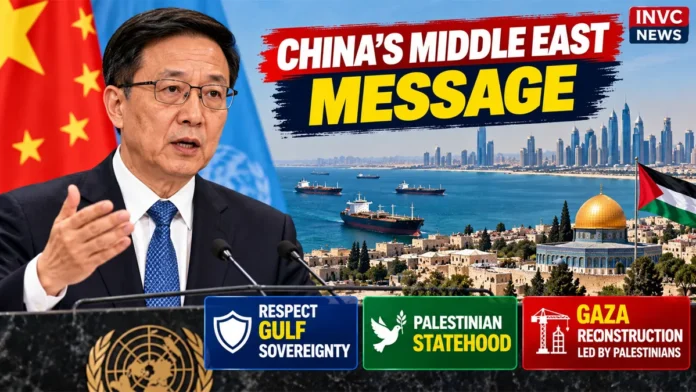
Addressing the United Nations General Assembly, Chinese Vice President Han Zheng said Beijing believes countries across the Middle East, including the Gulf, should have their sovereignty and security protected.
He also stressed that global supply chains must remain stable and unobstructed, reflecting China’s concern that conflict in the region could spill over into energy markets, shipping routes and international trade.
At the same time, Han reiterated China’s support for Palestinian sovereignty and called for Gaza’s reconstruction to move forward under the principle of “Palestinians governing Palestine.”
THE 60-SECOND BRIEF
China on the Gulf: Sovereignty and security of Middle Eastern countries should be respected.
China on trade: Industrial and supply chains should remain stable and unobstructed.
China on Palestine: Beijing continues to back Palestinian sovereignty.
China on Gaza: Reconstruction should proceed under Palestinian leadership.
China on the West Bank: Beijing supports advancing Palestinian governance.
China’s broader message: Regional stability, sovereign rights and global trade are closely connected.
Han Zheng Puts Gulf Sovereignty at the Center
Han’s remarks placed sovereignty at the heart of China’s Middle East policy.
He said countries in the region, including Gulf states, should have their security and territorial sovereignty respected.
The wording reflects Beijing’s long-standing emphasis on non-interference and state sovereignty.
But the message also carried a clear economic dimension.
Instability in the Gulf threatens some of the world’s most important oil, gas and shipping corridors.
China, as one of the world’s largest energy importers and trading economies, has a major stake in keeping those routes open.
China Warns Against Disrupting Global Supply Chains
Han also emphasized the importance of keeping international industrial and supply chains stable.
That message comes at a time when conflict across the Middle East has increased concern over oil flows, shipping insurance and trade routes.
China’s position is that geopolitical confrontation should not disrupt global commerce.
For Beijing, Gulf stability is therefore both a diplomatic and economic priority.
Palestine Remains Central to China’s Middle East Position
Han also returned to the Palestinian question, which Beijing continues to describe as central to Middle East peace.
China supports an independent Palestinian state and continues to back a two-state solution.
At the UN, Han called for governance in the West Bank to move forward while Gaza’s post-conflict reconstruction is carried out under Palestinian leadership.
The phrase “Palestinians governing Palestine” has become a recurring part of China’s diplomatic language on Gaza.
What Does “Palestinians Governing Palestine” Mean?
China uses the phrase to argue that future governance arrangements in Gaza should not be imposed externally.
Beijing says Palestinians themselves should remain at the center of administration, reconstruction and political decision-making.
China has also argued that Gaza and the West Bank should remain part of a unified Palestinian political framework.
That position is closely linked to Beijing’s support for a two-state solution.
China Supports Gaza Reconstruction
Han called for post-conflict reconstruction in Gaza to advance alongside wider Palestinian governance.
Reconstruction remains one of the most difficult issues facing the region.
Large parts of Gaza’s infrastructure have been damaged, while humanitarian access, electricity, water, healthcare and housing remain major challenges.
China’s position is that reconstruction should strengthen Palestinian institutions rather than create a permanent external governing structure.
West Bank Governance Also Matters
Han did not limit his remarks to Gaza.
He also called for progress in Palestinian governance in the West Bank.
That reflects China’s wider argument that Gaza and the West Bank should not become politically separated.
Beijing supports a future Palestinian state that includes both territories under a single sovereign framework.
China’s Message Is Also About Energy Security
The Gulf is one of the most important energy regions in the world.
Any disruption to shipping through strategic waterways can quickly affect crude oil prices, LNG supplies and transportation costs.
China imports large volumes of energy from the Middle East.
That gives Beijing a direct economic interest in avoiding prolonged regional confrontation.
Han’s emphasis on open supply chains and stable trade therefore has significant strategic meaning.
Beijing Wants Diplomacy, Not Wider Escalation
China has repeatedly called for ceasefires, negotiations and regional de-escalation.
Its broader Middle East policy seeks to position Beijing as a supporter of diplomatic solutions rather than military escalation.
Chinese officials have argued that major powers should avoid actions that deepen instability.
That approach also supports China’s effort to strengthen political and economic relationships with Gulf states.
Gaza Reconstruction Is Becoming a Global Issue
The debate over Gaza’s future is moving from immediate humanitarian relief toward longer-term reconstruction and governance.
The United Nations has warned that reconstruction cannot succeed without a credible political framework.
Current UN planning also emphasizes the need for Palestinian institutions to remain central to Gaza’s future.
China’s position therefore overlaps with a broader international debate over how Gaza should be governed and rebuilt.
Two-State Solution Remains Beijing’s Preferred Framework
China continues to support a two-state solution based on an independent Palestinian state alongside Israel.
Chinese officials have repeatedly backed a Palestinian state based on the 1967 borders, with East Jerusalem as its capital.
Beijing argues that long-term regional stability cannot be achieved without addressing Palestinian statehood.
Why Han Zheng’s Comments Matter
Han’s remarks connect three issues that are often discussed separately:
Middle East sovereignty.
Palestinian statehood.
Global trade and energy security.
China is effectively arguing that these issues are interconnected.
Regional war threatens national sovereignty.
Instability threatens shipping and energy flows.
And unresolved Palestinian statehood continues to fuel wider political tension.
China’s Wider Strategic Interest in the Gulf
China has expanded its economic ties across the Gulf through energy purchases, infrastructure projects, trade and investment.
Saudi Arabia, the United Arab Emirates, Qatar, Iran and other regional states all play important roles in China’s energy and commercial relationships.
That makes stability in the Gulf particularly important for Beijing’s long-term economic strategy.
What Happens Next?
Attention will now turn to whether China plays a more active diplomatic role in efforts involving Gulf security, Gaza reconstruction and Palestinian governance.
Three areas will matter:
Regional de-escalation: Whether diplomatic channels can reduce wider conflict.
Gaza reconstruction: How international financing and governance arrangements develop.
Energy and shipping: Whether Gulf trade routes remain open and stable.
China is likely to continue pushing all three issues together rather than treating them separately.
INVC NEWS Bottom Line
China is sending a clear message on the Middle East.
Beijing wants the sovereignty of Gulf and regional states respected, global supply chains protected and Palestinian governance placed at the center of Gaza’s future.
Han Zheng’s UN address shows that China sees Middle East stability not only as a political issue, but also as a question of energy security, international trade and global economic stability.
For Beijing, the argument is simple: regional sovereignty, Palestinian statehood and uninterrupted global commerce are now part of the same strategic equation.