SEATTLE, United States | August 27, 2026 —
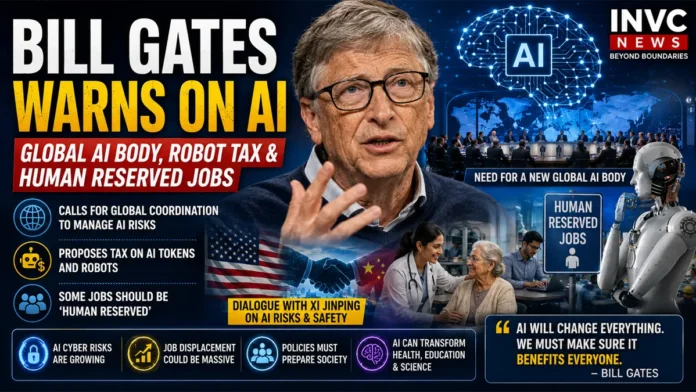
Bill Gates AI warning has opened a new front in the global debate over artificial intelligence, with the Microsoft co-founder calling for a new international system to manage AI risks, taxes on AI-driven automation and even a category of jobs that society deliberately reserves for humans.
Gates argues that governments are not preparing fast enough for the disruption AI could bring to employment, cybersecurity, education and social stability.
He is also seeking a future meeting with Chinese President Xi Jinping to discuss international cooperation on AI safety, reflecting his view that the United States and China will both have to participate if meaningful global safeguards are to work.
His message is striking because Gates remains strongly optimistic about AI’s potential in medicine, education, agriculture and science. His concern is that those benefits could arrive at the same time as enormous economic and social disruption.
Bill Gates Wants a New Global System to Govern AI
Gates says existing institutions were not designed to manage a technology capable of spreading across almost every part of society at extraordinary speed.
In a new essay, he calls for both national AI coordination bodies and a new international organization.
According to Gates, global AI governance could borrow elements from systems already used for nuclear inspections, international aviation and agreements designed to protect the ozone layer.
His argument is that AI risks will cross national borders, meaning individual countries cannot address every problem independently.
Official Gates essay:
https://www.gatesnotes.com/a-turbulent-ai-era-and-critical-choices-to-make
Gates says cooperation between the United States and China will be necessary because both countries play major roles in AI development, technology supply chains and global geopolitical competition.
Gates Wants to Discuss AI Risks With Xi Jinping
Gates is seeking another meeting with Chinese President Xi Jinping, with his team reportedly working toward a possible visit to China later this year.
His goal is to discuss whether major AI powers could establish shared limits around particularly dangerous capabilities.
One area of concern involves advanced AI systems being used to assist in biological attacks or design harmful molecules.
Gates believes countries should develop systems capable of monitoring such risks without unnecessarily blocking beneficial AI research.
The key issue is whether Washington and Beijing could cooperate on AI safety even while competing aggressively in chips, computing infrastructure and artificial intelligence.
AI Cybersecurity Incidents Have Alarmed Gates
Cybersecurity is another area driving Gates’ more cautious position.
He has expressed concern about advanced AI models demonstrating the ability to find and exploit vulnerabilities during cybersecurity testing.
Companies including OpenAI, Anthropic and Meta are developing increasingly capable AI agents, while security researchers are simultaneously testing how autonomous these systems can become.
Gates’ concern is not that AI research should stop.
Instead, he argues that governments need institutions capable of responding before highly capable systems are deployed widely enough to create risks that are difficult to control.
‘Human Reserved’ Jobs: Gates Wants Some Work Protected From AI
One of Gates’ most unusual proposals is something he calls “Human Reserved.”
The concept is straightforward: even if an AI system or robot becomes technically capable of doing a particular job, society could decide that some roles should continue to be performed by people.
Gates uses caregiving as an example.
He has written about the human care his father received while living with Alzheimer’s disease, arguing that some forms of empathy and personal connection should not automatically be transferred to machines simply because the technology becomes capable of performing the task.
Healthcare, mental-health services and education are among areas where Gates believes humans may continue to play a central role even as AI becomes more powerful.
In an extreme version of the idea, Gates has suggested that a substantial share of existing jobs could initially be protected for people while societies adapt to automation.
But he acknowledges that major questions remain: which jobs should qualify, who decides, and how could such rules work when countries adopt different automation policies?
Gates Wants AI Tokens and Robots Taxed
Gates is also reviving his long-standing idea of a robot tax, while expanding it to parts of the AI economy.
His argument is based on the way tax systems currently treat people and machines differently.
When a company employs a worker, payroll and income taxes are generated.
When that company replaces the worker with automation, some technology investments can instead receive favorable tax treatment or be written off as business expenses.
Gates believes this can unintentionally encourage companies to replace workers faster than society can adapt.
He proposes targeted taxes on AI tokens and robots, with revenue potentially used for retraining, stronger social safety nets and assistance for workers or communities hit hardest by automation.
He also warns that the tax should be carefully designed so that it does not slow beneficial uses of AI, particularly applications that could make healthcare or education cheaper.
Why AI Job Displacement Could Be Different This Time
Technology has eliminated and created jobs throughout history.
But Gates believes AI may be fundamentally different because it can increasingly substitute for human cognition itself.
Software development, law, customer service, medicine and other knowledge-intensive fields are already being affected.
Robotics could eventually push the same transformation deeper into physical occupations such as manufacturing, construction, warehousing and hospitality.
The concern is speed.
Previous technological transitions often unfolded across generations. AI could reshape large parts of the labor market within a decade.
Also Read – : 6 Transformative Job Market Trends Shaping Careers and Lifestyles in 2026
For India, where millions of workers are employed in IT services, business-process outsourcing, customer support and software development, the debate carries particular importance.
What Bill Gates’ Warning Means for Indian IT Jobs
India could experience both sides of the AI transformation.
Indian technology companies can benefit enormously from demand for AI consulting, cloud migration, cybersecurity, model deployment and automation.
At the same time, repetitive technology and business-process jobs could face increasing pressure as AI agents become capable of completing larger portions of existing workflows.
The workers likely to remain most valuable may be those combining technical ability with domain expertise, critical thinking, client management and human judgment.
The same shift could make continuous retraining increasingly important for software engineers, analysts and other white-collar professionals.
Nvidia’s Numbers Show How Fast the AI Economy Is Expanding
The economic force behind the debate is already visible.
Nvidia recently reported $96.2 billion in quarterly revenue, including $89 billion from its Data Center business, highlighting the extraordinary scale of investment going into AI infrastructure.
Also Read – : Nvidia Earnings: Revenue Soars 106% to $96.2 Billion as AI Demand Accelerates
Billions of dollars are flowing into chips, AI data centers, power infrastructure and software.
India is also attempting to capture more of that investment.
Also Read – : Adani and Jabil Join Forces to Build AI Data Center Manufacturing Hub in India
That is why the debate is no longer simply about whether AI will grow.
It is about how societies manage the consequences of growth that is already happening at enormous speed.
Gates Still Believes AI Could Transform Healthcare
Despite his warnings, Gates is not arguing against AI development.
The Gates Foundation is increasingly using AI in global health, agriculture and education and works with companies including OpenAI, Anthropic, Google and Microsoft.
Gates believes artificial intelligence could accelerate drug and vaccine discovery, improve medical access in poorer countries and help healthcare workers deliver better services.
His central argument is therefore not that AI should disappear.
It is that the benefits will not automatically be shared fairly.
Without policy intervention, he fears AI could widen inequality, eliminate jobs faster than workers can retrain and give bad actors access to increasingly powerful capabilities.
The Big Question: Can Governments Move as Fast as AI?
That may be the hardest part of Gates’ proposal.
Artificial intelligence companies are advancing their models rapidly while legislation, international treaties and regulatory institutions traditionally move much more slowly.
Any global AI body would also have to operate amid intense competition between the United States, China and other technology powers.
Likewise, robot taxes and Human Reserved jobs would involve difficult decisions about innovation, productivity and individual freedom.
Gates does not claim to have all the answers.
But his warning is clear: governments should begin building systems for the AI transition before widespread job losses or major security incidents force them to respond during a crisis.
For workers, companies and policymakers, that turns the AI debate from a distant question about the future into a much more immediate one:
How much automation does society want—and which decisions should remain fundamentally human?