NEW DELHI, August 14, 2026
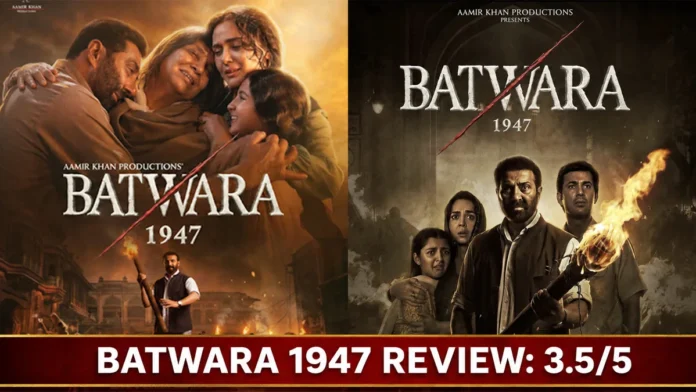
Batwara 1947 review: Rajkumar Santoshi’s historical drama transforms one Lahore haveli into a powerful symbol of everything India’s Partition displaced—families, identities, memories and the meaning of home.
Released in theaters on August 14, Batwara 1947 is an earnest, emotionally charged film led by a commanding Sunny Deol. It occasionally becomes slow and excessively dialogue-heavy, but its performances, moral conviction and deeply humane central conflict ultimately leave an impression.
This is not a film built around political arguments alone. At its heart, it is about two displaced families, one ancestral home and an elderly woman who refuses to accept that a newly drawn border can erase her past.
The film demands patience across its approximately 2-hour-and-25-minute runtime. In return, it offers a sincere and affecting story about humanity surviving amid communal violence.
Batwara 1947 movie details
| Category | Details |
|---|---|
| Film | Batwara 1947 |
| Director | Rajkumar Santoshi |
| Writers | Rajkumar Santoshi and Asghar Wajahat |
| Based on book | Jis Lahore Nai Vekhya, O Jamya E Nai |
| Producers | Aamir Khan and Aparna Purohit |
| Cast | Sunny Deol, Preity Zinta, Shabana Azmi, Ali Fazal, Karan Deol and Abhimanyu Singh |
| Music | A.R. Rahman |
| Runtime | Approximately 2 hours, 25 minutes |
| Release Date | August 14, 2026 |
| Rating | 3.5/5 |
Story: When an ancestral home becomes the center of Partition
The story begins in 1947 as riots spread across the subcontinent and millions are forced to cross newly created borders.
Sikander Mirza, played by Sunny Deol, reaches Lahore with his wife Hameeda, portrayed by Preity Zinta, and their family. They arrive carrying the emotional and physical exhaustion of people who have been uprooted from everything familiar.
The family is allotted a large haveli as part of its attempt to begin life again. However, the property is not abandoned.
An elderly Hindu woman, played by Shabana Azmi, still lives there. Her family has disappeared amid the violence, but she remains convinced that her son, Ratanlal, will return.
She refuses to surrender the haveli because it represents far more than ownership. Every room contains a memory, and every wall connects her to the family she has lost.
Sikander’s family also needs the house. They, too, have been displaced and forced to abandon their past. The film’s most powerful idea emerges from this contradiction: both sides are victims, yet history has placed them on opposite sides of the same door.
The conflict becomes dangerous when local strongman Yaqoob Khan, played by Abhimanyu Singh, attempts to exploit religious hostility and seize the property.
The haveli gradually becomes a miniature version of the divided subcontinent. Fear, grief, religion, politics and opportunism enter its rooms, but so do compassion and unexpected human bonds.
Sunny Deol delivers a commanding performance
Sunny Deol is the film’s emotional and dramatic anchor.
As Sikander Mirza, he combines physical authority with vulnerability. He is not simply playing another loud, invincible hero. Sikander is a displaced man trying to protect his family while preserving his conscience in an atmosphere shaped by suspicion and violence.
Deol’s voice and screen presence give weight to the film’s biggest confrontations. When Sikander challenges communal hatred, the actor’s conviction makes even familiar arguments feel urgent.
The screenplay gives him several long speeches about religion, humanity and coexistence. Some of these monologues run longer than necessary, but Deol delivers them with sincerity and control.
His quieter scenes are even better. A restrained glance or moment of hesitation often communicates more than the extended dialogue surrounding it.
The film relies heavily on Deol, but he proves capable of carrying that responsibility.
Shabana Azmi gives the haveli its soul
Shabana Azmi brings dignity, stubbornness and profound sorrow to the elderly woman who refuses to leave her home.
Her character embodies the emotional cost of Partition. She has lost her family, but abandoning the haveli would mean accepting that her former life—and perhaps her son—will never return.
Azmi avoids reducing her to a helpless victim. The character can be vulnerable, sharp, demanding and unexpectedly affectionate.
Some scenes lean toward traditional melodrama, particularly when she waits for her son’s return. Yet Azmi’s emotional authority prevents those moments from becoming entirely artificial.
Her evolving relationship with the Mirza family forms the film’s strongest emotional thread.
Preity Zinta makes a heartfelt return
Preity Zinta’s return to Hindi cinema gives Batwara 1947 additional warmth.
As Hameeda, she portrays a woman attempting to hold her family together in an unfamiliar city. Her character’s compassion becomes vital as the relationship between the newcomers and the elderly resident begins to change.
Zinta occasionally appears less comfortable in the film’s more theatrical passages, and a few dialogues sound overly written. However, she becomes increasingly effective as Hameeda’s initial discomfort gives way to empathy.
Her scenes with Shabana Azmi are among the film’s gentlest and most affecting moments.
Ali Fazal impresses through restraint
Ali Fazal delivers one of the film’s most natural performances.
Unlike several characters who communicate through speeches and confrontations, his character often functions through observation and restraint. Fazal brings calmness to a story frequently operating at a heightened emotional pitch.
He represents the possibility of intellectual and moral resistance to communal hatred. His presence strengthens the film without drawing unnecessary attention away from its central conflict.
Karan Deol shows improvement
Karan Deol receives an emotionally demanding supporting role along with a significant action sequence.
His performance is not equally convincing in every scene, but he shows greater confidence than in some of his earlier work. He is most effective when the character’s anger is rooted in fear, displacement and concern for his family.
The action sequence feels designed partly as a commercial crowd-pleasing moment. Even so, it gives the younger Deol an opportunity to establish his physical presence.
Abhimanyu Singh brings menace to the conflict
Abhimanyu Singh plays Yaqoob Khan with calculated aggression.
The character represents those who convert public fear into personal power. His interest in the haveli is presented as a combination of greed, political ambition and religious opportunism.
Although Yaqoob occasionally approaches the familiar territory of a conventional villain, Singh’s intensity creates genuine tension.
Direction: Sincere, powerful and occasionally old-fashioned
Rajkumar Santoshi approaches the subject with unquestionable conviction. His film is interested in the human consequences of Partition rather than merely recreating its scale.
The decision to concentrate much of the drama inside and around one haveli gives the narrative intimacy. Instead of presenting displacement only through massive crowds, the film examines what it means for one person to lose one house.
However, the direction sometimes feels old-fashioned. Santoshi frequently allows characters to explain the film’s themes after the situations have already made them clear.
The pace also dips in the middle, where similar conflicts and moral arguments begin to repeat. A sharper edit could have reduced the runtime and increased the emotional impact.
Still, the film recovers in its final stretch and delivers a moving conclusion without abandoning its central commitment to humanity.
Writing: Powerful ideas, too many words
The film draws from Asghar Wajahat’s acclaimed play Jis Lahore Nai Vekhya, O Jamya E Nai, and the strength of that foundation is visible throughout.
A Muslim refugee family occupying a Hindu woman’s Lahore home creates a rich moral dilemma. Nobody in that central conflict can be dismissed simply as an intruder or owner because both sides have suffered devastating loss.
The screenplay is at its best when it explores that complexity through relationships.
It becomes less effective when every idea is converted into a speech. Messages about religion, hatred and humanity are repeated several times, even after the audience has understood them.
Despite that excess, the writing retains emotional honesty and never loses sight of the people caught between political decisions.
Action works best as symbolic spectacle
As expected from a Sunny Deol film, Batwara 1947 includes moments of physical confrontation.
One scene features Sikander using a bullock-cart wheel against his attackers—a clear attempt to create the kind of larger-than-life visual associated with Deol’s screen persona.
The sequence may feel excessive within an otherwise grounded historical drama, but it is likely to appeal to viewers expecting a mass-action moment.
More importantly, the film does not allow action to overwhelm its emotional story.
Music and background score
A.R. Rahman’s music supports the historical setting without dominating it.
The first song slows the narrative at a point when the story is still building momentum. Later musical passages integrate more effectively with the characters’ grief and longing.
The background score is understated in some of the film’s strongest scenes, allowing silence and performance to carry the emotion.
The soundtrack may not rank among Rahman’s most memorable work, but it complements the film’s tone.
Batwara 1947 review verdict: Should you watch it?
Batwara 1947 is an ambitious and sincere film that places humanity above borders and religious identities.
Sunny Deol delivers a powerful, controlled performance, while Shabana Azmi gives the story its emotional soul. Preity Zinta makes a welcome return, Ali Fazal impresses with restraint and Abhimanyu Singh supplies the necessary menace.
The film is not flawless. Its pacing slows considerably, some sets appear visibly constructed and the screenplay often explains emotions that the performances have already conveyed.
Yet these shortcomings do not erase the strength of its premise or the sincerity of its message.
Viewers willing to engage with a measured, dialogue-driven historical drama will find Batwara 1947 moving and meaningful. It may test your patience at times, but it also rewards that patience with performances and moments that remain after the final scene.
Final Rating: 3.5 out of 5 stars