NEW DELHI | August 2, 2026
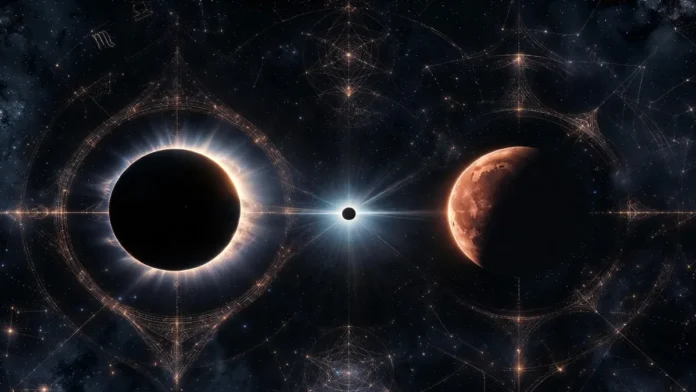
August Eclipses 2026 are attracting attention from both astronomers and followers of Vedic astrology, as a Total Solar Eclipse on August 12, 2026, and a Partial Lunar Eclipse on August 28, 2026 will occur within the same lunar fortnight. According to traditional Vedic astrology, when both a solar and lunar eclipse take place within approximately 15–16 days, it is considered an important celestial period, often referred to as an “Eclipse Season.”
According to Pandit Ajay Kaushik, such astronomical events have long been discussed in traditional Hindu astrology as periods that may symbolize change and transition. While eclipses are scientifically understood as predictable astronomical alignments of the Earth, Moon, and Sun, Vedic texts also associate them with symbolic interpretations related to society, governance, and individual life.
August 2026 Solar and Lunar Eclipse Schedule
According to the traditional Hindu Panchang:
Total Solar Eclipse
- Date: August 12, 2026
- Nakshatra: Ashlesha
- Moon Sign: Cancer (Karka)
- Indian Time: 11:17 PM (August 12) to 4:25 AM (August 13)
Partial Lunar Eclipse
- Date: August 28, 2026 (Raksha Bandhan)
- Nakshatra: Shatabhisha
- Moon Sign: Aquarius (Kumbha)
- Indian Time: 6:53 AM to 12:31 PM
According to available astronomical information, neither eclipse is expected to be visible from India. Since they will not be visible in India, traditional eclipse-related rituals such as Sutak are generally not observed under most Hindu traditions, although customs may vary among communities.
Why Are Two Eclipses in One Fortnight Considered Significant?
In astronomy, the occurrence of both a solar and lunar eclipse within a short period is known as an Eclipse Season, a natural phenomenon that occurs several times over an 18-month eclipse cycle.
According to Pandit Ajay Kaushik, Vedic astrology also considers such periods spiritually significant.
Traditional astrological interpretations suggest this period may symbolize:
- A time of transformation and change
- Greater emotional and psychological intensity
- Increased need for patience and thoughtful decision-making
- Opportunities for spiritual reflection and self-discipline
These interpretations are part of traditional astrological beliefs and should not be viewed as scientific predictions.
Traditional References from Brihat Samhita
Ancient Indian astronomical and astrological literature, including Brihat Samhita by Varahamihira, discusses eclipses and their symbolic interpretations.
Traditional texts associate eclipse periods with possibilities such as:
- Major political developments
- Administrative challenges
- Environmental disturbances
- Social and economic transitions
Modern science, however, does not establish a causal relationship between eclipses and earthquakes, storms, political events, or other societal developments.
The Story of Eclipses in Hindu Scriptures
The earliest mention of an eclipse appears in the Rigveda (Mandala 5, Sukta 40).
According to the hymn:
- The demon Svarbhanu covered the Sun in darkness.
- Sage Atri restored sunlight through his spiritual knowledge and hymns.
Later Hindu scriptures, especially the Bhagavata Purana (Canto 8), connect eclipses with the story of Rahu and Ketu, born during the churning of the cosmic ocean (Samudra Manthan).
According to the traditional narrative:
- Rahu periodically attempts to swallow the Sun and Moon.
- This symbolic act is represented as solar and lunar eclipses.
These stories are part of Hindu religious tradition and mythology.
What Do Astrologers Recommend During Eclipse Season?
According to Pandit Ajay Kaushik, many devotees observe spiritual practices during eclipse periods, including:
- Chanting “Om Namah Shivaya”
- Reciting the Mahamrityunjaya Mantra
- Reading sacred scriptures
- Meditation and self-reflection
- Charity and helping those in need
- Worship of Lord Shiva, especially during the sacred month of Shravan
These practices are based on traditional religious beliefs and are optional for followers.
Scientific Perspective
Astronomically, eclipses occur when the Sun, Earth, and Moon align in a straight line.
- A Solar Eclipse occurs when the Moon passes between the Earth and the Sun.
- A Lunar Eclipse occurs when the Earth passes between the Sun and the Moon, casting its shadow on the Moon.
Scientists emphasize that eclipses are predictable celestial events and do not directly cause natural disasters or influence human behavior.
Conclusion
August Eclipses 2026 bring together a rare combination of a Total Solar Eclipse and a Partial Lunar Eclipse within the same fortnight. While astronomy explains these events through celestial mechanics, Vedic astrology and Hindu scriptures regard them as spiritually meaningful periods for reflection, discipline, and devotion.
Whether viewed through science or tradition, these eclipses are expected to be among the most closely watched astronomical events of 2026.
__________________________________________________________________________________
Reference Links
For additional factual information, readers may refer to:
- NASA – Eclipse Explorer: https://science.nasa.gov/eclipses/
- NASA – Solar System Exploration: https://science.nasa.gov/solar-system/
- Time and Date – Eclipse Calendar: https://www.timeanddate.com/eclipse/
- Drik Panchang – Hindu Calendar & Panchang: https://www.drikpanchang.com/