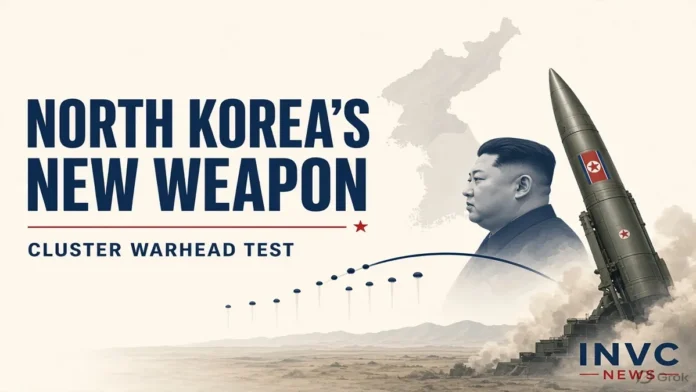
Seoul, November 1, 2026 : North Korea has tested a cluster-bomb warhead designed for tactical ballistic missiles, signalling another step in its efforts to expand the destructive capabilities of its missile forces. State media reported on Sunday that the test was conducted on Saturday, October 31, and assessed the warhead’s combat suitability and destructive power.
The development is significant because cluster munitions can disperse multiple smaller explosive devices across a wide area, potentially threatening military personnel, vehicles and infrastructure over a much larger footprint than a conventional single-explosion warhead.
According to North Korea’s Korean Central News Agency (KCNA), the country’s Missile Administration tested what it described as a Standard Type-2 cluster warhead. Pyongyang claimed that the weapon could devastate a target area measuring between 12 and 13 hectares at its highest reported density.
That area is equivalent to approximately 30–32 acres. However, the claimed performance has not been independently verified, and the announcement does not provide sufficient technical information to establish the weapon’s actual battlefield effectiveness.
60-Second Brief: What North Korea Has Announced
- North Korea tested a cluster-bomb warhead for tactical ballistic missiles on October 31.
- State media published details of the test on November 1.
- Pyongyang claims the Standard Type-2 warhead can affect an area of 12–13 hectares.
- General Kim Jong-sik reportedly supervised the test.
- North Korea says its cluster warheads fall into four categories.
- The country intends to make all four types available to military units by the end of 2026.
- South Korea says it tracked the relevant missile activity and maintained military readiness in coordination with the United States.
What Is a Cluster Warhead and Why Is It Dangerous?
A cluster munition is different from a conventional bomb that produces a single concentrated explosion.
It contains multiple smaller explosive devices, commonly known as submunitions. When the main munition opens in the air or releases its contents, these smaller devices spread across a wider area. They can then explode at different locations.
This design allows one weapon to affect multiple targets within a designated area. Depending on its construction and the conditions of use, a cluster warhead can threaten military formations, vehicles, equipment and other targets spread across a broad area.
But these weapons also carry serious humanitarian risks.
Some submunitions fail to explode when they land. Such unexploded devices can remain dangerous long after the fighting ends, effectively becoming a continuing threat to civilians.
Children, farmers and people returning to damaged homes or agricultural land can be particularly vulnerable. Even after a conflict has ended, unexploded submunitions may cause deaths and injuries for years.
North Korea Claims Four Types of Cluster Warheads
According to KCNA, North Korea’s Missile Administration has classified its cluster warheads into four categories based on their intended purposes.
A senior official from the administration reportedly said that military units would be equipped with all four types by the end of 2026. Units would then be able to select the appropriate warhead according to operational objectives and the characteristics of a target.
The announcement suggests that Pyongyang wants to move beyond individual weapons demonstrations and develop a broader range of warhead options for its tactical missile forces.
However, North Korea has not publicly provided a complete technical breakdown of the four categories, their specifications or the number of warheads expected to enter military service.
The latest test was reportedly supervised by General Kim Jong-sik, a member of the Workers’ Party of Korea’s Central Military Commission and first vice department director of the party’s Central Committee.
Hwasong-11 Ra and the April Cluster Warhead Test
The latest announcement follows another cluster-munition test reported by North Korea in April 2026.
At that time, Pyongyang said it had tested cluster-bomb and fragmentation-mine warheads mounted on the Hwasong-11 Ra tactical ballistic missile. Leader Kim Jong-un personally supervised that demonstration, according to North Korean state media.
North Korea claimed that the April test involved a target area of approximately 13 hectares at a distance of around 136 kilometres.
The Hwasong-11 series is associated with North Korea’s short-range tactical missile programme. Such systems are particularly relevant to the security environment on the Korean Peninsula, where military facilities and forces are concentrated within relatively short distances.
The October 31 test indicates that North Korea continues to explore different warhead configurations for its tactical missile systems.
Nevertheless, the publicly available information does not establish how many operational missiles have been equipped with these weapons or whether the latest warhead has completed all stages of military qualification.
South Korea Monitored the Latest Missile Activity
South Korea’s military said it had been monitoring the relevant activities before the latest launch.
According to the Joint Chiefs of Staff, the missile was detected being fired towards the Yellow Sea from an area near Chongju in North Pyongan Province. Seoul said it maintained a readiness posture while sharing information closely with the United States.
The launch is particularly important for South Korea because tactical missile systems equipped with cluster warheads could increase the threat to military facilities and personnel in the region.
The latest test also comes amid a broader series of North Korean weapons demonstrations.
On October 29, North Korea fired approximately a dozen short-range ballistic missiles from the Wonsan area towards the East Sea, according to South Korea’s military. The launches took place while German Chancellor Friedrich Merz was visiting South Korea.
These October 29 launches and the October 31 cluster-warhead test were separate events. Together, however, they underline the pace of North Korea’s recent military activity.
Russia Connection Adds to Regional Security Concerns
North Korea’s military modernisation has also drawn international attention because of its expanding defence cooperation with Russia.
Pyongyang has provided support to Moscow during the war in Ukraine, including the deployment of North Korean troops, according to reports from South Korean and Western officials.
The experience gained through involvement in a modern conflict has raised questions about whether North Korean forces are acquiring operational knowledge that could influence their military planning, training and weapons development.
However, it would be premature to conclude that the latest cluster-warhead test is a direct result of battlefield experience in Ukraine. North Korea has been pursuing missile and weapons development for years, and the latest announcement does not establish a direct link.
Why Cluster Munitions Face International Restrictions
Cluster munitions have been the subject of international concern because of their effects on civilians, both during and after armed conflicts.
The Convention on Cluster Munitions was adopted in Dublin in May 2008 and opened for signature later that year. It entered into force on August 1, 2010.
The convention prohibits states parties from using, developing, producing, acquiring, stockpiling or transferring cluster munitions, subject to the treaty’s provisions.
However, the treaty does not have universal membership. North Korea, the United States, Russia, China and South Korea are not parties to the convention.
This means the treaty’s specific prohibitions do not apply to these countries simply by virtue of the convention. Nevertheless, the use of cluster munitions remains subject to applicable international humanitarian law, including rules governing distinction, proportionality and precautions in attacks.
The humanitarian concern is especially serious when unexploded submunitions remain in populated areas or near agricultural land.
Trump Open to Talks With Kim, but No Meeting Scheduled
The latest weapons test comes at a time when diplomatic discussions over North Korea’s nuclear programme remain uncertain.
During trilateral discussions in Atlanta, the foreign ministers of South Korea, the United States and Japan reiterated their commitment to the complete denuclearisation of North Korea.
US Secretary of State Marco Rubio also said on October 31 that President Donald Trump remained open to meeting North Korean leader Kim Jong-un.
Rubio made clear, however, that no meeting had been scheduled. He said Trump would be willing to hold talks if Pyongyang was prepared to discuss issues of concern to Washington and its allies, including South Korea.
Trump and Kim held three meetings during Trump’s first presidential term, but those engagements did not produce a lasting agreement on North Korea’s nuclear programme.
The latest remarks indicate that Washington has not closed the door on diplomacy, even as Pyongyang continues to demonstrate its military capabilities.
What Happens Next?
The key question is whether North Korea will move from testing different cluster-warhead designs to deploying them across its tactical missile units.
Pyongyang has announced a target of making all four categories available to military units by the end of 2026. South Korea and the United States are likely to continue monitoring missile launches, weapons demonstrations and other developments that could affect regional security.
For now, the most important limitation is the lack of independent verification of North Korea’s claimed destructive range. The actual performance, reliability and operational status of the new warhead remain uncertain.
The Bottom Line: North Korea’s latest cluster-warhead test highlights its continuing effort to expand the capabilities of tactical ballistic missiles. The claimed ability to affect a 12–13-hectare area raises concerns for regional security, but the figures remain North Korean claims rather than independently confirmed performance data. With missile activity continuing and diplomatic engagement still uncertain, the Korean Peninsula remains under close international scrutiny.