
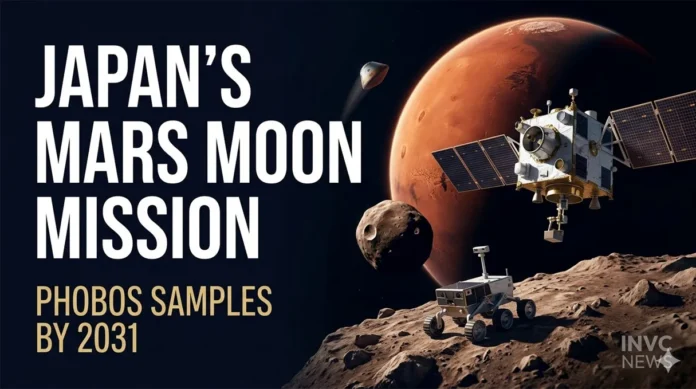
TOKYO | INVC NEWS | October 20, 2026 : Japan has launched an ambitious space mission designed to bring soil and rock samples from Phobos, one of Mars’ two moons, back to Earth by 2031. The Martian Moons eXploration (MMX) mission, led by the Japan Aerospace Exploration Agency (JAXA), is designed to investigate how Mars’ moons formed and reveal new clues about the evolution of the Red Planet and the early solar system.
The spacecraft lifted off aboard Japan’s H3 rocket from the Tanegashima Space Center. Over the next several years, it is expected to travel to the Martian system, study Phobos and Deimos, deploy a small robotic rover, collect material from Phobos and return a sample capsule to Earth.
What makes MMX particularly significant is not simply its destination. The mission must operate in an environment with extremely weak gravity, land on an unfamiliar surface, collect samples during carefully planned operations and transport the material across interplanetary distances. If successful, it will achieve the first sample return from a moon of Mars.
What Is Japan’s MMX Mission?
MMX stands for Martian Moons eXploration. The mission aims to investigate both Phobos and Deimos, the two small moons orbiting Mars, while concentrating its sample-collection operations on Phobos.
JAXA plans to bring back at least 10 grams of material from the moon. Although that amount may appear small, samples collected directly from another celestial body can provide scientists with information that remote observations alone cannot deliver.
The mission is expected to reach the vicinity of Mars in 2027, conduct detailed observations and sampling operations over the following years, and return its sample capsule to Earth in 2031.
The spacecraft will also observe Deimos during its journey through the Martian system. These observations could help scientists compare the two moons and better understand their relationship with Mars.
Why Is Landing on Phobos So Difficult?
Phobos is much smaller than Earth’s Moon. It has an irregular shape and measures approximately 22 kilometres across at its widest dimension.
Its gravity is extremely weak, making surface operations fundamentally different from those on Earth. A conventional wheeled robot cannot simply rely on the same assumptions used for vehicles operating on a planet with stronger gravity.
A spacecraft approaching Phobos must carefully control its descent and contact with the surface. A robot or lander could bounce, tip over or encounter difficulties on loose material and uneven terrain.
The challenge continues after landing. The mission must collect samples without destabilising the spacecraft or losing the material it intends to bring home.
MMX is designed to address these problems through a combination of surface reconnaissance, specialised sampling equipment, navigation systems and a dedicated sample-return capsule.
IDEFIX: The Four-Wheeled Rover Designed for a Tiny Moon
One of the mission’s most distinctive technologies is IDEFIX, a small rover developed through French and German cooperation.
The rover will be deployed on Phobos ahead of the main spacecraft’s sampling operations. Its purpose is to investigate the surface and help scientists understand the terrain before the larger spacecraft attempts to land and collect material.
IDEFIX is designed to operate in Phobos’ low-gravity environment, where ordinary movement and stability present unusual engineering challenges.
Its four-wheel configuration and self-righting capability are intended to help it recover if it ends up in an unfavourable orientation. Nevertheless, difficult terrain, loose material and obstacles could still complicate its operations.
The rover will move slowly while examining the surface, gathering information that can help scientists understand the physical characteristics of the landing area.
This reconnaissance is important because the main spacecraft must identify a suitable location for sampling. A poorly chosen landing site could increase the risk of damage or prevent the sampling equipment from operating as intended.
How Will the Rover Help the Main Spacecraft?
IDEFIX is more than a robotic vehicle designed to take pictures. It is also an important part of the mission’s risk-reduction strategy.
By observing the surface, the rover can help researchers assess the distribution of dust, rocks and uneven terrain. These observations will contribute to a better understanding of the conditions that the main spacecraft may encounter.
Phobos has never been explored through a successful surface sample-return mission. As a result, scientists must work with limited direct knowledge of its terrain and surface properties.
Information collected by the rover can help mission teams assess potential hazards and improve their understanding of the sampling environment.
This is particularly important when the spacecraft has limited opportunities to perform surface operations and must preserve the collected material for the long journey back to Earth.
The Two-Hour Sampling Challenge
JAXA’s mission plan includes a carefully controlled landing and sampling operation on Phobos. The main spacecraft is expected to make contact with the surface and collect material during a limited operational window.
The mission aims to recover at least 10 grams of samples using specialised collection techniques. The sampling process must be completed without compromising the spacecraft’s ability to leave the surface and continue the mission.
Low gravity makes the operation especially demanding. The spacecraft must manage its contact with the surface, operate its sampling equipment and secure the collected material for transport.
The samples will then be stored in a dedicated return capsule. That capsule must remain protected throughout the spacecraft’s journey back to Earth and survive the intense conditions of atmospheric re-entry.
Each stage depends on the successful completion of the previous one, making MMX a complex test of autonomous exploration and sample-return engineering.
How Will the Samples Reach Earth?
Returning the samples is one of the mission’s most important technological challenges.
After completing its observations and sampling operations, the spacecraft is scheduled to leave the Martian system in 2030. It will then begin a journey of approximately one year towards Earth.
During the mission, the spacecraft will also study Deimos, the second moon of Mars, before departing the region.
As the spacecraft approaches Earth, the sample-return capsule will separate and enter the atmosphere. JAXA plans to recover the capsule in Australia in 2031.
The capsule must protect the material during the return journey, withstand atmospheric re-entry and reach a recovery area where scientists can retrieve it for laboratory analysis.
A successful return would allow researchers to examine Phobos material using sophisticated instruments on Earth. These analyses could reveal chemical and mineralogical details that are difficult or impossible to establish using spacecraft instruments alone.
What Can Phobos’ Soil Reveal About Mars?
One of the biggest scientific questions surrounding Phobos and Deimos concerns their origins.
Scientists have proposed two major explanations.
The first is the giant-impact hypothesis. Under this scenario, a major collision involving Mars and another celestial body scattered material into orbit, from which the moons eventually formed.
The second is the captured-asteroid hypothesis. It suggests that Phobos and Deimos may have originated as asteroids that were captured by Mars’ gravity.
Analysing samples from Phobos could help scientists determine which explanation better fits the moon’s composition and geological history.
The material could also contain fragments or traces of substances originating from Mars itself. If such material is identified, it may provide additional information about the Red Planet’s surface and past geological processes.
Researchers will need to distinguish between material native to Phobos and material that may have arrived from Mars or other sources. Laboratory analysis will be essential to making those distinctions.
The findings could improve scientific understanding of how small moons form, how planetary systems evolve and how material moves between celestial bodies.
Why Japan’s Previous Sample-Return Missions Matter
Japan has already demonstrated its ability to collect material from asteroids and return it to Earth through its Hayabusa and Hayabusa2 missions.
That experience provides an important foundation for MMX. It includes knowledge of autonomous navigation, close approaches to small celestial bodies, sample collection and the safe return of collected material.
However, Phobos presents a different set of challenges. Its relationship with Mars, its surface conditions and the complexity of operating within the Martian system mean that previous success cannot guarantee the outcome of the new mission.
MMX must demonstrate technologies for travelling to the Martian system and completing a round trip, operating on a moon with extremely weak gravity and returning samples over interplanetary distances.
These capabilities could help advance future missions to other moons and small bodies throughout the solar system.
An International Effort Led by Japan
Although JAXA leads MMX, the mission involves international scientific and technological cooperation.
France and Germany have contributed to the IDEFIX rover, while NASA and other international partners are contributing scientific instruments, expertise and support.
This cooperation allows participating agencies to combine specialised engineering capabilities and scientific knowledge for a mission that would be difficult for any one organisation to undertake alone.
The project also represents a major step in the development of technologies needed for more complex planetary exploration.
Its objectives extend beyond the scientific study of Phobos. The mission is intended to improve the technologies required to reach planetary moons, conduct surface operations, collect samples and communicate reliably across deep-space distances.
How Does MMX Fit Into the Global Race for Sample Return?
Sample-return missions have become an important part of planetary science because they allow researchers to analyse material directly rather than relying solely on remote measurements.
China has also been developing a mission intended to return samples from Mars, while NASA has been evaluating ways to bring back samples collected by its Perseverance rover.
These efforts involve different targets, technical approaches and mission schedules. They nevertheless reflect a shared scientific objective: bringing material from other worlds into laboratories on Earth.
MMX stands out because its target is Phobos, a small moon whose origin remains uncertain. Rather than collecting samples directly from the Martian surface, the mission will investigate the material of a body that has evolved alongside Mars.
The results could help scientists understand both the history of the Martian system and the processes that shaped the early solar system.
What Happens Next?
Following its launch, MMX is expected to spend approximately a year travelling towards Mars. Once it reaches the Martian system, the spacecraft will conduct detailed observations of Phobos and prepare for surface operations.
The mission plan calls for the IDEFIX rover to investigate the surface before the main spacecraft carries out its sampling operations. The spacecraft will also observe Deimos before departing the Martian system.
The sample-return capsule is scheduled to reach Earth in 2031, with recovery planned in Australia.
These dates are mission targets rather than completed milestones. The spacecraft must successfully navigate each stage, operate in an unfamiliar environment and preserve the samples throughout the return journey.
The Bottom Line
Japan’s MMX mission is an ambitious attempt to solve a long-standing scientific mystery while demonstrating some of the most demanding technologies in robotic space exploration.
Its success will depend on more than reaching Phobos. The mission must deploy a rover in extremely weak gravity, investigate the surface, collect at least 10 grams of material and return that material safely to Earth.
If successful, MMX could provide crucial evidence about the origins of Mars’ moons and the evolution of the Martian system. It could also establish valuable capabilities for future missions to distant moons and other unexplored worlds.
For planetary science, the ultimate achievement would be bringing home a small sample of a little-known moon—and using it to answer much bigger questions about how our solar system formed.