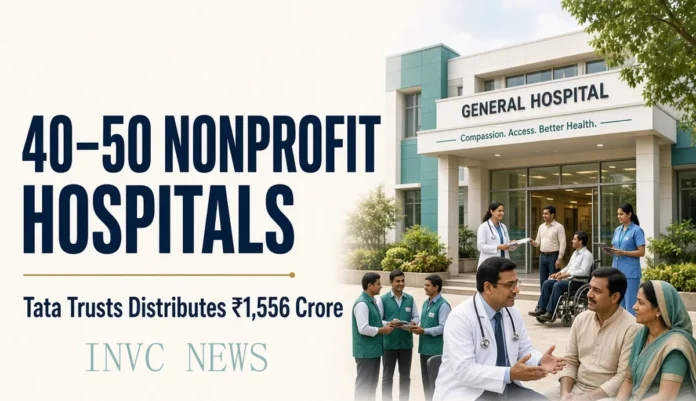
Mumbai, October 18, 2026: Tata Trusts is working towards establishing a network of 40 to 50 nonprofit general hospitals across India, with a proposed funding model designed to make quality healthcare more accessible to people who cannot afford treatment. Chairman Noel Tata outlined the plan in the organisation’s 2025–26 annual report, which also reported ₹1,556.31 crore in philanthropic disbursements during the financial year ended March 2026.
The proposed hospital network would follow a model in which payments from patients who can afford treatment help support care for those with limited financial means. However, the report does not specify the hospitals’ locations, the investment required or a timeline for establishing the network. <Entity value=”Tata Trusts” category=”organization” disambig=”Indian philanthropic organisation”/> is also placing greater emphasis on building long-lasting institutions and measuring the real-world impact of its social initiatives. <Cite refs={[“turn310087search0″,”turn310087search1”]}/>
A Healthcare Model Designed to Bridge the Affordability Gap
Access to affordable medical treatment remains a challenge for many families, particularly in rural and underserved areas. The proposed network seeks to address that gap by linking the ability to pay with access to quality care.
Under the model described by Noel Tata, patients who can afford treatment would help make healthcare accessible to those who cannot. The plan signals an ambition to expand healthcare delivery through nonprofit general hospitals rather than relying exclusively on grants to existing programmes.
The annual report, however, does not establish whether all 40–50 hospitals will be newly built, developed through partnerships or created using a combination of approaches. Details about locations, capacity, costs and implementation schedules have not yet been disclosed.
Five-Year Healthcare Strategy: 2026–2031
Alongside the proposed hospital network, Tata Trusts has outlined a five-year healthcare strategy covering 2026 to 2031. The plan sets out several targets intended to strengthen primary healthcare and improve services for underserved communities.
Key objectives include:
- Reaching approximately 25 lakh people across around 75 blocks.
- Strengthening more than 100 public health facilities.
- Extending primary healthcare services to 10 lakh older people.
- Training more than 20,000 healthcare workers.
- Improving the management of diabetes and hypertension.
These targets indicate that the organisation’s healthcare efforts will extend beyond hospital infrastructure to include prevention, early intervention, public health capacity and the management of chronic diseases.
Strengthening existing public facilities could also help improve access to basic services in areas where specialist care and medical infrastructure remain limited.
Tata Trusts Distributed ₹1,556.31 Crore in FY26
Tata Trusts reported total philanthropic disbursements of ₹1,556.31 crore during FY 2025–26. Rural development and livelihood initiatives received the largest allocation among the categories listed in the report.
The distribution included ₹1,353.32 crore for institutional grants and directly implemented projects, while ₹202.99 crore was provided as individual grants.
The reported allocations included:
- Rural development and livelihoods: ₹457.62 crore
- Education: ₹270.26 crore
- Cancer care: ₹178.46 crore
- Institutional support: ₹169.31 crore
- Healthcare services: ₹105.97 crore
Under individual grants, ₹143.30 crore went towards medical assistance and ₹59.38 crore towards education.
The figures show that the organisation’s philanthropic work spans several areas, including rural livelihoods, education, healthcare and direct support for individuals. The proposed hospital network is one part of a broader effort to strengthen institutions and expand access to essential services.
Cancer Care Programmes Report More Than 100,000 Outpatient Consultations
Cancer care remained another important component of Tata Trusts’ healthcare work during FY26.
According to the annual report, its cancer care programmes recorded 106,626 outpatient consultations, completed 24,874 chemotherapy cycles and carried out 2,879 surgeries during the financial year.
These figures provide a measure of the services delivered through existing programmes, while the organisation’s stated direction also includes strengthening distributed cancer-care models to bring treatment closer to patients’ homes.
For patients and families, access to treatment nearer to home can help reduce the practical and financial burden associated with repeated hospital visits. The extent of future expansion will depend on the programmes and partnerships developed under the organisation’s wider healthcare strategy.
Rural Livelihoods and Education Also Receive Support
Tata Trusts reported that its rural livelihood initiatives supported nearly four lakh families during FY26. Its education-related programmes reached approximately 21 lakh students across 13 states and Union Territories.
These programmes reflect the breadth of the organisation’s philanthropic activities beyond healthcare. Rural livelihood initiatives focus on supporting families and economic opportunities, while education programmes seek to extend learning opportunities across different regions.
The annual report places these activities within a wider approach that emphasises sustained outcomes rather than judging success solely by the amount of money distributed or the number of people reached.
Noel Tata Calls for Greater Focus on Lasting Impact
In his message accompanying the annual report, Noel Tata said philanthropic organisations should assess their work by the changes they create and whether those changes endure.
The emphasis is on moving beyond expenditure figures and beneficiary counts towards meaningful, measurable outcomes. It also reflects a stated intention to build institutions that can serve the country over the long term.
The report highlights the importance of coordination among governments, philanthropic organisations and other partners in achieving lasting social progress.
What Happens Next?
The proposed network of 40–50 nonprofit general hospitals is an important ambition, but several details remain outstanding. Tata Trusts has not yet disclosed the planned locations, project costs, hospital capacities or an implementation timeline in the annual report.
Those details will help clarify how quickly the network could take shape and how the proposed payment model will operate in practice. The success of the initiative will ultimately depend not only on the number of hospitals established, but also on the affordability, quality and reach of the services they provide.
The bottom line: Tata Trusts distributed ₹1,556.31 crore in FY26 and is working towards a nationwide network of 40–50 nonprofit hospitals. If implemented as envisaged, the model could help extend quality healthcare to patients who might otherwise struggle to afford treatment. The next key milestone will be clarity on funding, locations and implementation.