New Delhi, India | October 12, 2026
Could humanity face extinction before the end of this century? A new assessment by The Lancet Commission on 21st Century Global Threats to Health warns that nuclear conflict and the malicious use of artificial intelligence (AI) could pose existential threats to humanity by 2100.
The report identifies 17 major threats that could undermine human health and survival between 2025 and 2100. Other concerns include climate change, air pollution, antimicrobial resistance, childhood malnutrition, infectious disease outbreaks, obesity, armed conflict and declining international health assistance.
The assessment does not predict that humanity will inevitably become extinct by 2100. Instead, it examines severe but uncertain risks and emphasizes that governments have opportunities to reduce their impact through policy changes, scientific innovation and international cooperation. The findings were presented at the World Health Summit in Berlin in October 2026. Source: The Lancet Commission and World Health Summit
What Is the Lancet Commission’s Report?
The Lancet Commission on 21st Century Global Threats to Health brings together international experts in public health, science, economics, security and policy. Its assessment draws on historical evidence and risk modeling covering 204 countries and territories.
Researchers examined hundreds of possible threats before identifying 17 that could cause substantial health losses over the remainder of the century. The analysis compares plausible best-case and worst-case scenarios, using disability-adjusted life years (DALYs) to estimate the burden of illness, disability and premature death that could potentially be prevented.
The commission’s approach is intended to help governments identify where preventive action, funding and innovation could make the greatest difference. Its central message is that these threats should not be treated as isolated problems because they can reinforce one another.
Two Risks With the Potential to Threaten Human Existence
1. Malicious Use of Artificial Intelligence
The report identifies the malicious use of AI, including its potential role in developing biological weapons, as a threat with possible extinction-level consequences.
Advanced AI tools could make certain forms of biological research easier to carry out. If such capabilities were deliberately misused to create dangerous biological agents, the resulting outbreak could pose a serious international threat.
The commission does not suggest that AI will inevitably produce a pathogen capable of wiping out humanity. Rather, it highlights a high-consequence risk that warrants safeguards, responsible research practices and stronger oversight of advanced AI and AI-enabled biological design tools.
2. Nuclear Conflict and the Risk of Nuclear Famine
A large-scale nuclear war could cause devastation far beyond the areas directly affected by explosions.
Fires triggered by nuclear detonations could send smoke and soot into the upper atmosphere, potentially reducing the amount of sunlight reaching Earth’s surface. A resulting period of global cooling could disrupt agriculture, reduce food production and trigger widespread food shortages.
In an extreme scenario, the consequences could extend across national borders and threaten global food security on an unprecedented scale.
The commission identifies nuclear conflict as another threat with the potential to cause human extinction. Although the likelihood of such an outcome remains uncertain, the possible consequences make prevention and international risk reduction critical priorities.
What Are the Other 15 Global Threats?
Alongside nuclear conflict and the malicious use of AI, the assessment identifies 15 other major threats to human health and survival.
These include:
- Climate change
- Air pollution
- Antimicrobial resistance
- Childhood malnutrition
- Conventional armed conflict
- Declining international development assistance for health
- High alcohol consumption
- High blood pressure
- Income inequality
- Low educational attainment
- Naturally occurring pandemics
- Obesity
- Poor mental health
- Smoking
- Unhealthy aging
These threats differ in their causes and effects, but many are interconnected. For example, climate change can worsen food insecurity and disease risks, while inequality can limit access to healthcare and education. Conflict can damage health infrastructure and disrupt essential services.
The report uses DALYs to estimate preventable losses of healthy life. This measure includes years lost because of premature death and years lived with illness or disability. It should not be confused with a direct estimate of how many people will die or become extinct.
Why India Faces Multiple Risks
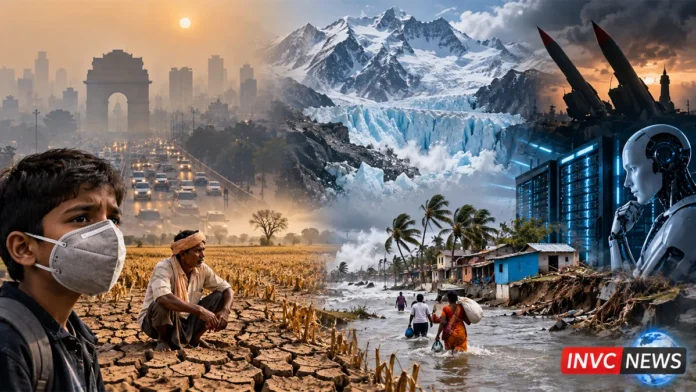
India faces a combination of environmental, public health and geopolitical challenges that could become more severe without effective preventive measures.
Air Pollution and Agricultural Practices
Fine particulate matter, particularly PM2.5, is a major public health concern across South Asia. In India, crop-residue burning contributes to seasonal pollution, alongside other sources such as transport, industry and household emissions.
Reducing pollution requires more than technological solutions. Effective enforcement, coordination between states, support for farmers and practical alternatives to crop burning are also important.
The challenge is to make cleaner practices economically workable while protecting public health and agricultural livelihoods.
Drought, Food Security and Policy Responses
Recurring droughts can place pressure on India’s farmers, rural communities and food systems. Public policies and food-management measures have helped the country avoid famine over recent decades despite repeated drought conditions.
However, past resilience does not guarantee protection against future crises. More intense weather extremes, water stress and agricultural disruption could increase risks to food availability and rural incomes.
Early-warning systems, resilient farming practices, reliable food distribution and long-term water management can help reduce the impact of droughts.
Climate Change, Heat and Public Health
India’s extensive coastline, Himalayan regions and large population dependent on climate-sensitive livelihoods make it vulnerable to several effects of climate change.
Rising sea levels threaten coastal communities, while changes in glaciers and mountain environments can create risks for water supplies and people living in high-altitude regions.
Extreme heat can also affect health, productivity and nutrition. Agricultural disruption may reduce rural incomes, while changing temperatures and rainfall patterns can influence the spread of diseases such as malaria and dengue in some areas.
Adaptation measures—including heat-action plans, stronger healthcare services, climate-resilient agriculture and improved disaster preparedness—will be important in reducing these risks.
Nuclear Conflict and AI-Enabled Biological Threats
India would not be insulated from the consequences of a major nuclear conflict or a severe biological emergency. Such threats can cross borders through environmental effects, disrupted supply chains, disease transmission and damage to food systems.
International cooperation, safeguards against the misuse of advanced technologies and measures to reduce the risk of armed conflict are therefore important for India’s security as well as global stability.
Three Recommendations to Reduce Catastrophic Risks
The commission proposes three broad priorities for governments and international institutions.
1. Build Health Systems That Can Prepare for Emergencies
Healthcare systems need the capacity to anticipate threats, prevent avoidable harm and maintain essential services during crises—not simply respond after emergencies occur.
This requires sustained funding, disease surveillance, emergency planning, trained personnel and systems that can continue functioning under pressure.
2. Increase Investment in Innovation and Strengthen Oversight
The report calls for greater investment in areas where existing solutions remain inadequate, including vaccines, new antibiotics, obesity treatments and technologies to address climate change and remove carbon dioxide from the atmosphere.
At the same time, advanced AI and AI-enabled biological design tools require appropriate governance and safeguards to reduce the risk of misuse.
The objective is to support beneficial innovation while managing technologies that could cause widespread harm.
3. Establish Better Monitoring of Global Threats
The commission recommends more systematic assessment of emerging risks, stronger tracking of scientific evidence and data, and clearer communication with political and security leaders.
Regular monitoring can help decision-makers recognize warning signs early, identify gaps in preparedness and act before threats escalate into major emergencies.
What Governments Should Do Next
The report also stresses the importance of long-term planning, public trust and international cooperation.
Governments and multilateral institutions should conduct regular risk assessments rather than focusing exclusively on immediate political priorities. Policies to reduce inequality, strengthen food systems and expand access to affordable, quality healthcare can help communities withstand multiple threats at once.
Because many risks cross borders, countries also need effective international coordination. No single government can independently manage the full consequences of a global pandemic, nuclear conflict or climate-related disruption.
A Warning, Not an Inevitable Prediction
The Lancet Commission’s assessment highlights the scale of the challenges that could shape human health and survival through 2100. Nuclear conflict and the malicious use of AI are identified as threats with possible extinction-level consequences, while climate change, pollution, disease and social inequalities could cause enormous preventable harm.
The report’s message is not that humanity is destined to disappear. It is that the choices governments, institutions and societies make today can influence how these risks develop over the coming decades.
Preventive action, responsible technological governance, stronger healthcare systems and international cooperation could help reduce the dangers and protect future generations.