By Team INVC | INVC NEWS
Published: October 10, 2026 | 12 : 16 PM IST
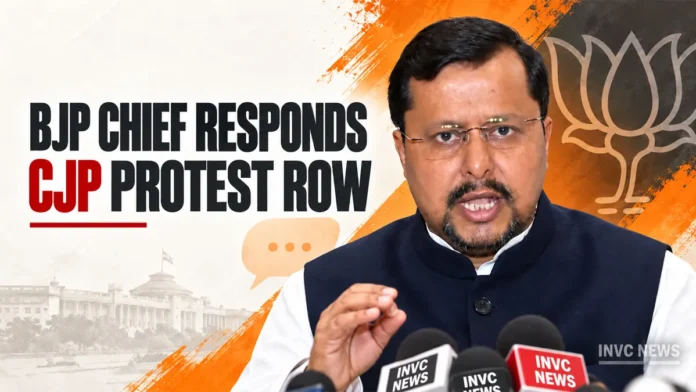
NEW DELHI, India | October 10, 2026 — Nitin Nabin’s CJP remarks escalated the political confrontation surrounding Saturday’s planned Delhi demonstration, with the BJP president accusing Rahul Gandhi and CJP leaders of attempting to destabilize India. He also alleged that foreign forces were influencing their campaign, without identifying those forces or presenting supporting evidence in the remarks reviewed for this report.
Speaking to reporters amid heightened security in the capital, Nabin said the government would respond firmly to attempts to create tension. He also said BJP workers would counter the opposition’s campaign among the public.
His intervention adds the ruling party’s response to a dispute that protesters describe as a fight over electoral integrity. The Cockroach Janta Party has demanded Chief Election Commissioner Gyanesh Kumar’s resignation over alleged voter-list irregularities and the Special Intensive Revision, or SIR.
BJP chief portrays protests as a campaign to destabilize India
Nabin accused two political groups of competing to create instability. He identified one with the INDIA bloc and Lok Sabha opposition leader Rahul Gandhi. He associated the other, CJP, with supporters of AAP leader Arvind Kejriwal.
That description reflects Nabin’s political characterization. It does not establish that Kejriwal controls the movement or that the groups share a single organizational structure.
The BJP president argued that the campaign threatened the peace needed for India’s development. He said the public would recognize the protesters’ intentions and prevent them from succeeding.
Meanwhile, protest organizers have framed their demands around the accuracy of electoral rolls and accountability at the Election Commission. The competing descriptions reveal the central divide: the protesters question electoral administration, while Nabin questions the purpose of their mobilization.
Foreign-influence allegation comes without named actors
Nabin alleged that opposition leaders were pursuing both political objectives and the interests of foreign forces.
However, he did not name a foreign government, organization or individual in the remarks reviewed. Nor did those remarks provide documents or other evidence establishing foreign direction of the campaign.
Consequently, the claim remains an allegation by the BJP president. It should not be read as a confirmed finding by an investigative agency.
The accusation broadens the confrontation beyond the immediate dispute over voter lists. It places the protesters’ motives at the center of the BJP’s response, alongside its criticism of their methods and language.
Nabin links opposition campaign to electoral setbacks
The BJP president argued that voters had rejected opposition leaders and that those leaders were unwilling to accept the outcome.
He accused them of responding to electoral defeats by attempting to disrupt the country rather than learning from the results. He also described challenges to the government’s mandate, made in the name of defending the Constitution, as an insult to voters.
These statements represent his assessment of the opposition’s conduct. They do not establish that everyone participating in the demonstration shares the motives he attributed to its leaders.
In addition, Nabin defended the government’s record under PM Modi. He said India continued to progress despite global crises and argued that opposition parties resented the country’s development.
BJP president criticizes language aimed at institutions
Nabin also objected to statements targeting constitutional institutions and people holding high public office.
He argued that India’s young people remained committed to the Constitution, democracy and Indian culture. Therefore, he said, they would reject language that he considered disrespectful toward those institutions.
His comments followed Rahul Gandhi’s Saturday post predicting the departure of Kumar and the central government, after which, Gandhi said, the “repair of democracy” would begin.
That message expressed a political prediction. It did not announce Kumar’s resignation or a change of government.
Government warning accompanies police restrictions
Nabin said the government would deal strictly with efforts to create tension. However, his statement did not specify a new legal measure or announce particular charges against the people he criticized.
Delhi Police had already denied permission for the proposed Jantar Mantar gathering. Officers subsequently detained protesters and movement leaders as security checks and travel restrictions affected parts of the capital.
Meanwhile, CJP issued a briefing urging supporters to remain peaceful, respect barricades and avoid damaging property. It also condemned detentions and demanded the release of those held.
Two competing claims shape the confrontation
Nabin’s remarks position the BJP’s response around stability, electoral mandates and respect for institutions. The protesters, in contrast, seek scrutiny of electoral-roll decisions and Kumar’s role.
Neither side’s political statements alone settle the underlying allegations. Those questions depend on supporting evidence, official explanations and any formal proceedings.
For now, Nabin’s warning marks a sharper ruling-party response to the protest campaign. His foreign-influence claim remains unsubstantiated in the remarks reviewed, while the dispute over electoral administration continues.