
By Team INVC | INVC NEWS
Published: October 8, 2026 | 07 : 51 AM IST
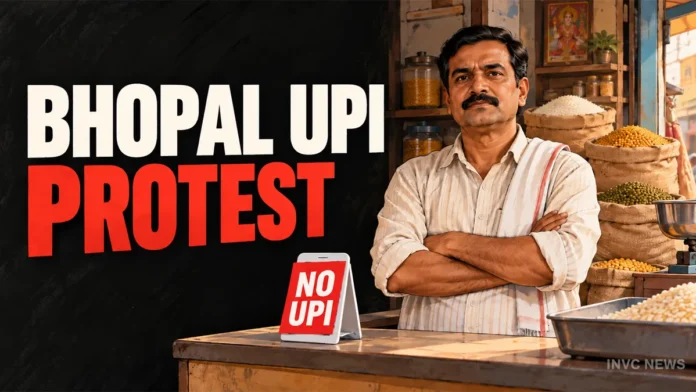
BHOPAL, India | October 8, 2026 — Bhopal No UPI Day could change how shoppers pay at participating stores in the Hanumanganj-Jumerati market today. A local rice and pulses traders’ association has urged merchants to decline UPI payments on October 8 as a symbolic protest against merchant discount rate charges.
The appeal concerns payment acceptance at participating shops. It does not establish a nationwide UPI shutdown, a banking restriction, or a technical failure of payment applications.
For customers, the immediate step is straightforward: confirm how a shop will accept payment before placing an order or completing a purchase.
Why Traders Have Called the Protest
According to local reporting, the rice and pulses traders’ association in Hanumanganj-Jumerati has called the demonstration to seek reconsideration of MDR-related decisions.
Vivek Sahu, general secretary of the Bhopal Kirana Vyapari Mahasangh, said payment charges could add to the financial burden on small and medium traders. He described UPI as a convenient payment method and the protest as a peaceful way to communicate merchants’ concerns to the government.
However, an association’s appeal does not confirm that every shop will participate. Customers should check with individual sellers rather than assume uniform payment arrangements across the market.
What MDR Means for Merchant Payments
MDR stands for merchant discount rate. It refers to a payment-processing charge within the merchant payment ecosystem.
In its September 15 clarification, the Ministry of Finance described a 0.4% MDR for specified person-to-merchant UPI payments above ₹2,000, with a ₹300 cap for transactions of ₹75,000 or more.
The ministry said person-to-person transfers, merchant payments up to ₹2,000, and qualifying small-merchant transactions would remain free. It also said merchants must not pass MDR charges on to customers.
That distinction matters: a merchant-side processing charge does not mean every customer must pay an additional fee whenever they scan a QR code.
Rollout Timing Remains a Separate Question
The Financial Express reported on October 8 that authorities may defer the planned October 15 rollout to January 1, 2027.
However, the report cited people familiar with the matter and said no final decision had taken place. A possible delay should therefore remain a reported possibility until an official announcement confirms it.
Meanwhile, today’s local protest is a separate event. Its date does not establish that a new charge begins on October 8.
What Shoppers Should Do Before Buying
First, ask the seller whether the shop accepts UPI today. If it does not, ask which alternative payment method it accepts.
Next, confirm the final bill and request a receipt. If you plan to make a large purchase, discuss payment arrangements before the seller prepares or dispatches the goods.
Also, carry only the cash you reasonably need. A local protest does not justify an assumption that you will lose access to all digital payments.
For a delivery order, confirm payment instructions directly with the business through its usual contact channel. This can prevent confusion when the goods arrive.
If a Payment Is Already Pending
A shop declining new UPI payments and an earlier transaction showing “pending” are different situations.
If you have already initiated a payment, check its status in your payment app and your bank account before paying again. Ask the seller to check its records as well, and keep the transaction reference.
Avoid relying on a screenshot alone to settle a disagreement. Clear records help both sides identify whether the payment succeeded, failed, or still requires follow-up.
Check the Location Before Forwarding the News
A message saying “UPI is closed today” removes the detail that makes this story useful: the local traders’ appeal and its intended area.
When sharing the update, include Bhopal, the Hanumanganj-Jumerati market, and October 8. That gives shoppers practical context without suggesting a nationwide service interruption.
The protest’s actual impact will depend on participation. Until on-the-ground reporting establishes its extent, the accurate description remains a call for participating traders to decline UPI payments.