
By Team INVC | INVC NEWS
WASHINGTON, United States | October 6, 2026 —
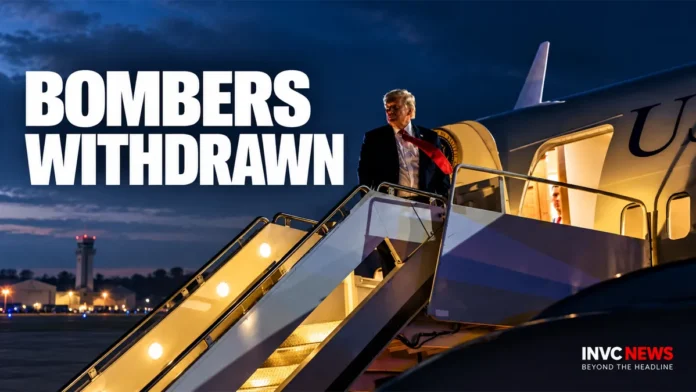
US bombers at RAF Fairford have returned to their home stations after a security scare, and President Donald Trump says Washington knows who made the threats. Speaking Monday, Trump suggested an Iranian connection and warned of consequences. However, he did not publicly identify those responsible or disclose supporting evidence. The withdrawal raises a consequential question: how will the United States protect its overseas aircraft while maintaining military options against Iran?
INVC NEWS | BEYOND THE HEADLINE
THE 60-SECOND BRIEF
- The Pentagon confirmed Sunday, October 4, that all US bombers deployed to RAF Fairford had returned to their home stations in the United States.
- Trump said Monday that threats prompted the move.
- He claimed Washington knows the people responsible and suggested links to Iran.
- His remarks did not publicly establish those identities or the alleged connection.
- The withdrawal follows a security investigation involving the British airbase.
- Moving aircraft does not, by itself, establish that US strike operations have ended.
What Happened: Bombers Returned to the United States
A Pentagon official confirmed that the bombers deployed to RAF Fairford had returned to their US home stations.
The aircraft movements followed an investigation into a suspected plot involving the base. However, confirmation of the redeployment does not independently establish every reported detail about the threat.
RAF Fairford is a Royal Air Force installation in Gloucestershire, England, that hosts US Air Force operations. Describing it simply as an American-owned base would obscure that distinction.
The facility has supported American bomber deployments and recent operations against Iran, according to published reporting.
Who Did Trump Threaten?
Trump directed his warning at the people he said had made threats against the American aircraft.
“We actually know the people that made the threat,” he told reporters, according to published accounts of his remarks.
He also suggested that those people had links to Iran. Nevertheless, he did not publicly name them or explain how US authorities had reached that assessment.
Therefore, the available statement does not allow readers to identify a specific person, organization, or Iranian official as responsible.
The distinction matters: a presidential assertion about intelligence is different from evidence presented publicly or findings established through an investigation.
What Remains Unclear About the Threat
Trump declined to provide details about the nature of the threat, including whether it involved drones.
Reports describing a suspected attack plot require careful attribution. They should not become a claim that an attack occurred or that investigators have established every participant’s role.
Likewise, the return of the bombers does not prove that the base’s defenses failed. Commanders can reposition aircraft as a precaution while authorities continue investigating.
The public account leaves important questions unanswered, including the precise threat, its credibility, and its relationship to the earlier security incident.
What Each Side Says
Trump linked the withdrawal to threats and suggested an Iranian connection.
The Pentagon confirmed the aircraft movements while emphasizing that the US bomber force retains the ability to carry out long-range operations, including missions originating in the United States.
Reporting also records Iran’s denial of involvement in the alleged plot. That denial and the American accusations remain competing positions; neither should replace the need for verifiable evidence.
The deployment announcement establishes where the aircraft returned. It does not settle responsibility for the suspected threat.
Why RAF Fairford Matters
An overseas operating location can support aircraft positioning, maintenance, and mission preparation closer to a potential theater of operations.
Consequently, relocating bombers changes their deployment arrangement. However, it does not automatically remove their military capabilities.
Long-range aircraft can operate from other locations, subject to the requirements of a particular mission. The Pentagon’s statement indicates that Washington continues to maintain that option.
Any claim that the withdrawal either guarantees another attack or rules one out would go beyond the announced facts.
The Iran Remarks Came at Different Times
Separately, Trump said Saturday, October 3, that he faced further decisions concerning Iran and contrasted an easier approach with a harder one.
Those remarks preceded his Monday comments about threats at Fairford. Combining them into a single exchange would distort the sequence.
His description of Iran as devastated also represents his assessment. It does not provide an independently measured account of the country’s military condition.
The statements show continued pressure from Washington, but they do not specify a new operation, target, or timetable.
What Happens Next
The next significant developments would include an official investigative update, evidence concerning responsibility, or a further deployment announcement.
Readers should distinguish confirmed movements from speculation about future strikes. Aircraft returning home is a verifiable event; the purpose and timing of any subsequent operation require separate confirmation.
INVC NEWS Bottom Line
Trump threatened consequences for unnamed people he accused of threatening US bombers in Britain. The Pentagon confirmed their return to the United States.
The aircraft movement is established. The identities, alleged Iranian links, and precise nature of the threat remain matters requiring further public evidence.