By Team INVC | INVC NEWS
NEW DELHI, India | October 2, 2026 —
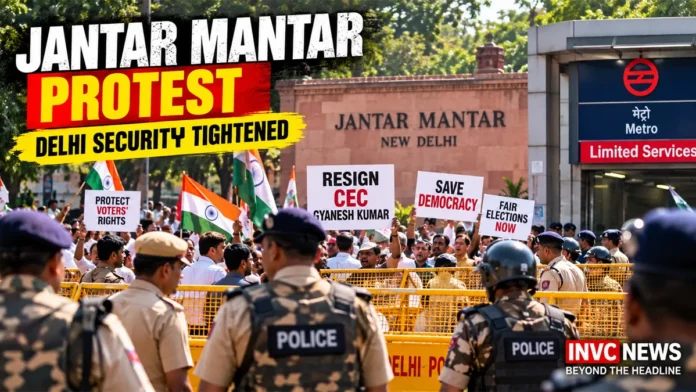
A political confrontation over India’s electoral rolls spilled onto the streets of central Delhi on Friday as protesters demanding the resignation of Chief Election Commissioner Gyanesh Kumar attempted to gather at Jantar Mantar despite police denying permission for the demonstration.
AAP Delhi chief Saurabh Bharadwaj was detained after reaching the protest area, along with several other demonstrators, as police tightened security around Jantar Mantar.
But the immediate impact extends far beyond the protest site.
Entry and exit facilities at 11 Delhi Metro stations were closed until further notice, prohibitory orders under Section 163 of the Bharatiya Nagarik Suraksha Sanhita (BNSS) remained in force, and traffic movement was regulated across key parts of central Delhi.
For commuters, the message is immediate: travel through central Delhi could face disruption.
For Indian politics, however, the stakes are much larger.
The confrontation is the latest escalation in a widening dispute over electoral-roll revisions, voter deletions and the functioning of the Election Commission — allegations the protesters and opposition groups are raising while the poll body has defended the need for electoral-roll verification.
THE 60-SECOND BRIEF
What happened: Protesters attempted to gather at Jantar Mantar demanding the resignation of Chief Election Commissioner Gyanesh Kumar.
Who was detained: AAP Delhi chief Saurabh Bharadwaj was among those detained by police.
Was the protest authorized? Delhi Police said permission had not been granted for a protest or march at Jantar Mantar.
What restrictions are in force? Section 163 of the BNSS is in force in New Delhi, restricting unauthorized gatherings, demonstrations and processions.
Metro impact: Entry and exit at 11 Delhi Metro stations were closed until further notice.
Can passengers still interchange? Interchange facilities remained available at several major stations despite entry and exit restrictions.
Why are protesters targeting the CEC? Organizers and opposition groups are raising allegations over electoral-roll revisions, voter deletions and the Election Commission’s handling of the Special Intensive Revision process.
What does the Election Commission say? The Commission has maintained that intensive verification is necessary to protect the integrity of electoral rolls, including addressing duplicate entries and verifying voter eligibility.
Why Jantar Mantar Became a Security Zone
The confrontation had been building before protesters reached central Delhi.
Delhi Police said no permission had been granted for the proposed demonstration at Jantar Mantar.
Police and additional security personnel were deployed around the area, while barricades and movement restrictions were put in place.
Officials cited public safety, public order and traffic management while enforcing the restrictions.
Section 163 of the BNSS remained in force in New Delhi.
Under the restrictions, unauthorized gatherings, demonstrations, processions, sit-ins and other specified activities can be prohibited.
That set up an immediate confrontation.
The protesters wanted to demonstrate against the Election Commission.
Police said the gathering was not authorized.
Saurabh Bharadwaj Detained
AAP Delhi chief Saurabh Bharadwaj reached Jantar Mantar to join the protest and was subsequently detained by police.
Several other protesters were also detained as authorities moved to prevent an unauthorized gathering from taking shape.
Bharadwaj and his party have backed the demand for greater accountability from the Election Commission.
AAP members were not alone.
Student and youth organizations, activists and political figures had also announced participation or support for the protest.
Groups associated with the demonstration included the All India Students’ Association (AISA), Students’ Federation of India (SFI), Democratic Youth Federation of India (DYFI), Indian Youth Congress and AAP, among others.
Rajya Sabha MP Manoj Jha and senior lawyer Prashant Bhushan had also been associated with calls surrounding the demonstration.
Why Are Protesters Demanding Gyanesh Kumar’s Resignation?
This is the central political question behind the scenes at Jantar Mantar.
Protest organizers and opposition leaders have raised allegations concerning the Special Intensive Revision, or SIR, of electoral rolls and voter deletions.
They argue that questions surrounding the revision process require greater transparency and accountability from the Election Commission.
Some opposition leaders have alleged that legitimate voters have been removed or placed at risk of exclusion.
Those remain political and institutional allegations and should not be treated as established proof that the Election Commission manipulated electoral rolls.
The Election Commission has defended electoral-roll verification as part of its constitutional responsibility to maintain accurate voter lists.
Its stated rationale for intensive revision includes verifying voter eligibility and addressing issues such as duplicate registrations, deaths and voters who have permanently shifted residence.
That distinction is critical.
The protest is not evidence that the allegations against the Election Commission have been established. It represents a political and civic challenge to the Commission’s handling of the electoral-roll process.
11 Delhi Metro Stations Hit by Entry-Exit Restrictions
For thousands of Delhi commuters, the most immediate consequence is transportation disruption.
Entry and exit facilities were closed at the following 11 Metro stations:
- Janpath
- Patel Chowk
- Central Secretariat
- Rajiv Chowk
- Seva Teerth
- Mandi House
- Lok Kalyan Marg
- INA
- Chawri Bazar
- Ramakrishna Ashram Marg
- New Delhi
The restrictions were announced until further notice.
However, interchange facilities remained available at designated major interchange stations, allowing passengers already inside the Metro network to switch lines where permitted.
That distinction matters for commuters.
A station being closed for entry and exit does not necessarily mean trains have stopped passing through it or that every interchange function has been suspended.
Central Delhi Traffic Also Affected
Road travel is also facing disruption.
Delhi Traffic Police announced restrictions and regulated movement around Jantar Mantar and adjoining areas.
Affected stretches include areas around Connaught Place, Patel Chowk, Parliament Street, Tolstoy Marg and Jantar Mantar Road.
Traffic may be diverted or regulated depending on security conditions.
Commuters have been advised to avoid affected stretches wherever possible and plan their journeys in advance.
Anyone traveling through central Delhi should therefore allow additional time and remain prepared for route changes.
Why Section 163 Matters
The use of Section 163 adds another layer to the confrontation.
The provision allows authorities to impose restrictions when they believe urgent measures are necessary to prevent danger, disturbance of public order or other specified risks.
Delhi Police said the provision was already in force in New Delhi and stressed that unauthorized protests, marches and sit-ins would not be permitted.
Protesters and their supporters, meanwhile, have framed their mobilization around democratic accountability and the right to raise questions about the electoral process.
That creates two competing issues at the center of the story:
the state’s responsibility to maintain public order and citizens’ ability to engage in political protest.
The immediate legal question at Jantar Mantar concerns whether the gathering had authorization under the restrictions in force.
The wider political argument goes much further.
The SIR Dispute Is the Real Story Behind the Barricades
The barricades, detentions and Metro restrictions are the visible part of the story.
The deeper dispute concerns India’s electoral rolls.
The Election Commission has undertaken Special Intensive Revision exercises as part of its voter-list verification process.
The Commission has previously stated that population movement can lead to repeated registrations when voters relocate and register at a new address without deletion of their earlier entry.
Its framework also provides procedures for identifying electors who may have died, shifted residence or appeared as duplicate registrations.
Opposition parties and critics, however, have challenged aspects of the process and raised concerns about legitimate voters potentially losing their place on electoral rolls.
That is why a technical exercise involving voter databases has developed into a major political issue.
The argument is ultimately about something every voter understands:
Who gets to remain on the electoral roll — and how is that decision verified?
Why This Matters to Ordinary Voters
It can be tempting to see the Jantar Mantar confrontation as another political protest.
That would miss the larger issue.
Electoral rolls determine who is registered to vote.
An inaccurate list can create problems in two directions.
If ineligible or duplicate entries remain, questions arise about electoral integrity.
If eligible voters are wrongly removed, citizens could face barriers to exercising their right to vote.
That is why both accuracy and due process matter.
And it is why the political fight over SIR has moved beyond administrative procedure into a broader national debate over voter rights, transparency and trust in electoral institutions.
Protest Pressure Spreads Beyond Delhi
The agitation is not confined to Jantar Mantar.
Demonstrations and political mobilization over the Election Commission and voter-roll controversy have also been planned elsewhere, while opposition groups are attempting to expand the issue nationally.
That means Friday’s confrontation in Delhi may represent one stage of a broader political campaign rather than an isolated protest.
The coming days will therefore be important.
Opposition parties will seek to maintain pressure.
The Election Commission will face demands to defend its procedures and public confidence in the revision process.
Authorities, meanwhile, will have to manage demonstrations while enforcing public-order restrictions.
WHAT EACH SIDE SAYS
Protesters and opposition groups: They allege serious problems with electoral-roll revisions and voter deletions and are demanding accountability from the Election Commission, including the resignation of CEC Gyanesh Kumar.
Election Commission: The Commission’s documented position is that intensive verification is necessary to protect the integrity of electoral rolls, including identifying duplicate registrations and verifying voter eligibility.
Delhi Police: Police said permission had not been granted for the Jantar Mantar protest and that Section 163 restrictions were in force.
These positions should not be conflated.
The existence of allegations does not establish wrongdoing, while the Election Commission’s defense of its process does not by itself resolve the concerns raised by critics.
The dispute ultimately turns on evidence, procedures, transparency and legal scrutiny.
WHAT HAPPENS NEXT
Three developments now deserve close attention.
First, whether authorities restore normal entry and exit operations at the 11 affected Metro stations.
Second, whether additional protests or detentions follow in Delhi and other cities.
Third — and politically most important — whether the confrontation produces a substantive response from the Election Commission to the specific allegations being raised by protest organizers and opposition parties.
The streets around Jantar Mantar may return to normal quickly.
The dispute over electoral rolls is unlikely to disappear as easily.
INVC NEWS BOTTOM LINE
The Jantar Mantar confrontation is bigger than the barricades surrounding central Delhi.
Saurabh Bharadwaj’s detention, Section 163 restrictions and the closure of entry and exit facilities at 11 Metro stations make the immediate story significant for anyone moving through the capital.
But the national significance lies elsewhere.
Opposition parties, student organizations and activists are challenging the Election Commission over electoral-roll revisions and demanding CEC Gyanesh Kumar’s resignation. The Election Commission, meanwhile, has defended intensive verification as necessary for maintaining accurate and credible voter lists.
For voters, the central question is not which side can generate the loudest protest. It is whether India’s electoral rolls can remain accurate, transparent and trusted while ensuring that every eligible citizen retains the ability to vote.
That is why what is happening at Jantar Mantar matters far beyond Jantar Mantar.