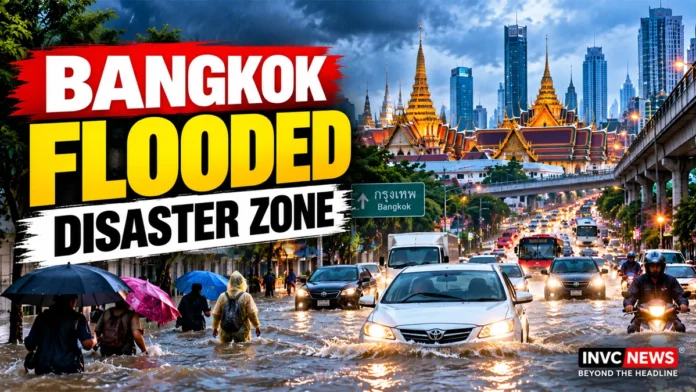
BANGKOK, Thailand | September 29, 2026 — Bangkok may have escaped the worst of the rain, but the emergency is far from over.
Large parts of Thailand’s capital remain waterlogged after extraordinary rainfall overwhelmed roads, canals and drainage systems, while authorities warn that standing water could take another two to three days to clear if the weather remains favorable.
All 50 districts of Bangkok have been placed under disaster-affected status, thousands of residents have moved into temporary shelters, and the flood crisis has expanded far beyond the capital.
Across Thailand, hundreds of thousands of households have been affected.
And across the border in southern Myanmar, floods and landslides have killed residents, buried homes and left dozens of people missing in areas where rescue teams are struggling to gain access.
For travelers, residents and businesses, the immediate question is no longer how much rain fell.
It is how long the disruption will last—and whether another round of rain could reverse the fragile improvement.
THE 60-SECOND BRIEF
Bangkok: All 50 districts are under disaster-affected status.
Rainfall: Nearly 300–320 mm fell across parts of the capital during roughly two to three days.
Bangkok impact: Thai government updates say hundreds of thousands of residents have been affected.
Shelters: Thousands of people have moved into evacuation centers.
Thailand: Authorities have reported flood deaths in several provinces, although casualty figures are still being updated.
Myanmar: Floods and landslides in the southern Tanintharyi region have killed people and left roughly 20–30 missing, according to rescue groups.
Today’s outlook: Thailand’s government says Bangkok’s standing floodwater could take another two to three days to clear if significant new rain does not return.
Bangkok Is a Disaster Zone — But What Does That Mean?
Bangkok authorities declared the capital a disaster-affected area after prolonged rainfall pushed canals beyond their capacity and flooded roads, homes and businesses.
The designation covers all 50 districts.
It does not mean the entire city is underwater.
Instead, the declaration gives authorities greater flexibility to coordinate emergency operations, mobilize equipment, provide relief and support evacuations in the hardest-hit communities.
Eastern and low-lying districts have suffered some of the most persistent flooding.
Residents in several neighborhoods have had to move through knee- or waist-deep water, while vehicles have been stranded and ground-floor homes damaged.
Nearly a Month’s Rain Arrived in Days
Bangkok normally deals with heavy rain during the September monsoon.
What made this episode particularly disruptive was how much rain arrived in a compressed period.
Authorities reported close to 300 mm or more of rainfall over roughly 48 hours, with some assessments placing the total near 320 mm over the wider rain event.
That was enough to overwhelm drainage systems and fill major canals.
Once the canals were full, water from streets and residential areas had nowhere to move quickly.
The problem therefore continued even after rainfall began easing.
Water Could Take Another Two to Three Days to Clear
There is some encouraging news Tuesday.
The Thai government said standing floodwater in Bangkok could be drained within two to three days, provided the city does not receive significant additional rainfall.
Heavy rain was not expected immediately, according to the government’s latest assessment.
Officials are continuing to pump water from affected districts and lower levels in major canals.
However, neighborhoods close to waterways and other low-lying areas may take longer to recover.
That means residents should not assume that improving skies automatically mean the flood emergency has ended.
Hundreds of Thousands Affected in Bangkok
The scale of the disruption has grown dramatically as authorities update their assessments.
A Thai government update on September 28 estimated that about 700,000 people in Bangkok had been affected by the flooding.
Thousands have relied on evacuation centers, while city authorities have also moved vulnerable and bedridden residents to medical facilities.
Emergency teams have been distributing food, drinking water and other essential supplies.
High-clearance vehicles, boats and pumping equipment have been deployed in affected areas.
Flood Crisis Extends Across Thailand
Bangkok is only one part of Thailand’s flood emergency.
The Department of Disaster Prevention and Mitigation reported flooding across Bangkok and dozens of provinces.
A September 28 government snapshot listed approximately 1.79 million residents and more than 576,000 households affected across Bangkok and 27 provinces.
Other nationwide assessments covering the broader period since September 16 have included even more provinces.
Water levels have been rising in some areas while beginning to fall in others.
That uneven picture means Thailand is dealing with several different flood situations at the same time.
How Many People Have Died in Thailand?
The casualty count requires careful attribution because official and media updates have changed as new information has arrived.
Thailand’s Department of Disaster Prevention and Mitigation reported eight deaths through Monday, including fatalities in Sa Kaeo, Chanthaburi and Saraburi.
That official update said no deaths had been recorded in Bangkok at that stage.
However, an Associated Press report published Tuesday cited a later nationwide toll of at least 12 deaths, including two in Bangkok.
Because these figures come from different reporting times, the safest conclusion is that the toll remains fluid and may be revised again as authorities complete assessments.
INVC NEWS is therefore not treating any single changing figure as the final death toll.
Myanmar Faces an Even Harder Rescue Operation
The same regional weather system has also brought severe flooding and landslides to southern Myanmar.
The Tanintharyi region, including areas around Dawei and Launglon, has been particularly hard hit.
Local rescue workers said villages had been cut off by damaged roads, floodwater and landslides.
At least eight bodies were reported recovered in Launglon in one rescue-group account, while other local assessments suggested the death toll across the wider region could be higher.
Between 20 and 30 people have also been reported missing.
Some local organizations have put the wider death toll at 10 or more, but Myanmar authorities have not provided a single comprehensive official figure.
That uncertainty matters.
Myanmar’s ongoing civil conflict has made it much harder for rescue organizations to reach affected communities and independently assess the scale of the disaster.
Landslide Sweeps Through Village
One of the most serious incidents reported in southern Myanmar involved a landslide striking a village in Launglon township.
Local rescuers said homes were buried and several victims included young people who had gathered at a monastery.
Search teams continued looking for missing residents, but access remained difficult.
Some villages could reportedly be reached only on foot.
Hundreds of displaced people have taken shelter in monasteries and other temporary locations.
Is Bangkok Safe for Travelers?
Bangkok remains open, but travel conditions vary sharply by neighborhood.
The city’s main airport has remained operational, although flooding and transport disruption can make journeys to and from terminals considerably slower.
Visitors should allow additional travel time and avoid attempting to drive through flooded streets.
Several government and immigration services have also been affected by special holidays and temporary closures on September 28 and 29.
Public transport conditions are improving in some areas, but localized flooding can change routes quickly.
For anyone already in Bangkok, the most important advice is simple: check the condition of the specific neighborhood and route, not just the citywide forecast.
The Economic Cost Is Already Rising
The flood has also become an economic story.
An economist cited in recent assessments estimated Thailand’s nationwide flood damage at at least 11 billion baht, or roughly $327 million, with the figure potentially rising.
Bangkok itself could account for billions of baht in losses.
Retail businesses, transportation, logistics, tourism and households have all been affected.
For small businesses in flooded neighborhoods, even a few days without customers can create significant losses.
Why Bangkok Is So Vulnerable
Bangkok faces a structural flood problem.
Much of the city sits on a low-lying river delta only slightly above sea level.
Its dense urban development, high rainfall, canal network and land subsidence make drainage difficult during extreme downpours.
That means even after rainfall stops, the city still needs somewhere to move enormous volumes of water.
The current crisis is therefore not only a weather story.
It is also a test of how one of Southeast Asia’s largest cities manages increasingly intense urban flooding.
What Happens Next
Three things matter most now.
First, whether Bangkok can drain standing water within the government’s two-to-three-day estimate.
Second, whether additional heavy rain returns before canals and reservoirs have enough capacity.
Third, whether rescuers in southern Myanmar can reach communities that remain cut off and determine the true number of dead and missing.
Thailand’s Cabinet is also expected to consider longer-term flood prevention and recovery measures.
For Bangkok, the immediate emergency may be easing.
For the wider region, however, the disaster is still unfolding.
INVC NEWS Bottom Line
Bangkok’s rain may be easing, but the flood crisis has entered its most important phase: getting people home, draining neighborhoods and preventing another downpour from undoing that progress.
All 50 districts of the Thai capital remain covered by disaster-affected status, hundreds of thousands of people have been impacted, and authorities say complete drainage could still take days.
Beyond Bangkok, Thailand is counting fatalities and widespread damage.
In neighboring Myanmar, floods and landslides have created an even more uncertain emergency, with deaths confirmed, dozens reported missing and rescue teams struggling to reach isolated communities.
The rain may be moving on. The human and economic consequences are not.