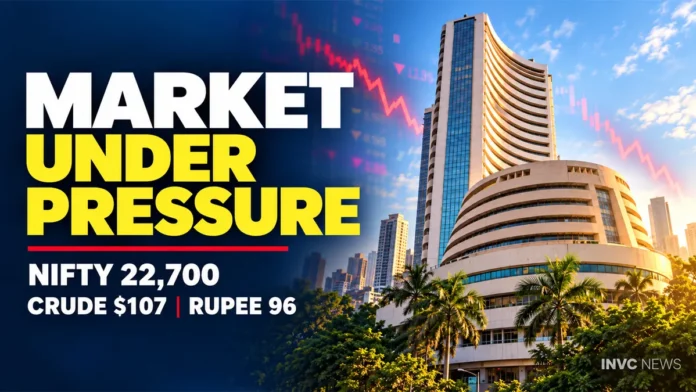
MUMBAI, India | September 29, 2026 — Three numbers are setting the tone for Dalal Street this morning: Nifty near 22,700, Brent crude around $107 a barrel, and the Indian rupee weaker than 96 against the U.S. dollar.
Taken separately, each would be enough to make investors cautious. Together, they are creating one of the toughest combinations the Indian stock market has faced in recent sessions.
The Sensex and Nifty opened lower on Tuesday after a sharp selloff in the previous session. But the real story is bigger than the opening decline.
Expensive crude threatens India’s import bill and inflation outlook. A weaker rupee makes those imports even costlier. Persistent foreign investor selling adds pressure to heavyweight stocks.
That is why today’s market matters even to investors who are not actively trading.
The question now is simple: Can Nifty defend the 22,700 zone, or is Dalal Street preparing for another leg lower?
THE 60-SECOND BRIEF
Nifty 50: Around 22,732 in early trade
Sensex: Around 72,634 in early trade
Brent crude: Trading near $107 a barrel
Indian rupee: Around 96.15 against the U.S. dollar in early currency trade
Market trend: Most major sectoral indexes opened lower
Key Nifty zone: 22,700
Main risks: High crude prices, rupee weakness, foreign selling and elevated global bond yields
These are early-session figures and may change significantly during the trading day.
Why This Market Fall Is Different
A normal market correction can be driven by profit-taking, a weak sector or disappointing corporate earnings.
Today’s pressure is more complicated.
Indian equities are being squeezed by multiple macroeconomic forces at the same time.
Crude oil has climbed toward $107 a barrel. The rupee has weakened beyond 96 to the U.S. dollar. Foreign investors have continued reducing exposure to Indian equities.
That creates pressure not only on stock prices but also on the wider economic outlook.
For India, which depends heavily on imported crude oil, higher energy prices can eventually feed into transportation costs, manufacturing expenses and inflation.
So this is not simply a red-screen day.
It is a story about how global energy prices could begin affecting Indian households, businesses and financial markets.
Nifty 22,700 Is the Level Everyone Is Watching
The Nifty 50 began Tuesday around the 22,700 zone after suffering a steep decline in the previous session.
That level has now become an important short-term reference point for traders.
If Nifty manages to defend the area and recover, the market could attempt to stabilize after the recent selloff.
However, sustained weakness below the zone could bring lower support levels into focus.
Technical levels are not guarantees. They simply show where buying and selling activity has recently become concentrated.
That makes 22,700 the number investors are likely to watch most closely today.
Crude at $107 Changes the Equation
The biggest external risk for India right now may be oil.
Brent crude trading near $107 a barrel immediately raises concerns about India’s import costs.
Higher crude prices can affect several parts of the economy.
Fuel-intensive industries face higher operating expenses.
Airlines and logistics companies can see costs rise.
Paint, chemical and other crude-linked businesses may face pressure on margins.
Most importantly, prolonged high oil prices can make inflation harder to control.
For equity investors, that creates another question: if inflation remains elevated, how much flexibility will the Reserve Bank of India have on interest rates?
This is why crude oil has effectively become one of the most important indicators for Dalal Street.
Rupee Beyond 96 Adds Another Layer of Pressure
The Indian rupee weakened to around 96.15 against the U.S. dollar in early trade.
A weaker currency can make imported commodities more expensive.
For an oil-importing economy, that creates an especially difficult combination.
India may need to pay more dollars for crude just as each dollar becomes more expensive in rupee terms.
That is why movements in crude and the currency are increasingly connected in the market narrative.
If both remain under pressure simultaneously, investors may become more defensive.
Foreign Investors Are Still Pulling Money Out
Foreign institutional selling remains another important part of the market weakness.
Foreign investors have withdrawn billions of dollars from Indian equities during September, according to market data cited in recent reports.
There are several reasons.
High U.S. bond yields can make American assets more attractive to global investors.
Expensive oil raises concerns about India’s macroeconomic outlook.
Currency weakness can also reduce dollar-denominated returns for overseas investors.
Domestic institutions have absorbed some of that selling, but sustained foreign outflows can still weigh heavily on major index stocks.
Sensex Is Already Carrying Monday’s Damage
Tuesday’s weak opening comes after a painful Monday session.
The Sensex fell more than 1,100 points in the previous session, while Nifty dropped more than 350 points.
That means today’s market is not starting from a neutral position.
Investors are already dealing with damaged sentiment.
This makes even a modest morning decline more important than it might appear on the surface.
If buyers step in, the market could stabilize.
If selling accelerates, yesterday’s losses could begin to look like the start of a broader correction rather than a one-day shock.
The Pressure Is Broad, Not Isolated
Early trade showed weakness across most major sectors.
Mid-cap and small-cap stocks also came under pressure.
That matters because broad-based selling usually signals a wider change in risk appetite rather than a problem confined to one company or industry.
Financial stocks, metals, automobile companies and other heavyweight sectors were among the areas investors were watching closely.
Defensive pockets may outperform temporarily, but the overall market tone remains cautious.
Why U.S. Bond Yields Matter to Indian Investors
Indian markets are also facing competition from global bond markets.
When U.S. Treasury yields rise sharply, global investors can earn relatively attractive returns from dollar-denominated government bonds.
That can reduce the appeal of riskier emerging-market assets.
India can therefore lose foreign capital even if there is no major domestic economic shock.
This is one reason Dalal Street can fall despite relatively strong domestic growth data.
Markets price not only economic strength but also the relative attractiveness of competing investments around the world.
What Investors Should Watch Today
For most readers, five signals matter more than minute-by-minute index movements.
Nifty 22,700: Whether the index holds this zone could shape intraday sentiment.
Brent crude: Any move significantly above the current $107 area could increase pressure.
Rupee: Further weakness beyond 96 may intensify concerns about imported inflation.
Foreign flows: Continued heavy overseas selling could keep large-cap stocks under pressure.
Geopolitical developments: Any development affecting global oil supply or major shipping routes could quickly move Indian markets.
What Could Bring Relief?
The market does have potential positive triggers.
A meaningful decline in crude prices would reduce pressure almost immediately.
A recovery in the rupee could improve sentiment.
Reduced foreign selling would help stabilize heavyweight stocks.
Domestic institutional buying could also cushion volatility.
However, investors may want to distinguish between a short-lived intraday rebound and a genuine improvement in the underlying risk environment.
The broader picture will depend on oil, currencies and global yields—not just one green hour on the trading screen.
What This Means for Long-Term Investors
A volatile market does not automatically mean long-term investors need to make dramatic portfolio changes.
But it does make risk management more important.
Investors may want to watch whether highly valued stocks are seeing sharper corrections and whether companies with high energy costs, foreign-currency debt or weak cash flows become more vulnerable.
Market volatility can create opportunities, but the same volatility can punish rushed decisions.
That is why today’s numbers matter more as signals than as reasons for panic.
INVC NEWS Bottom Line
Dalal Street is facing a three-way squeeze: Nifty is testing the 22,700 zone, crude oil is hovering near $107 a barrel, and the rupee has weakened beyond 96 to the dollar.
The early declines in Sensex and Nifty are only part of the story.
The bigger question is whether India’s market can stabilize while oil, currency pressure, global yields and foreign selling remain unfavorable.
For investors, today’s session could provide an important clue.
If Nifty defends 22,700 and crude cools, the market may find breathing room. If both move the wrong way, volatility could deepen before confidence returns.