GURBULAK, Turkiye | September 28, 2026 — Iran is trying to replace ships with trucks.
The problem is that roads were never built to carry the enormous volume of trade once moving through the country’s southern ports.
As a U.S. naval blockade disrupts Iran’s maritime trade and crude exports, Tehran is increasingly pushing imports and exports through its land borders with Turkiye, Pakistan and other neighbors.
The result is now visible on a mountain highway in eastern Turkiye.
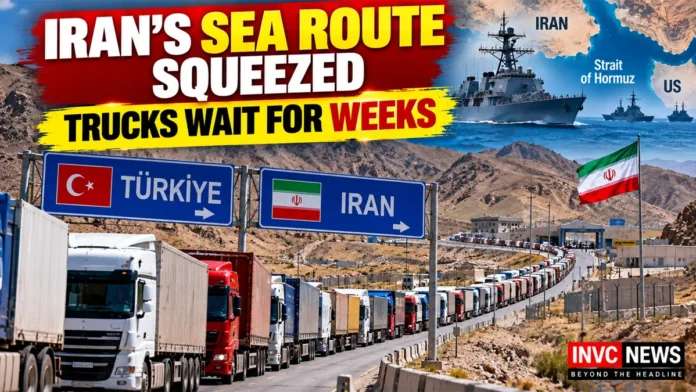
Truck queues have stretched for kilometers. Drivers who once crossed within a few days are waiting far longer. On the Iranian side, some have reported delays of 12 to 25 days.
And the congestion is exposing a much bigger problem for Tehran:
Can land routes keep Iran’s economy supplied if its maritime lifeline remains restricted?
THE 60-SECOND BRIEF
Iran is rapidly redirecting trade from sea routes toward land crossings.
The Gürbulak-Bazargan crossing between Turkiye and Iran has become one of the most important pressure points.
Truck queues have stretched to around 7 kilometers.
Some drivers say waits that once lasted a few days now stretch much longer.
On the Iranian side, drivers have reported delays ranging from 12 to 25 days.
An Iranian trade official said truck numbers at one point surged from around 200 to 1,200.
Before the conflict, more than 80% of Iran’s two-way trade by volume moved through maritime routes from its southern coast.
That means trucks, railways and Caspian ports can help — but replacing the sea is a far bigger challenge.
A 7-Kilometer Line of Trucks Shows the Scale of the Problem
The road toward the Gürbulak border crossing has become an unlikely picture of Iran’s economic pressure.
Truck after truck waits to enter the country.
Some carry industrial materials.
Others carry chemicals, vehicle parts, consumer goods or ingredients required by Iranian manufacturers.
Normally, congestion at the border is nothing unusual.
What has changed is the scale.
Drivers who have used the crossing for years say waiting times have surged as more cargo that once arrived through maritime routes is redirected overland.
For Iran, every truck matters.
But there is an unavoidable mathematical problem.
A convoy of trucks cannot easily replace a cargo ship.
Iran Is Trying to Rewire Its Trade Map
Iran’s geography gives it options.
The country shares land borders with seven neighbors.
Turkiye provides a gateway toward Europe.
Pakistan connects Iran toward South Asia and routes linked with China.
Railways through Central Asia offer another path toward China and Russia.
The Caspian Sea provides access to northern markets.
Tehran is now trying to use all of them more aggressively.
That strategy has produced results.
Traffic at the Turkiye crossing has increased sharply, while rail and Caspian routes are also carrying more cargo.
But the transformation is expensive, slow and logistically difficult.
Iran built its trade system around ports for a reason.
Ships can move enormous quantities of goods far more efficiently than long lines of trucks.
From 200 Trucks to 1,200
Iranian officials have openly acknowledged the strain.
One Iranian trade official said the number of trucks arriving at the border had jumped from roughly 200 to around 1,200.
The problem is not simply the number of vehicles.
Border crossings have fixed capacity.
Customs officers can inspect only so many trucks.
X-ray machines can process only so many vehicles.
Road lanes can hold only so much traffic.
Parking, fuel facilities, toilets and driver accommodation also become critical when hundreds of vehicles remain stationary for days.
Once the number of trucks overwhelms that system, every additional vehicle makes the queue harder to clear.
Some Drivers Are Waiting Weeks
For truckers, this geopolitical crisis has become painfully personal.
A driver earns money by moving cargo.
A truck sitting in a border queue does not generate another journey.
Some Iranian drivers say trips they once completed twice a month have been reduced to one.
Others report lengthy waits before they can leave Iran and return to Turkiye.
On the Iranian side of the border, reported customs delays during the past month have ranged from 12 to 25 days.
That means one shipment can tie up a vehicle and its driver for weeks.
At the same time, drivers face higher fuel, tire and maintenance costs.
The longer the trucks sit still, the more fragile the economics of overland trade become.
The Blockade Has Changed Iran’s Economic Calculations
Iran relied heavily on maritime trade before the current conflict.
More than four-fifths of the country’s two-way trade by volume moved through its southern maritime corridor before the war.
That dependence made ports essential to the economy.
They handled consumer imports.
Industrial inputs.
Raw materials.
And crucially, Iran’s energy exports.
The U.S. naval blockade has sharply disrupted that system.
Washington’s blockade does not cover every kilometer of Iran’s coastline. U.S. naval forces operate farther south around routes linking the Gulf of Oman and Arabian Sea, where shipping connected with Iranian ports faces restrictions and inspection.
The effect on Iran’s maritime economy has nevertheless been severe.
Oil Is an Even Bigger Problem Than Cargo
Consumer goods can, at least theoretically, be placed on trucks.
Millions of barrels of crude oil are another matter.
Iran’s economy depends heavily on energy exports for foreign currency.
Moving crude through pipelines or tankers is dramatically more efficient than putting equivalent volumes onto road vehicles.
That explains why Iran’s overland strategy can provide economic breathing room but cannot fully solve the maritime problem.
It can keep certain goods moving.
It cannot easily recreate the scale of Iran’s traditional oil trade through Hormuz and the Gulf.
Turkiye Has Become a Crucial Economic Gate
The Turkiye route has therefore become unusually valuable.
The Gürbulak-Bazargan crossing is already one of the best-developed crossings available to Iran.
Trade between the two countries increased during the first half of the year.
Imports entering Iran through Gürbulak also climbed sharply as businesses looked for alternatives to maritime shipping.
Meanwhile, hundreds of trucks now cross toward Iran each day.
For Tehran, that makes Turkiye much more than a neighboring market.
It has become part of Iran’s emergency trade architecture.
But Turkiye Cannot Simply Open the Gates
The pressure is also creating challenges for the Turkish side.
A border cannot process unlimited freight simply because demand increases.
Officials have been adding capacity and improving facilities.
At Gürbulak, measures have included additional lanes and increased scanning capability.
Those efforts have reportedly helped reduce some waiting times.
But infrastructure expansion takes time.
And nobody knows how long the extraordinary level of traffic will continue.
That uncertainty makes massive new investment difficult.
Pakistan Is Facing Pressure Too
Turkiye is not Iran’s only alternative.
Tehran is also attempting to move more goods through Pakistan.
Iranian and Pakistani officials have discussed keeping crossings open around the clock and expanding border infrastructure.
Plans have also included another crossing at Kuhak.
That could improve capacity.
However, Pakistan’s border infrastructure has its own limitations.
Long distances, customs procedures and transport bottlenecks mean the eastern route cannot simply absorb all of Iran’s displaced maritime trade either.
Railways Offer Another Escape Route
Rail could ultimately prove more efficient than trucks for some categories of cargo.
Iran says its rail border connections toward Central Asia, Russia and China remain operational and are handling increased freight.
Rail can move much larger volumes than individual trucks.
However, it still faces capacity, route and infrastructure constraints.
And rail connections do not offer the same flexibility or sheer carrying capacity as maritime container shipping.
So Iran is effectively assembling a patchwork of alternatives:
Roads.
Railways.
Caspian ports.
Informal financial channels.
And whatever maritime trade remains possible.
Moving Trade Overland Comes With a Huge Price Tag
The economics are daunting.
The head of the Iran-China Chamber of Commerce has estimated that shifting Iran’s China trade from sea to land could add roughly $18 billion a year in costs.
That extra expense does not simply disappear.
Some of it can move through the supply chain.
Importers pay more.
Manufacturers pay more for components.
Transport companies face higher costs.
Eventually, consumers can end up paying more for products.
That is particularly serious for an economy already facing severe inflation and currency pressure.
This Is Why the Truck Queue Matters
A long line of trucks can look like a transport story.
It is actually an economic story.
Every vehicle waiting at the border represents delayed inventory.
Delayed manufacturing inputs.
Higher logistics costs.
Reduced income for drivers.
And another reminder that Iran is struggling to replace a trade system built around the sea.
The longer the maritime disruption continues, the greater the pressure on those alternative corridors.
Can Caspian Ports Save Iran?
Iran is also looking north.
Ports on the Caspian Sea offer connections toward Russia and Central Asia and can link into road and rail networks.
This route gives Tehran another way to reduce dependence on its southern ports.
However, the Caspian has limitations too.
Falling water levels restrict how deeply loaded vessels can operate.
Port capacity is also far smaller than what Iran historically handled through its southern maritime infrastructure.
So once again, the alternative helps.
But it does not fully replace what has been lost.
Why the Hormuz Talks Suddenly Matter Even More
This logistical crisis explains why negotiations involving the Strait of Hormuz are about far more than diplomacy.
Iran has indicated that it could reopen the strategic waterway under a broader agreement with Washington.
The United States and Iran remain divided over sanctions, the blockade, nuclear issues and regional security conditions.
But behind those negotiations sits enormous economic pressure.
Every additional week of restricted maritime trade increases the burden on Iran’s roads, railways and border crossings.
That makes the truck queues part of the wider geopolitical equation.
THE BIGGER PICTURE
Iran has spent decades adapting to sanctions.
It has built alternative payment systems.
It has developed informal trade networks.
It has learned to move goods through neighboring countries.
That experience gives Tehran resilience.
But the current challenge is different in scale.
Sanctions can make maritime trade difficult.
A physical blockade can constrain the movement of ships themselves.
Replacing those vessels requires not one alternative route but an entire parallel logistics network.
And such a network cannot be created overnight.
INVC NEWS Bottom Line
Iran has found a way to keep more goods moving despite severe disruption to its southern maritime routes:
put them on trucks and send them across land borders.
But the kilometers-long queues at Turkiye’s Gürbulak crossing reveal the limits of that strategy.
Hundreds of additional trucks are arriving.
Some drivers face delays lasting days or even weeks.
Costs are rising.
Border infrastructure is being stretched.
And road, rail and Caspian routes still cannot easily replace the scale of trade once handled by Iran’s southern ports.
So the most important question is no longer whether Iran can survive without normal maritime trade in the short term.
It is this:
How long can an economy built around ships keep functioning when it is forced to depend increasingly on trucks?
What happened. Why it matters. What comes next.