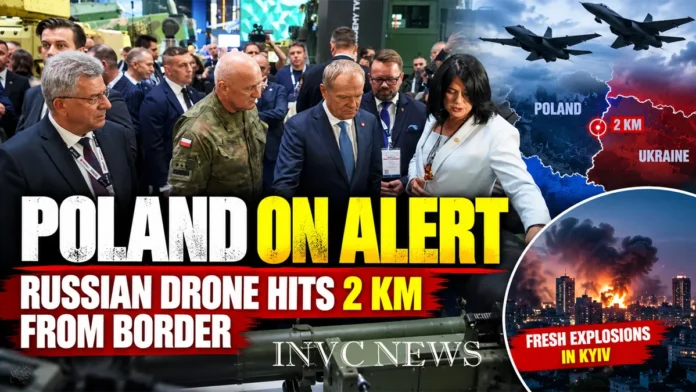
WARSAW, Poland / KYIV, Ukraine | September 29, 2026 — A Russian strike landed on Ukrainian territory just about two kilometers from NATO member Poland, forcing Warsaw to activate military aircraft and place its air-defense systems on readiness.
Polish officials say the drone did not cross into Polish airspace.
That distinction is crucial. Poland was not attacked in this incident. But the distance between the Russian strike and NATO territory was small enough to trigger an immediate military response.
Hours later, another warning came from Ukraine’s capital.
Fresh explosions were heard in Kyiv early Tuesday, September 29, and missile debris fell into the courtyard of a residential building, according to city authorities.
Together, the two developments show how Russia’s continuing air campaign is creating pressure on two fronts: Ukraine is trying to defend its cities, while NATO countries along its borders are preparing for the possibility that the next missile or drone may come even closer.
THE 60-SECOND BRIEF
A Russian jet-powered drone struck Ukrainian territory around two kilometers from the Dorohusk border crossing with Poland on September 28.
Polish Defense Minister Władysław Kosiniak-Kamysz said there was no violation of Polish airspace.
Poland activated military aviation, while air-defense and radar systems were placed on readiness.
Operations at Lublin and Rzeszów airports were temporarily affected during the security response.
After the threat passed, Polish aircraft returned to their bases.
Then, early September 29, explosions were heard again in Kyiv.
Initial reports said missile debris fell inside a residential courtyard and a non-residential building caught fire.
Why Two Kilometers Matters
The biggest number in this story is not a casualty count.
It is two kilometers.
According to Poland’s defense minister, a Russian jet-powered drone struck Ukraine roughly two kilometers from the Dorohusk border crossing.
That meant the attack remained on Ukrainian territory.
But military commanders could not assume that every incoming weapon would remain on the same side of the frontier.
Poland therefore activated aircraft and kept its air-defense systems prepared for action.
Once the immediate danger had passed and no Polish airspace violation was recorded, the aircraft returned to their bases.
This is precisely how a war occurring outside NATO territory can still force a NATO country into an active defensive posture.
Poland Did Not Enter the War
The military response needs careful context.
Poland did not announce that it was joining the Russia-Ukraine war.
Nor did Polish authorities say Russia had attacked Poland in this episode.
The aircraft deployment was defensive and precautionary.
Poland has repeatedly increased military readiness when Russian missile and drone attacks take place close to its eastern frontier.
The latest incident demonstrates why.
A weapon traveling at high speed can approach an international border quickly, leaving air-defense crews limited time to determine its path and decide whether intervention is required.
Civilian Aviation Felt the Impact
The alert also affected civilian aviation.
Operations at Lublin and Rzeszów airports were temporarily suspended or restricted as Polish authorities responded to the nearby Russian attack.
Rzeszów has particular strategic importance because southeastern Poland has become a major logistical gateway connected to Western assistance for Ukraine.
The disruption therefore illustrated how a strike remaining inside Ukraine can still affect transportation and security operations inside Poland.
Normal operations resumed after authorities determined that the immediate threat had passed.
Kyiv Then Came Under Pressure Again
While attention focused on Poland’s eastern border, Kyiv faced another night of uncertainty.
Explosions were heard in the Ukrainian capital early September 29.
Kyiv Mayor Vitali Klitschko said missile debris landed in the courtyard of a residential building.
A non-residential structure also caught fire elsewhere in the capital.
The initial reports did not establish a fresh casualty toll from Tuesday morning’s incident.
That detail matters because casualty figures from September 28 should not be automatically combined with the new September 29 attack.
Ukraine Was Already Counting Heavy Losses
The fresh explosions followed a deadly day across Ukraine.
Later reporting placed the nationwide death toll from Russian attacks on September 28 at at least 10, with more than 80 people injured.
Kyiv was among the areas hit.
A drone struck the National Academy of Sciences of Ukraine, where two people were reported killed.
Authorities also reported 24 people injured across attacks in the capital.
Other Ukrainian regions, including Dnipro and Zaporizhzhia, also reported casualties and damage.
The new explosions therefore came before Ukraine had fully assessed the consequences of the previous day’s strikes.
Faster Drones Are Changing the Equation
The weapon reported near Poland adds another dimension to the story.
Polish authorities described it as a jet-powered drone.
Ukraine has also reported increasing use of faster jet-powered attack drones during Russia’s latest aerial campaign.
Compared with many propeller-driven attack drones, faster systems can reduce the time available for detection and interception.
For Ukraine, that increases pressure on air defenses.
For Poland and other NATO members bordering Ukraine, it creates an additional challenge: determining quickly whether a weapon will remain inside Ukrainian territory or cross an international border.
Ukrainian President Volodymyr Zelenskyy said around 90 jet-powered drones were among more than 120 drones used during one of the latest waves of attacks.
He also said Ukraine’s interception rate against the faster systems was about 57%.
Those figures were provided by the Ukrainian government and should be understood as Ukrainian assessments.
Why NATO Is Watching Closely
Poland’s response has wider significance because it is a NATO member.
A strike inside Ukraine and an attack on NATO territory are legally and strategically very different events.
That is why the absence of a Polish airspace violation is one of the most important confirmed facts in this episode.
At the same time, the incident shows how narrow that separation can become.
NATO countries on Europe’s eastern flank have been strengthening surveillance, air defenses and military readiness amid concerns about drones, missiles, sabotage and other security threats.
NATO’s top military commander, General Alexus Grynkewich, has also urged European countries to respond more clearly to Russian-linked sabotage, cyber activity and drone incidents.
What Russia Says
Russia has repeatedly said that its long-range attacks in Ukraine target military or military-related infrastructure.
Ukraine disputes that characterization and points to damage suffered by residential buildings, healthcare facilities and other civilian sites.
Reports reviewed for this incident did not include an immediate Russian response specifically addressing the drone strike near the Dorohusk crossing.
That means it would be premature to make assumptions about Moscow’s intended proximity to the Polish border beyond what has been confirmed about the impact location.
What Happens If the Next Drone Crosses the Border?
That is the question this incident leaves behind.
This time, Polish authorities say the weapon remained inside Ukraine.
But Poland still had to activate military aircraft.
Air-defense crews still had to prepare.
Civil aviation was still affected.
And authorities still had to determine whether the threat was moving toward NATO territory.
The danger is therefore not limited to where a drone ultimately lands.
It also lies in the minutes before military commanders know where it is going.
What Happens Next
Three developments now deserve attention.
First, Kyiv authorities will assess the full impact of the September 29 explosions and determine whether there are additional casualties.
Second, Poland will continue monitoring Russian drone and missile activity near its eastern frontier.
Third, NATO members will be watching whether Russia continues using faster attack drones close to alliance borders.
Poland has also been reviewing procedures governing how its forces respond to drones and missiles approaching or entering its airspace.
That debate is likely to gain urgency whenever another strike takes place close to the frontier.
INVC NEWS Bottom Line
The significance of this incident is not that Russia attacked Poland. Polish authorities say it did not.
The significance is that a Russian jet-powered drone struck Ukraine only about two kilometers from NATO territory, close enough for Poland to activate military aircraft and prepare its air defenses.
Hours later, explosions were heard again in Kyiv.
For Ukraine, the immediate challenge is surviving another sustained wave of Russian aerial attacks.
For Poland and NATO, the calculation is different:
How much warning will they have if the next drone does cross the border?
That is what makes this more than another Russia-Ukraine battlefield update.
It is also a story about how close the war is operating to NATO’s front door.