MUMBAI, India | September 28, 2026 —
Indian stocks suffered another brutal Monday morning as a fresh surge in crude oil pushed the Nifty 50 close to a six-month low and dragged every major sector into the red.
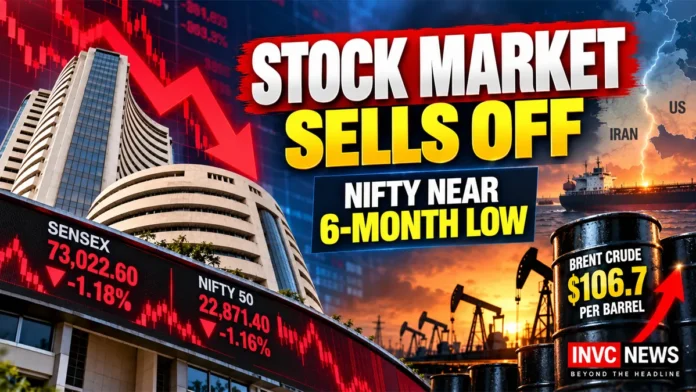
By 10:00 AM IST, the Nifty had fallen 1.16% to 22,871.40, while the BSE Sensex was down 1.18% at 73,022.60.
The immediate trigger came from the oil market.
Brent crude futures jumped about 2.3% to $106.7 a barrel after a deadlock in U.S.-Iran peace efforts revived fears over supplies moving through the Strait of Hormuz.
For India — one of the world’s biggest crude oil importers — that is exactly the kind of combination investors fear.
Oil is rising, stocks are falling, and the market has already been losing ground for seven straight weeks.
The question now is no longer whether Dalal Street is under pressure.
It is how much more pressure the market can absorb.
THE 60-SECOND BRIEF
The Nifty 50 fell 1.16% to 22,871.40 by 10:00 AM.
The Sensex dropped 1.18% to 73,022.60.
Both benchmarks traded near their lowest levels in almost six months.
Brent crude rose about 2.3% to roughly $106.7 per barrel.
All 16 major sectoral indexes were trading lower.
Mid-cap and small-cap indexes fell around 1.1% each.
Meanwhile, the Sensex and Nifty have now declined for seven consecutive weeks, losing nearly 6%.
Financials, banks and heavyweight stocks added to the pressure.
Why Did the Indian Stock Market Fall So Sharply?
The answer begins with crude oil.
Oil prices moved higher after U.S.-Iran negotiations failed to deliver a breakthrough over the conflict and the Strait of Hormuz.
The shipping route remains critical to global energy markets.
Any threat to supplies passing through it can quickly push crude prices higher.
For India, expensive oil creates several problems at the same time.
It raises the import bill.
It can increase inflation.
It can put pressure on the rupee.
And it can squeeze companies whose margins depend heavily on fuel, transportation or raw-material costs.
Therefore, when Brent pushes beyond $106, Indian equity investors pay attention immediately.
The Number Investors Cannot Ignore: $106.7
A few dollars in crude may not sound dramatic.
For India, however, sustained high oil prices can have consequences across the economy.
India imports most of the crude it consumes.
As a result, a prolonged oil surge can increase the amount of foreign currency needed to pay for energy imports.
That can affect the current account and the rupee.
Higher fuel costs can also move through transportation, aviation, chemicals, paints, manufacturing and consumer goods.
Ultimately, companies face a difficult choice.
Absorb the higher costs and hurt profits.
Or pass them to customers and risk weaker demand.
Either outcome can make equity investors nervous.
Every Major Sector Is Red
Monday’s decline is particularly important because weakness is not limited to one corner of the market.
All 16 major sectoral indexes were trading lower.
Financial services and banking indexes fell about 1.6% each, making them among the biggest drags on the benchmarks.
Heavyweight private lenders also came under pressure.
HDFC Bank fell about 1.8%.
ICICI Bank declined roughly 1.7%.
Reliance Industries dropped around 1.4%.
Because these stocks carry significant weight in the benchmark indexes, sharp losses in them can quickly pull the Sensex and Nifty lower.
Small-Caps and Mid-Caps Are Falling Too
The selling has also spread beyond large-cap stocks.
Both broader small-cap and mid-cap indexes slipped around 1.1% in morning trade.
That matters.
When benchmark indexes fall but smaller stocks remain stable, investors can sometimes argue that weakness is concentrated in a few heavyweights.
That is not the picture Monday morning.
Pressure is broad.
Large caps are down.
Banks are down.
Financials are down.
Mid-caps are down.
Small-caps are down.
The market is not giving investors many places to hide.
Seven Straight Weeks of Losses
Monday’s fall also arrives after an unusually painful stretch for Indian equities.
The Nifty and Sensex have already fallen for seven consecutive weeks.
During that period, the benchmarks have lost nearly 6%.
It ranks among their longest weekly losing streaks on record.
That changes the psychology of the market.
A one-day decline after a strong rally often attracts bargain hunters.
A sharp fall after seven weeks of weakness can have the opposite effect.
Investors may hesitate.
Traders may reduce risk.
And every new negative global trigger becomes harder for the market to absorb.
Why the U.S.-Iran Deadlock Matters to Dalal Street
The negotiations may be happening far from Mumbai.
But oil connects the geopolitical story directly to Dalal Street.
U.S. President Donald Trump said he rejected an Iranian proposal connected with reopening the Strait of Hormuz and ending the fighting.
Iran, meanwhile, has continued to argue that diplomacy offers the path toward resolving the conflict.
For financial markets, the immediate concern is not simply what each side says.
The key issue is whether the disagreement prolongs uncertainty around energy supplies.
The longer that uncertainty lasts, the greater the risk premium traders can build into crude prices.
And higher oil is rarely welcome news for India.
Is Nifty 23,000 Now a Warning Sign?
The Nifty has already broken below the psychologically important 23,000 level.
That threshold matters because traders often watch round numbers as sentiment and technical reference points.
The index was at 22,871.40 by 10:00 AM.
Therefore, attention will now shift to whether buyers return at lower levels or selling continues deeper into the session.
Intraday levels can change quickly.
However, a sustained move below 23,000 would reinforce the market’s recent weak trend.
For short-term traders, volatility may remain elevated.
What Could Stop the Fall?
The most immediate answer is crude oil.
If Brent retreats sharply, some of the pressure on Indian assets could ease.
Likewise, any genuine breakthrough in U.S.-Iran diplomacy that lowers concerns around the Strait of Hormuz could improve sentiment.
Investors will also watch the rupee, foreign institutional flows and global bond yields.
However, after seven consecutive weeks of losses, the market may need more than one positive headline to restore confidence.
The longer the correction continues, the more investors will focus on whether valuations have become attractive enough to bring buyers back.
Should Investors Panic?
Sharp red screens naturally create anxiety.
But investors should separate short-term market moves from long-term investment decisions.
Oil prices and geopolitical developments can move quickly in both directions.
Therefore, making large decisions based purely on an intraday fall can carry its own risks.
At the same time, Monday’s decline should not be dismissed.
The breadth of the selling, the seven-week losing streak and crude above $106 together show that the market is dealing with genuine macroeconomic pressure.
Investors need to watch risk rather than simply assume every fall is automatically a buying opportunity.
THE BIGGER PICTURE
The biggest problem for Indian stocks is not any one number on the Sensex.
It is the combination of pressures arriving together.
Expensive crude.
Geopolitical uncertainty.
Weak market momentum.
Pressure on financial heavyweights.
And seven consecutive weeks of benchmark losses.
Each factor is manageable on its own.
Together, they create a far more difficult environment.
That is why movements in oil may matter almost as much as corporate earnings for the direction of Indian stocks in the short term.
INVC NEWS Bottom Line
Dalal Street is no longer dealing with a routine bad session.
By 10:00 AM Monday, the Nifty had fallen to 22,871.40 and the Sensex to 73,022.60, placing the benchmarks near six-month lows.
All 16 major sectors were in the red.
Small-caps and mid-caps were also falling.
And Brent crude was hovering around $106.7 per barrel.
After seven straight weeks of losses, one question now dominates the market:
If oil stays above $100 and the U.S.-Iran deadlock continues, where does the next meaningful buying support come from?
That answer could decide whether Monday becomes another painful session in a long correction — or the point where buyers finally return.
What happened. Why it matters. What comes next.