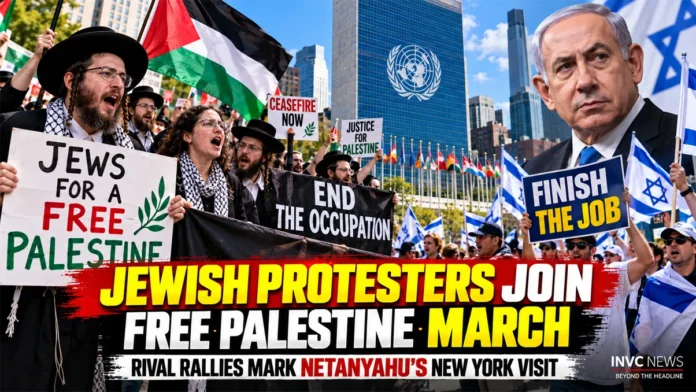
NEW YORK, United States | September 25, 2026 — Jewish demonstrators joined a Free Palestine march in New York during protests surrounding Israeli Prime Minister Benjamin Netanyahu’s visit to the United Nations, publicly rejecting the idea that his government speaks for Jewish people everywhere.
At the same time, a separate pro-Israel demonstration took place nearby, where participants expressed support for Israel and its military campaign. Some protesters called on Israel to “finish the job”, highlighting the sharply contrasting views visible on the streets of New York.
The competing demonstrations turned Netanyahu’s UN visit into a wider debate over Gaza, Israel, Palestinian rights, antisemitism and political divisions within Jewish communities.
INVC NEWS | BEYOND THE HEADLINE
What happened. Why it matters. What comes next.
THE 60-SECOND BRIEF
Jewish protesters joined Palestinian supporters in a Free Palestine march in New York.
Some participants said Benjamin Netanyahu did not represent them or all Jewish people.
A separate pro-Israel gathering took place nearby, with demonstrators expressing support for continued Israeli action.
The protests unfolded around Netanyahu’s appearance at the United Nations General Assembly and exposed sharply different views over Gaza, Israeli security and the political direction of Netanyahu’s government.
Jewish Protesters Join Free Palestine March
Jewish demonstrators marched alongside Palestinian supporters during protests in New York as Netanyahu attended the United Nations General Assembly.
Some participants directly challenged the idea that criticism of Netanyahu or the Israeli government should automatically be viewed as hostility towards Jewish people.
Their message was straightforward: Netanyahu represents the government of Israel, not Jewish communities worldwide.
The demonstration also underscored the range of views among Jewish activists, from opposition to Netanyahu’s government and calls for Palestinian rights to more fundamental criticism of Zionism.
Rival Pro-Israel Rally Takes Place Nearby
While Free Palestine demonstrators marched against Netanyahu, pro-Israel protesters gathered nearby.
Some participants expressed support for continued Israeli military operations, with the phrase “finish the job” heard among demonstrators.
Other pro-Israel groups focused on Israel’s security and concern over rising antisemitism.
The rival rallies created a striking contrast, with opposing movements responding to the same conflict and the same Israeli leader within a short distance of one another.
Netanyahu’s UN Appearance Becomes Flashpoint
Netanyahu’s appearance at the United Nations became a focal point for protests across New York.
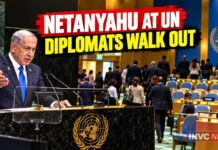
During his UN address, the Israeli prime minister defended his government’s military actions and rejected allegations made against Israel over the war in Gaza.
Some delegates walked out during the speech.
Outside the UN complex, protesters demanded an end to the war and changes in US policy towards Israel.
Police detained demonstrators after some participants blocked roads and remained in place despite orders to move.
Jewish Groups Take Different Positions
The demonstrations highlighted an important distinction: Jewish opinion on Israel and Netanyahu is not uniform.
Some Jewish organisations oppose Netanyahu while continuing to support Israel.
Others take anti-Zionist positions.
Pro-Israel Jewish groups, meanwhile, argue that Israel faces serious security threats and that international criticism often fails to account for those concerns.
These divisions have become increasingly visible as the Gaza conflict continues.
Gaza Remains at the Centre
The war in Gaza remains the main driver of the protest movement.
Critics of Israel accuse Netanyahu’s government of causing unacceptable civilian suffering and have called for stronger international pressure to end the conflict.
Israel rejects allegations that it deliberately targets civilians and says its operations are aimed at armed groups and threats to Israeli security.
Those competing claims continue to shape both international diplomacy and street protests.
Why the Protests Matter
The demonstrations were not simply another confrontation between pro-Israel and pro-Palestinian camps.
They also reflected a dispute over representation.
Jewish protesters marching with Palestinian supporters rejected the idea that Netanyahu’s policies should be presented as representing all Jewish people.
Pro-Israel protesters, meanwhile, argued that Israel’s security concerns require continued political and military backing.
The result was a public display of how divided opinion has become around Israel, Gaza and Netanyahu’s leadership.
What Happens Next
The protests are likely to continue influencing debate over Gaza, US support for Israel, Palestinian rights and antisemitism.
Activist groups on both sides are expected to maintain pressure as diplomatic arguments around the conflict continue.
The New York demonstrations also suggest that future coverage will need to account for divisions not only between communities, but within them.
INVC NEWS Bottom Line
Jewish protesters joining a Free Palestine march challenged the idea that Benjamin Netanyahu speaks for all Jewish people.
Nearby, pro-Israel demonstrators backed continued Israeli action.
Together, the rival demonstrations revealed a broader political divide over Gaza, Israeli security and Netanyahu’s leadership — including deep disagreements within Jewish communities themselves