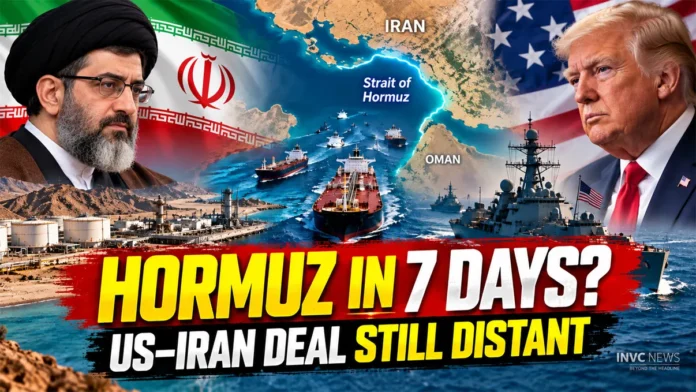
NEW YORK, United States | September 25, 2026 — Iran’s latest proposal to reopen the Strait of Hormuz within seven days has created a fresh diplomatic opening with the United States, but the fundamental disputes separating Washington and Tehran remain unresolved.
Iran has signalled that it could reopen the strategically crucial waterway if the United States reduces military pressure and lifts its blockade on Iranian ports.
The proposal represents a limited shift from Tehran’s previous position. However, disagreements over the June US-Iran memorandum, sanctions, control of navigation through Hormuz and the broader post-war security arrangement continue to obstruct a wider settlement.
THE 60-SECOND BRIEF
Iran has offered to reopen the Strait of Hormuz within seven days under conditions linked to reduced US military pressure and the lifting of restrictions on Iranian ports.
Tehran submitted its latest proposal to Washington through mediators on September 16.
Indirect diplomacy has continued around the United Nations General Assembly in New York, with Gulf states playing an increasingly important intermediary role.
However, Iran and the United States still interpret the June agreement differently.
Iran continues to regard that memorandum as an important basis for future arrangements, while Washington has resisted parts of Tehran’s interpretation of what the deal allows.
Cyrus Schayegh, professor of international history and politics at the Geneva Graduate Institute, described Iran’s latest proposal as only a limited indication of diplomatic movement.
What Iran Is Offering
Iran’s latest proposal centres on the Strait of Hormuz, one of the most important energy corridors in the world.
Tehran has indicated that it could reopen the waterway within seven days if Washington reduces military pressure and removes its blockade of Iranian ports.
Iranian officials have presented the offer as part of a broader attempt to revive negotiations rather than as an unconditional reopening of the strait.
Iran submitted the proposal through intermediaries on September 16.
The timing is significant.
Iranian officials are attending the United Nations General Assembly in New York, creating an opportunity for diplomatic contacts involving Tehran, Washington and regional governments.
No direct breakthrough between the two sides has been announced.
Why the Seven-Day Offer Matters
A seven-day reopening timetable appears to give negotiators a concrete mechanism around which discussions could take place.
It also indicates that Tehran may be willing to separate the immediate issue of maritime access from some of the much larger disputes between Iran and the United States.
That does not mean those disputes have disappeared.
Schayegh argued that the proposal represents only a small diplomatic movement because both governments continue to maintain positions that have repeatedly blocked a broader settlement.
In his assessment, Tehran continues to insist on preserving leverage accumulated during the conflict and regards the June memorandum as central to the roadmap ahead.
Washington, meanwhile, has resisted Iran’s interpretation of that framework.
The June Memorandum Is Still at the Heart of the Dispute
The United States and Iran signed an interim memorandum on June 17 as part of efforts to extend a ceasefire and establish arrangements for reopening the Strait of Hormuz.
But the agreement did not eliminate disagreements over how the waterway should operate.
Iran has argued that the memorandum gives Tehran authority to determine certain transit routes and mechanisms through the strait.
The United States has challenged Iranian restrictions and maintains that international shipping should be able to move through the waterway without the controls Tehran has sought to impose.
That difference has become one of the central obstacles in subsequent negotiations.
The dispute therefore extends beyond simply whether Hormuz is open or closed.
It concerns who determines the rules governing passage through one of the world’s most strategically important waterways.
Why Hormuz Changes the Diplomatic Equation
The Strait of Hormuz connects Gulf oil and gas producers with international markets.
Before the conflict, roughly one-fifth of globally traded oil and natural gas moved through the route.
Restrictions on shipping have therefore affected far more than relations between Washington and Tehran.
Saudi Arabia, the United Arab Emirates, Qatar, Kuwait and other regional economies all have a direct interest in stable navigation.
Energy-importing countries across Asia and Europe also face consequences when traffic through the waterway falls.
That gives Gulf governments a strong incentive to push both Iran and the United States towards an arrangement capable of protecting commercial shipping.
Gulf States Could Become Critical Mediators
Regional governments have stepped up diplomatic activity during the United Nations meetings.
Qatar has been working with Pakistan on efforts to reduce tensions and encourage dialogue.
Oman has also played an important role in discussions surrounding maritime arrangements in the Strait of Hormuz.
Iranian Foreign Minister Abbas Araghchi has held discussions with senior Gulf officials during the New York meetings.
These governments occupy a distinctive diplomatic position.
They maintain security relationships with Washington while also retaining channels of communication with Tehran.
Schayegh argued that Gulf states could therefore play an important part in bringing the two sides closer together.
However, he said regional governments would also need greater coordination over what they want from both Iran and the United States.
What Washington Has Said
The Trump administration has continued to demand greater access through the Strait of Hormuz while maintaining economic and military pressure on Tehran.
President Donald Trump used his United Nations address this week to defend his administration’s Iran policy and called for the reopening of the waterway.
Secretary of State Marco Rubio has indicated that Washington remains open to dialogue.
However, public statements from the administration have not demonstrated acceptance of Iran’s latest framework.
That leaves a significant gap between willingness to communicate and willingness to accept the conditions required for an agreement.
The US Midterms Add Another Layer
The diplomatic calendar is also intersecting with US domestic politics.
The United States holds its midterm congressional elections on November 3.
The Iran conflict and higher energy costs have become part of the domestic political debate.
Schayegh said he does not expect major diplomatic movement before those elections.
That remains an analyst’s assessment rather than a confirmed timetable for negotiations.
Washington and Tehran could still change their positions before November if military, economic or regional conditions shift.
The Bigger Picture
Iran’s seven-day Hormuz proposal matters because it shows that diplomatic channels remain open.
It does not, by itself, amount to a peace settlement.
Washington and Tehran remain divided over sanctions, maritime authority, military pressure and implementation of the June memorandum.
Iran appears unwilling to surrender the strategic leverage it gained through control over access to Hormuz.
The United States, meanwhile, has shown little indication that it will accept Tehran’s preferred interpretation of the post-war framework.
The result is diplomacy without convergence.
Both sides are communicating.
Both sides have incentives to prevent uncontrolled escalation.
But neither side has yet publicly accepted the other’s fundamental conditions.
What Happens Next
Attention will now turn to whether the United States formally responds to Iran’s September proposal.
Diplomats will also watch Qatar, Oman and other Gulf governments for signs of a coordinated mediation effort.
A practical arrangement covering shipping through Hormuz could potentially emerge before a comprehensive political settlement.
However, the larger issues surrounding sanctions, military pressure and future control of the waterway would still require negotiation.
Any new military escalation could quickly undermine that process.
Conversely, an agreement guaranteeing more predictable commercial transit through Hormuz could create space for broader talks.