MUSCAT, Oman | September 24, 2026 —
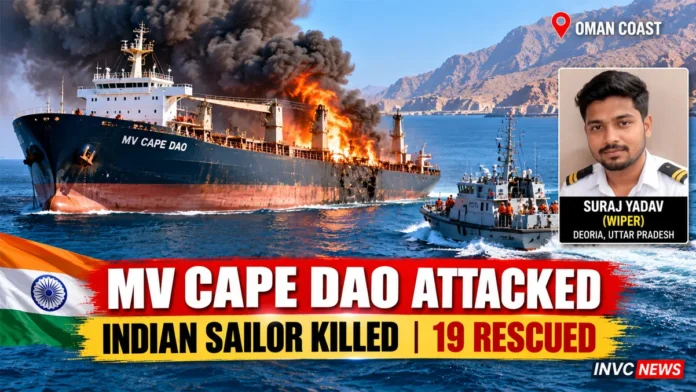
An Indian seafarer from Uttar Pradesh has been killed after the commercial vessel MV Cape Dao came under attack off the coast of Oman while sailing toward India, intensifying concerns over the safety of merchant crews operating around the Strait of Hormuz.
The deceased has been identified as Suraj Yadav, a wiper from Deoria district in Uttar Pradesh.
India’s Ministry of External Affairs said the vessel had 20 Indian seafarers on board. Nineteen survived and were rescued, while Yadav lost his life in the attack.
The Antigua and Barbuda-flagged bulk carrier had 28 crew members in total. Oman’s maritime authorities evacuated 27 survivors with assistance from the Royal Navy of Oman.
India has condemned the attack and called for an immediate end to attacks on commercial shipping, seafarers and civilian infrastructure in the region.
Suraj Yadav Suffered Fatal Head Injuries
Union Minister for Ports, Shipping and Waterways Sarbananda Sonowal said Suraj Yadav suffered serious head injuries during the attack and later died.
The minister expressed condolences to his family and said the government would ensure that Yadav’s mortal remains are brought back to India with dignity.
He also directed maritime authorities to coordinate with Oman and the vessel’s management company for the safe and early return of the surviving Indian crew members.
For Yadav’s family in Deoria, what began as another voyage toward India ended in tragedy thousands of kilometres from home.
19 Indian Seafarers Safely Evacuated
The MEA confirmed that all 19 surviving Indian crew members have been rescued.
The Indian Embassy in Muscat is coordinating with Omani authorities and the ship’s recruitment and placement agency.
The surviving crew members were taken ashore after the vessel was evacuated.
Oman’s Maritime Security Centre said a Royal Navy of Oman vessel carried out the evacuation following the attack near the Musandam region.
The Omani authorities provided the rescued crew with necessary medical assistance.
What Hit MV Cape Dao?
This remains one of the most important unanswered questions.
The Forward Seamen’s Union of India said MV Cape Dao was struck twice and described the attack as involving two torpedoes.
According to the union, one strike hit the port-side accommodation area on the C-deck, while another hit the port-side hull near the engine room.
However, official descriptions have not been completely uniform.
Shipping Minister Sarbananda Sonowal referred to a missile attack, while maritime-security reporting described two hits from unknown projectiles.
Therefore, the precise weapon used has not yet been independently established.
No government or armed group had publicly claimed responsibility for the attack at the time of publication.
Attack Triggered Fire in Engine Room
The strike caused a fire in the vessel’s engine-room area.
The damage forced the crew to abandon the ship and prompted the emergency evacuation.
The vessel was travelling toward India after departing from the UAE region and was sailing through waters close to one of the world’s most strategically important maritime corridors.
Its proximity to the Strait of Hormuz adds significance to the incident.
The strait carries a major share of global oil and gas shipments and has become increasingly dangerous amid widening tensions in West Asia.
India Condemns Attack
The Ministry of External Affairs issued a strong response after the incident.
India condemned the attack and described the continuing targeting of commercial shipping in the region as deeply worrisome.
New Delhi said attacks on commercial ships, seafarers and civilian infrastructure must end.
It also called for the restoration of free and unimpeded navigation and commerce through international waterways.
India reiterated its position that dialogue and diplomacy remain necessary to reduce regional tensions and restore peace.
MEA Pushes for Early Repatriation
The Indian Embassy in Oman is working with local authorities to arrange the early return of the rescued Indian seafarers.
The embassy is also in contact with Yadav’s family.
The government thanked Oman for its assistance during the rescue operation.
The incident once again underlines the risks faced by Indian seafarers working aboard merchant vessels passing through conflict-affected waters.
Thousands of Indian nationals work aboard commercial ships around the world, including vessels carrying oil, gas, dry bulk cargo and containers through the Gulf.
Seafarers’ Union Demands Stronger Protection
The Forward Seamen’s Union of India has reacted sharply to the killing.
The union called for greater protection for civilian seafarers passing through the Strait of Hormuz and surrounding waters.
It has demanded safe passage and greater accountability after a series of attacks on commercial vessels.
The union has also urged the Indian government to examine stronger maritime-security measures for Indian seafarers travelling through high-risk regions.
The death of Suraj Yadav has added urgency to those demands.
Why Strait of Hormuz Is So Important
The Strait of Hormuz is one of the world’s most important shipping passages.
It connects the Persian Gulf with the Gulf of Oman and the Arabian Sea.
Oil and LNG cargoes from several major Gulf producers pass through the route.
Any sustained threat to commercial shipping in these waters can affect not only crew safety but also global freight rates, insurance costs, oil prices and supply chains.
India is particularly exposed because it imports most of the crude oil it consumes.
That gives New Delhi a direct strategic interest in maintaining safe navigation through the region.
Commercial Seafarers Increasingly Caught in Conflict
Merchant crews are civilians.
Yet commercial vessels have increasingly found themselves exposed to military and geopolitical confrontation across West Asian sea routes.
For sailors, the consequences can be immediate.
A ship may be transporting ordinary commercial cargo, but once it enters a conflict zone, crew members face threats ranging from missiles and drones to mines, boarding attempts and navigation restrictions.
India’s latest statement therefore goes beyond the death of one sailor.
It raises a broader demand that civilian shipping should not become a battlefield.
Government Promises Support to Suraj Yadav’s Family
The government has assured assistance to the family of Suraj Yadav.
Sonowal said the entire country stands with the family during their loss.
Authorities are working to return his mortal remains to India while arranging the repatriation of the 19 surviving Indian seafarers.
For now, several questions remain unanswered.
Who attacked MV Cape Dao?
What weapon was used?
And how can civilian sailors be protected if attacks around Hormuz continue?
For India, the immediate priority is bringing its sailors home.
The larger challenge is ensuring that another Indian family does not have to pay the price for a conflict unfolding across one of the world’s busiest shipping corridors.