NEW DELHI, India | September 23, 2026 — The West Asia crisis and disruption around the Strait of Hormuz are reshaping global energy trade — and Indian refiners have emerged as important suppliers of petrol, diesel and other petroleum products to markets scrambling for alternative sources.
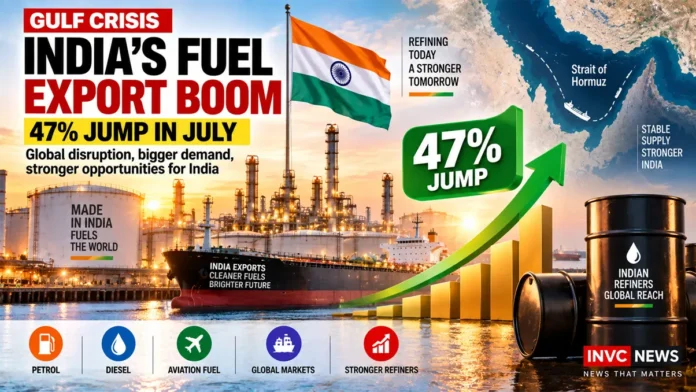
India’s refined-fuel exports climbed to 1.53 million barrels per day in July 2026, their highest monthly level of the year, according to commodity analytics data.
That represented a massive 47% increase from June, when exports stood at roughly 1.04 million barrels per day.
The momentum continued in August.
Official Indian government trade data show petroleum-product exports jumped 63.27% year-on-year in value, rising from $4.17 billion in August 2025 to $6.81 billion in August 2026.
The numbers highlight how India’s huge refining industry is finding new opportunities as disruptions in West Asia and Russia tighten supplies of refined fuels across international markets.
But there is an important catch.
India is also one of the world’s largest crude-oil importers, meaning expensive oil creates a much larger import bill at the same time that refiners benefit from stronger export prices.
The 47% Jump Explained
The widely reported 47% surge refers specifically to fuel-export volumes in July compared with June 2026.
India exported:
June 2026: Around 1.04 million barrels per day
July 2026: Around 1.53 million barrels per day
That works out to an increase of approximately 47% month-on-month.
Compared with July 2025, exports were around 23% higher.
The jump came as Indian refineries increased runs, crude availability improved and strong refining margins made overseas sales particularly attractive.
August Data Show an Even Bigger Value Surge
The Commerce Ministry’s August trade data underline how valuable refined-fuel exports have become.
Petroleum-product exports increased from:
$4.17 billion in August 2025
to
$6.81 billion in August 2026
That is a year-on-year increase of 63.27%.
India’s total merchandise exports also rose strongly to $43.81 billion in August, up 26.1% from a year earlier.
Petroleum products were among the major contributors to that growth.
Fiscal-Year Petroleum Exports Also Surge
CRISIL Intelligence says petroleum exports have risen roughly 46% year-on-year so far this fiscal year, considerably faster than the growth in non-oil exports.
The ratings and research firm identified three major reasons:
higher refining margins,
recovering export volumes,
and new overseas markets.
The West Asia conflict has played an important role in changing global trade flows.
Countries that previously depended more heavily on Gulf or Russian petroleum products have increasingly looked elsewhere.
India has been able to capture part of that displaced demand.
Why India Is Suddenly So Important in the Fuel Market
India has one of the world’s largest refining systems.
The country has the capacity to process far more crude oil than is needed simply to produce petrol and diesel for its domestic market.
That allows large refineries — particularly private-sector complexes — to import crude, process it into higher-value products and export those fuels globally.
Products exported from India include:
Diesel
Petrol
Aviation turbine fuel
Naphtha
Fuel oil
and other refined petroleum products.
When global refining capacity becomes constrained, countries with large and flexible refineries gain an advantage.
India is currently one of them.
Strait of Hormuz Disruption Changed Global Supply Routes
The Strait of Hormuz normally carries a huge share of the world’s energy supplies.
Conflict involving Iran and disruptions around the Gulf have sharply reduced normal commercial shipping through the waterway.
This has affected petroleum exports from several major producers and forced buyers to diversify their supply chains.
Indian refined products have consequently found stronger demand in parts of Asia and Africa.
Research by McKinsey also shows that Asian and African markets increased their reliance on Indian refined petroleum as Gulf supplies became more difficult to access.
India Found New Buyers
One of the biggest changes has been the diversification of India’s fuel-export destinations.
Traditional markets remain important, but newer buyers have increased their purchases.
Singapore remained one of India’s largest destinations during the July export surge.
South Africa also emerged as a significant buyer.
Other markets in Africa and Asia have increased imports as they search for dependable supplies outside disrupted Gulf routes.
Earlier Indian government analysis also showed petroleum exports being redirected toward markets such as:
Singapore
South Africa
and Tanzania
as shipments to West Asia itself declined.
That is an important point.
India did not necessarily sell more petroleum products into the troubled Gulf region.
Instead, it increasingly supplied other countries affected by the disruption in global trade.
Refining Margins Are the Real Prize
The opportunity is not only about exporting more barrels.
It is also about the difference between the cost of crude oil and the selling price of refined fuel.
This difference is broadly reflected in refining margins.
During periods of fuel shortages, diesel, petrol and aviation-fuel prices can rise faster than crude-oil prices.
That creates better margins for refiners capable of maintaining production.
CRISIL says India’s oil terms of trade have improved since the West Asia conflict began because prices for refined petroleum exports increased even faster than crude-import prices.
That helps explain why exporters can benefit even while crude itself becomes more expensive.
But Is the Gulf Crisis Really a ‘Benefit’ for India?
Not for the entire Indian economy.
This distinction is crucial.
India imports the overwhelming majority of the crude oil it consumes.
Between April and August 2026, India’s crude-oil import bill reportedly rose to approximately $74.8 billion, compared with about $50.4 billion a year earlier.
That represents an increase of roughly 48% in dollar terms even though crude-import volumes were broadly flat.
Higher crude prices can increase:
transportation costs,
inflation risks,
government subsidy pressures,
industrial costs,
and pressure on India’s current account.
Therefore, the Gulf crisis creates a commercial opportunity for India’s refining and petroleum-export sector, but it should not automatically be described as a net economic benefit for India.
India Imports Crude, Then Exports Higher-Value Fuel
This is where India’s refining model becomes important.
India does not need to produce all the crude oil domestically to become a major fuel exporter.
Refineries can import crude from countries such as Russia, Iraq, Saudi Arabia, the UAE, Brazil and others.
They then convert that crude into higher-value products such as diesel and petrol.
If the value of exported refined products rises faster than the cost of crude processing, refiners can earn stronger margins.
This is essentially how India can simultaneously remain a major crude importer and a major petroleum-product exporter.
Russian Oil Still Matters, but the Mix Is Changing
Russia remains an important crude supplier to India, although its share has recently declined.
India’s Russian crude imports fell around 16.5% in August to roughly 2.1 million barrels per day, according to shipping data.
Preliminary September flows have been lower again.
Indian refiners are therefore continuing to diversify their crude purchases depending on price, sanctions exposure, availability and shipping conditions.
That flexibility becomes especially valuable during a geopolitical crisis.
India Has Another Advantage: Huge Refining Capacity
India operates more than 20 refineries with combined processing capacity of roughly 5.6 million barrels per day.
Large complexes operated by companies including Reliance Industries can process different grades of crude and produce fuels that meet specifications required in multiple global markets.
That flexibility allows Indian refiners to react quickly when overseas supply gaps emerge.
It also explains why India can redirect products from one region to another as demand changes.
The Biggest Opportunity May Be Diesel
The global diesel market remains especially tight.
Diesel plays a critical role in trucking, agriculture, construction, industrial production and shipping.
Unlike crude oil, replacing lost refining capacity is difficult in the short term.
Middle East disruption, sanctions and damage to refining infrastructure in other regions have tightened the market.
As a result, countries with available refining capacity can command stronger prices for diesel exports.
India is well positioned in that market.
What Happens If Hormuz Reopens?
A sustained reopening of the Strait of Hormuz could gradually normalize Gulf petroleum exports.
That could reduce some of the extraordinary refining margins currently benefiting exporters.
More Gulf fuel supplies could return to international markets, increasing competition for Indian refiners.
Oil and petroleum-product prices could also ease if shipping risks decline.
Therefore, the current export boom is partly tied to an unusually disrupted global energy market.
It should not automatically be assumed that the same growth rates will continue indefinitely.
India Has Turned a Supply Shock Into an Export Opportunity
The numbers nevertheless tell a remarkable story.
A country that depends heavily on imported crude oil has also become one of the world’s most important refining hubs.
When West Asian fuel supplies were disrupted, India had three assets working in its favour:
large refining capacity,
access to multiple crude suppliers,
and the ability to redirect finished fuels toward new markets.
July’s 47% month-on-month jump in fuel-export volumes, August’s 63.27% year-on-year surge in petroleum-export value, and CRISIL’s estimated 46% fiscal-year growth all point in the same direction.
India’s refiners are capturing a bigger share of a disrupted global fuel market.
The broader Indian economy, however, still has to pay the price of expensive imported crude.
That is why the most accurate conclusion is not simply that the Gulf crisis has “benefited India.”
It has created a major export opportunity for India’s refining industry — while simultaneously increasing India’s energy-import burden.