NEW DELHI, India | September 22, 2026 —
Oil shocks, geopolitical tensions, stubborn inflation and slowing major economies are keeping the global economic outlook uncertain.
Yet one economy continues to stand out.
India.
The World Economic Forum’s latest Chief Economists’ Outlook says India retains the strongest growth outlook among the major geographies covered in its September 2026 survey, with resilient domestic demand helping the economy absorb global shocks.
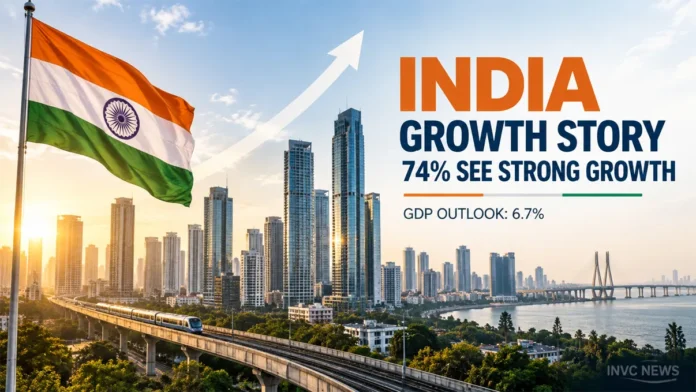
The report points to growth of around 6.7% in FY 2026-27, while an overwhelming 98% of surveyed chief economists expect India to deliver at least moderate growth over the next 12 months.
More strikingly, 74% expect strong or very strong growth.
In May, that figure was only 52%.
That is not a small shift in sentiment.
It is a significant vote of confidence at a time when much of the world is struggling to find momentum.
India Is Not Just Growing — Confidence Is Rising
The headline GDP number tells only part of the story.
What makes the latest WEF survey interesting is the sharp change in economists’ expectations.
In May, just over half of respondents expected strong or very strong Indian growth.
By September, that share had jumped to nearly three-quarters.
The survey covered 92 chief economists from the public and private sectors and assessed 10 major regions, including the United States, Europe, China, Japan, India, South-East Asia and the Middle East.
Among them, India emerged with the strongest growth expectations.
That puts the country in a very different position from several other large economies facing slower demand, weak investment or policy uncertainty.
India’s Biggest Weapon? Its Own Consumers
Exports matter.
Foreign investment matters.
Global trade matters.
But India’s biggest economic shield right now may be sitting inside its own borders.
Domestic demand.
A large consumer base, investment activity and spending within the economy are helping India remain less dependent on a single external growth engine.
That becomes particularly valuable when international conditions turn hostile.
If the United States slows, Europe struggles or global trade becomes volatile, India still has an enormous internal market capable of supporting economic activity.
That does not make the economy immune to global shocks.
But it gives India a cushion that many countries simply do not have.
Then Came the 7.8% GDP Surprise
There is another twist.
The WEF survey was completed before India released its latest quarterly GDP figures.
On August 31, official data showed that India’s real GDP grew 7.8% year-on-year during April-June 2026, strengthening the growth story further.
Manufacturing expanded strongly.
Investment remained robust.
Services continued to grow.
The result came despite an unsettled international environment.
So the survey’s optimism arrived before economists had even absorbed the full impact of the latest GDP reading.
That makes subsequent upgrades from other institutions easier to understand.
Moody’s Goes One Step Further: 7% Growth
Moody’s Ratings has already raised its FY 2026-27 India growth forecast sharply.
Its earlier projection?
6%.
Its new forecast?
7%.
The ratings agency cited stronger-than-expected activity and India’s resilience to the economic shock caused by the continuing Middle East conflict.
That upgrade sends an important message.
Global institutions are not simply looking at one impressive quarter.
They are reassessing how much economic pressure India can absorb without losing momentum.
But the party is not risk-free.
High energy prices, food inflation and geopolitical disruptions remain serious threats.
Jobs: Stable, But This Is Where the Pressure Remains
Strong GDP numbers create obvious excitement.
But people do not experience GDP directly.
They experience the economy through jobs, wages and household income.
That is why India’s labour market remains one of the most important parts of the story.
The latest official labour survey showed unemployment among people aged 15 and above at 5.0% in August, slightly down from 5.1% in July.
At the same time, the labour force participation rate increased from 55.4% to 55.6%.
The worker population ratio also improved.
Those numbers suggest a relatively stable labour market.
However, WEF’s economists are not expecting dramatic change.
Around 70% expect unemployment to remain broadly unchanged over the next 12 months.
Another 17% expect it to increase, while 13% expect it to fall.
That means one challenge remains clear:
India may have the strongest growth story, but turning that growth into enough high-quality jobs remains essential.
Inflation Is Back Above RBI’s 4% Target
There is another warning light on the dashboard.
Inflation.
India’s consumer inflation rose to 4.82% in August, up from 4.45% in July.
Food inflation stood even higher at 5.95%.
The good news?
Headline inflation remains inside the Reserve Bank of India’s tolerance band of 2% to 6%.
The less comfortable news?
It is now above the central bank’s 4% medium-term target.
Still, economists appear less worried than they were a few months ago.
In the WEF survey, 55% expect moderate inflation over the next 12 months, while 45% expect high inflation.
Back in May, 61% had expected high or very high inflation.
So inflation remains a concern — but the fear surrounding it has eased.
RBI May Not Rush to Move Rates
The Reserve Bank of India currently has its policy repo rate at 5.25%.
Most economists surveyed by WEF do not expect dramatic monetary-policy action.
Around 67% expect policy to remain broadly unchanged over the coming year.
Another 24% expect tightening.
That tells us something important.
If growth remains strong while inflation stays within the tolerance range, the RBI may not face immediate pressure to make aggressive policy changes.
But that equation could change quickly if global oil prices rise sharply.
India imports a large share of its energy needs.
And expensive energy has a habit of travelling through the economy — from transportation to manufacturing and eventually household prices.
Government Spending Is Also Expected to Stay Steady
The fiscal-policy outlook is similarly calm.
Around 72% of surveyed economists expect no major change in fiscal policy, while 22% see the possibility of a somewhat looser stance.
That suggests expectations of continuity rather than a dramatic stimulus push.
Strong growth gives policymakers some breathing room.
But fiscal decisions could become more difficult if higher crude prices increase subsidy costs or geopolitical tensions force additional spending.
India vs the World: Why the Contrast Matters
The global economy is not collapsing.
But confidence is uneven.
Europe continues to face weak growth prospects.
China’s outlook has softened compared with earlier expectations.
The United States still shows resilience, but its growth outlook does not carry the same intensity as India’s.
That leaves India in an unusual position:
a major economy growing rapidly while much of the world remains cautious.
It is exactly the kind of divergence global investors notice.
But One Big Number Does Not Pay Household Bills
Here is where the economic celebration needs some discipline.
A 7.8% quarterly growth print sounds spectacular.
A 7% Moody’s forecast sounds strong.
A 74% confidence reading from chief economists sounds even better.
But the ultimate test is much simpler.
Do families see income rising?
Do businesses create jobs?
Can young people find good work?
Can food and housing costs remain manageable?
Can small businesses benefit from the growth cycle?
If the answer increasingly becomes yes, India’s GDP story becomes a household story.
If not, impressive macro numbers can begin to feel distant from everyday life.
India’s Growth Engine Is Running — Now Comes the Harder Test
The latest WEF assessment offers India something every economy wants:
confidence.
Domestic demand remains strong.
GDP momentum remains healthy.
Labour participation is improving.
Inflation remains inside the RBI’s tolerance band.
Global agencies are raising forecasts rather than cutting them.
That is a powerful combination.
But maintaining it may be harder than achieving it.
Oil prices can change rapidly.
Wars can disrupt supply chains.
Food inflation can squeeze consumers.
And millions of new workers need opportunities every year.
So India enters the next phase with the strongest growth outlook in the WEF survey — but also with a bigger responsibility.
The world is watching India’s GDP numbers.
Indian households will be watching whether that growth reaches them.
And that may be the most important economic test of all.