NEW DELHI, India | September 22, 2026 —
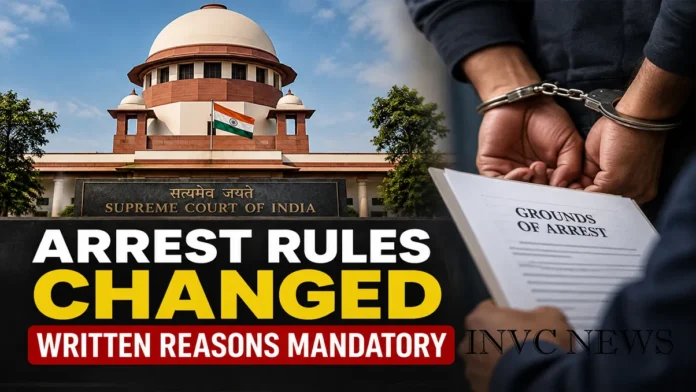
The Supreme Court arrest rule has significantly strengthened the rights of people taken into police custody, with India’s top court holding that an arrested person must receive the grounds of arrest in writing and in a language they understand.
The Supreme Court said this protection flows directly from Article 22(1) of the Constitution and applies across offences, regardless of how serious the allegations may be.
More importantly, failure to comply with the constitutional requirement can render the arrest and subsequent remand illegal and entitle the arrested person to release.
The ruling came in Jaskaran Jeet Singh Deol v. State of Punjab, decided on September 21, 2026, by a Bench of Justices Ujjal Bhuyan and Atul S. Chandurkar. The reportable judgment carries the citation 2026 INSC 1022.
What Exactly Has the Supreme Court Said?
The Court made the rule clear: authorities must communicate the grounds of arrest to the arrested person in writing and in a language that the person understands.
The Court described this as a fundamental and statutory right rather than a minor procedural formality.
Therefore, police cannot simply tell an accused that they have been arrested in connection with a particular FIR and treat that statement as sufficient.
The arrested person must know the actual grounds on which the authorities decided to take away their liberty.
This requirement allows the accused to understand the case against them, seek legal advice and challenge the arrest before a court.
Must Written Grounds Be Handed Over at the Exact Moment of Arrest?
Usually, authorities should provide written grounds when making the arrest.
However, the Supreme Court recognised that exceptional situations can arise.
For example, if police witness a serious offence taking place and immediate arrest becomes necessary, preparing a written document before taking the person into custody may not always be practical.
In such circumstances, the arresting officer may initially communicate the grounds orally.
But that exception does not eliminate the written requirement.
Police must subsequently provide the grounds in writing within a reasonable period and in no case later than two hours before producing the arrested person before a Magistrate for remand proceedings.
If authorities fail to meet that timeline, the Court said the arrest and subsequent remand can become illegal.
Rule Applies to All Offences
One of the most important parts of the judgment concerns the breadth of the protection.
The Supreme Court said Article 22(1) does not depend on a particular criminal statute.
The requirement applies to offences under ordinary criminal law as well as special enactments.
The Court reaffirmed that constitutional protection extends across the spectrum of criminal offences and cannot disappear simply because authorities allege a grave or serious crime.
Reports on the ruling have also highlighted its relevance to arrests made under special laws such as the Unlawful Activities (Prevention) Act and the Prevention of Money Laundering Act.
No Written Grounds? Arrested Person Can Be Released
The consequences can be substantial.
The Court held that violating Article 22(1) does not amount to an ordinary technical defect.
If authorities fail to furnish the grounds of arrest as constitutionally required, the detention becomes unconstitutional.
The arrested person can therefore seek release.
The Court also clarified an important distinction: such a person does not walk free because a court has granted regular bail.
Instead, the person is released because the State failed to lawfully justify the detention under constitutional safeguards.
Even a later chargesheet or cognizance order cannot retrospectively cure an arrest that violated Article 22 at the outset.
Police Cannot Simply Arrest the Person Again
The judgment becomes even more significant when it deals with re-arrest.
Suppose a court releases an accused because police failed to provide written grounds of arrest.
Police cannot simply wait outside and immediately arrest that person again using their own discretion.
Instead, the investigating agency must first provide the written grounds.
It must then approach the concerned Magistrate and explain why custody remains necessary.
The application must also explain why police failed to provide the grounds during the original arrest.
In addition, the immediate superior officer must endorse the request.
Only after judicial scrutiny can authorities proceed with re-arrest if the Magistrate finds sufficient legal grounds.
Investigation May Have to Go to Another Officer
The Supreme Court added another accountability mechanism.
If an accused has already secured release because the original arrest violated Article 22(1), the superior authority must hand further investigation to another officer when authorities seek renewed custody.
The Court also directed the initiation of a departmental inquiry into the officer responsible for the constitutional lapse.
If that inquiry returns an adverse finding, disciplinary action can follow, along with an entry in the officer’s service record.
That provision gives the ruling consequences not only for the arrested person but also for police accountability.
24-Hour Rule Remains Equally Important
Article 22 contains another major safeguard.
Authorities must produce an arrested person before the nearest Magistrate within 24 hours, excluding necessary travel time.
The Supreme Court stressed that violation of this requirement also concerns fundamental liberty.
Therefore, police cannot keep a person in custody beyond the constitutionally permitted period without judicial oversight.
Depending on the facts, the High Court may also order compensation when authorities violate the protection against detention beyond 24 hours.
What Was the Case Before the Supreme Court?
The ruling arose from a Punjab case involving allegations under provisions of the Bharatiya Nyaya Sanhita and the Protection of Children from Sexual Offences Act.
Police arrested Jaskaran Jeet Singh Deol on May 17, 2026.
When authorities produced him before the Magistrate the next day, the Magistrate noted that police had not supplied written grounds of arrest.
The dispute eventually reached the Supreme Court.
While deciding the constitutional and procedural questions surrounding arrest and possible re-arrest, the Supreme Court made it clear that it was not expressing any opinion on the merits of the criminal allegations themselves.
Why This Judgment Matters to Every Citizen
The importance of this ruling extends far beyond one criminal case.
An arrest represents one of the strongest powers the State can exercise against an individual.
Once police take away a person’s liberty, that individual must know exactly why the State has done so.
The Supreme Court has now reinforced that this information cannot remain vague, informal or inaccessible.
Written grounds create a record.
That record allows the arrested person, lawyers and the Magistrate to examine whether the arrest actually has a lawful foundation.
It also makes arbitrary detention more difficult to hide behind paperwork prepared later.
Supreme Court Sends Judgment Across India
The Court directed authorities to circulate the judgment to all Directors General of Police in states and Union Territories, Registrar Generals of High Courts and Directors of State Judicial Academies.
That direction underlines the national importance of the ruling.
For citizens, the message is simple but powerful:
Being accused of an offence does not erase constitutional protection.
Police have the power to arrest where the law permits it.
But the Constitution also places conditions on how that power must be exercised.
And after this ruling, written grounds of arrest have become an even more important safeguard whenever the State takes away a person’s liberty.