NEW DELHI, India | September 22, 2026 —
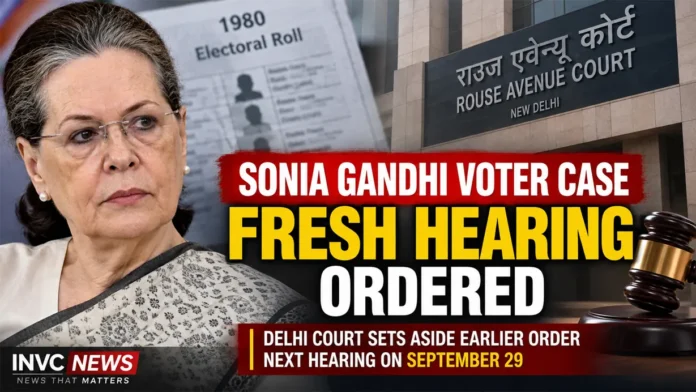
The decades-old Sonia Gandhi voter list case has returned to court scrutiny after a Delhi court set aside an earlier magistrate order that had rejected a complaint seeking a probe into her alleged inclusion in the 1980 electoral roll before she acquired Indian citizenship.
Special Judge Vishal Gogne allowed a revision petition challenging the September 11, 2025 order of the Additional Chief Judicial Magistrate and sent the matter back for fresh consideration.
The court has listed the matter for further proceedings on September 29, 2026.
What is the allegation in the Sonia Gandhi voter list case?
The complaint was filed by advocate Vikas Tripathi.
It alleges that Sonia Gandhi’s name appeared in the electoral roll of the New Delhi parliamentary constituency in 1980, while she acquired Indian citizenship on April 30, 1983.
The complainant has questioned what documents were allegedly used to include her name in the electoral roll before she became an Indian citizen.
The complaint also alleges that her name was removed from the electoral roll in 1982 and subsequently appeared again in 1983.
These remain allegations before the court and have not been established as findings of guilt.
Why did the Delhi court set aside the earlier order?
The latest order does not declare that the allegations against Sonia Gandhi have been proved.
Instead, the court found problems with the way the magistrate had dealt with the complaint.
Special Judge Vishal Gogne described the earlier decision as a “non-speaking order”, meaning that it did not adequately set out the reasons behind its conclusions.
The court also held that the order suffered from a “manifest error in law” in relation to the procedure under Section 175(3) of the Bharatiya Nagarik Suraksha Sanhita.
According to the order reported by multiple publications, the magistrate had not heard the concerned police officer or called for a police status report before deciding the matter.
Court sends complaint back for fresh consideration
The sessions court has now returned the matter to the magistrate.
The magistrate will have to consider the complaint again, hear the relevant parties and pass a reasoned order.
This means the present decision does not automatically amount to registration of an FIR against Sonia Gandhi.
The next stage will determine how the magistrate proceeds after reconsidering the complaint and the available material.
What did the earlier magistrate court decide?
The controversy reached the courts in 2025 when the complainant sought criminal proceedings over the alleged electoral-roll entry.
On September 11, 2025, the magistrate rejected the complaint seeking an investigation.
The magistrate had questioned the evidentiary basis of the allegations, including reliance on an uncertified electoral-roll extract.
That decision was subsequently challenged through the revision petition that has now succeeded.
Sonia Gandhi has rejected the allegations
Sonia Gandhi has previously opposed the revision petition.
Through her lawyers, she argued that the allegations were based on incorrect and speculative claims and sought dismissal of the petition.
Her side also argued that the complaint did not identify a specific forged or fabricated document and questioned attempts to turn a decades-old electoral-roll dispute into criminal proceedings.
Why September 29 will now be important
The latest order has reopened the procedural path that had been closed by the magistrate’s 2025 decision.
The focus will now return to the magistrate court on September 29.
At that stage, the court will reconsider the complaint under the directions issued by the revisional court.
The key legal question is therefore not whether Sonia Gandhi has already been found responsible for fraud or forgery — she has not — but whether the allegations and supporting material warrant further proceedings under criminal law.
Until the magistrate passes a fresh order, the accusations remain allegations being tested through the judicial process.