By Team INVC | INVC NEWS
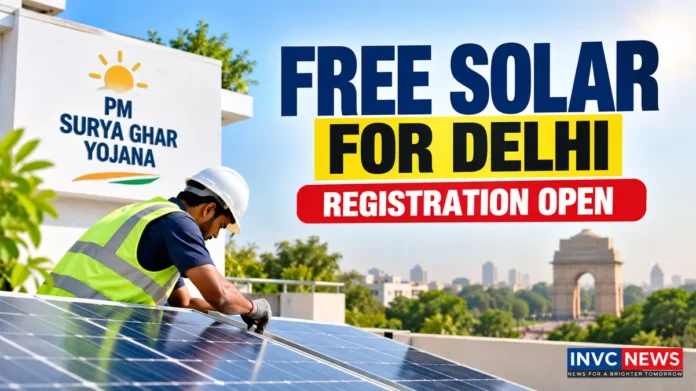
NEW DELHI, India | September 21, 2026 —Delhi households using up to 400 units of electricity a month can now apply for a rooftop solar system of up to 3 kW under the PM Surya Ghar-linked Delhi solar programme. Registrations have opened on the Delhi Solar Portal, and installations for eligible consumers are being offered on a first-come, first-served basis. The current rollout aims to reach around 2.3 lakh households across the capital.
For families worried about rising electricity costs, this is the most important part of the announcement: eligible households in the targeted category can seek installation without bearing the normal upfront cost of a rooftop solar system. The scheme combines central support with Delhi’s solar programme and a utility-led installation model.
Who Can Apply for Free Rooftop Solar in Delhi?
The current Delhi rollout is aimed at residential electricity consumers using up to 400 units per month.
Under the announced scheme, eligible households can receive rooftop solar installations of up to 3 kW. The Delhi government has said the programme will cover around 2.3 lakh homes and will operate on a first-come, first-served basis.
That means people who meet the eligibility conditions should not assume that registration can be postponed indefinitely.
The programme has a limited target, so early applicants who complete verification and meet technical requirements may have an advantage over those who wait.
Do 400 Units Mean You Will Get 400 Units of Free Electricity?
No. This is an important distinction.
The 400-unit figure refers to the household consumption category being targeted for the free rooftop installation, not a promise that every household will automatically receive 400 units of solar electricity each month.
Actual electricity generation depends on the size of the solar plant, rooftop conditions, sunlight, weather, orientation and maintenance.
Delhi Solar Portal guidance says a 1 kWp rooftop system can generate around 4 to 5 units on a clear sunny day, although output varies throughout the year.
How to Apply for the Delhi Free Solar Panel Scheme
Consumers can apply through the Delhi Solar Portal using their electricity connection details.
The registration form currently asks for the consumer account number, DISCOM, mobile number, address, rooftop area, district and pincode. Applicants can select a desired plant capacity of 2 kW or 3 kW under the Utility Led Aggregation model.
The application process is straightforward:
- Open the official Delhi Solar Portal and choose the PM Surya Ghar rooftop solar application option.
- Enter your CA number and select your electricity distribution company.
- Verify your mobile number through OTP.
- Enter your residential address and available rooftop area.
- Select the required 2 kW or 3 kW solar capacity.
- Submit consent for installation under the Utility Led Aggregation model.
- Wait for eligibility, rooftop and connection verification before installation moves ahead.
Consumers of BRPL, BYPL, TPDDL, NDMC and MES can use the consent process currently displayed on the official portal.
You Do Not Have to Find an Installer Yourself Under the ULA Model
For many households, selecting a reliable solar installer can be one of the most confusing parts of rooftop solar.
The Delhi scheme attempts to simplify that.
Under the ULA model, the rooftop solar system will be installed by a vendor assigned by the DISCOM or the state-designated implementing agency. The consumer must provide access for installation, inspection and verification.
The Delhi Solar Portal also states that consumers claiming central assistance under PM Surya Ghar must use vendors empanelled with the national programme.
That makes it especially important to avoid paying unknown agents or installers who approach households claiming guaranteed approval.
How Much Central Solar Subsidy Is Available?
Under PM Surya Ghar, the central subsidy for residential consumers is currently:
₹30,000 per kW for the first 2 kW, followed by ₹18,000 for the additional third kW.
That means the central assistance reaches a maximum of ₹78,000 for a qualifying 3 kW residential system.
Delhi also has its own solar incentives. The official state subsidy page lists a capital subsidy of ₹10,000 per kW for residential households, capped at ₹30,000 for a 3 kW plant, under the Delhi Solar Energy Policy.
However, the exact financial treatment can depend on the installation model and scheme route used by the consumer, so applicants should rely on the amount shown during their official application rather than claims made by private agents.
How Much Rooftop Space Do You Need?
A house needs enough usable, largely shadow-free rooftop space for the panels.
Water tanks, nearby buildings, trees, parapet walls and other structures can reduce usable solar area.
The Delhi Solar Portal provides a rooftop calculator that uses monthly electricity consumption, available shadow-free area and desired solar capacity to estimate feasibility, subsidy and potential savings.
A technical inspection may therefore approve a smaller system if the property cannot safely or efficiently support 3 kW.
People living in upper-floor homes with clear roof access may find installation easier than residents who do not control or have permission to use the rooftop.
Can People Living in Apartments Also Benefit?
Apartment residents should not automatically assume rooftop solar is unavailable to them.
Delhi’s solar policy includes options for Group Housing Societies and Resident Welfare Associations, including support for common facilities and group-based rooftop models.
However, an individual apartment owner may not have exclusive rights over the roof.
Such residents may need approval from the housing society, RWA or property management structure depending on the installation model.
That means apartment residents should first establish rooftop rights and society approval before expecting an individual system.
Will Solar Panels Really Reduce Your Electricity Bill?
They can, but the savings will differ from one household to another.
A home using most of its electricity during daylight hours can consume part of the solar generation directly. Depending on metering arrangements, surplus generation may also receive credit under applicable rules.
Delhi’s official calculator estimates potential monthly bill savings based on consumption, rooftop size and system capacity.
However, households should avoid treating any generic savings figure as guaranteed.
Solar generation changes with seasons, panel orientation, shade and maintenance.
Check Your CA Number Before Starting the Application
One small preparation can make the registration much easier.
Keep your latest electricity bill available.
The Delhi Solar Portal requires the Consumer Account or CA Number, and applicants must also identify their DISCOM.
A mobile number is required for OTP verification, while the application asks for address and rooftop information.
Having these details ready can prevent applicants from abandoning the process halfway through.
Beware of Fake ‘Free Solar’ Agents
A high-interest government benefit inevitably creates an opportunity for misleading calls, messages and websites.
Residents should therefore avoid sharing OTPs, bank information or identity documents with unverified callers claiming that they can “reserve” a solar panel slot for a fee.
The genuine Delhi application process is available through the government’s Delhi Solar Portal, and PM Surya Ghar central assistance operates through the authorised national programme and empanelled vendors.
If a person asks for money simply to secure registration, verify the demand directly with the relevant DISCOM before making any payment.
Why Eligible Delhi Households Should Check the Scheme Now
For households using up to 400 units a month, the new portal removes one of the biggest reasons families postpone rooftop solar: the initial cost and complexity of arranging installation. The current programme combines government support with a DISCOM-linked installation route and limits the initial rollout to around 2.3 lakh households. Because allotment is being offered on a first-come, first-served basis, eligible residents who have suitable rooftop space should check their CA number, confirm their DISCOM and review the official application now rather than discovering later that the available allocation has already been taken.