By Team INVC | INVC NEWS
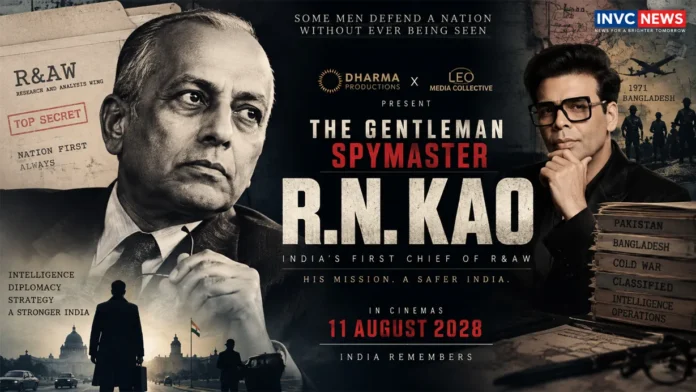
MUMBAI, India | September 21, 2026 — Bollywood has spent years creating fictional spies who cross borders, break codes, survive impossible missions and save the country before the end credits roll. Karan Johar has now found a story that needs far less invention. Dharma Productions and Leo Media Collective are bringing Rameshwar Nath Kao, the founder and first chief of India’s Research and Analysis Wing, to the big screen — and the real history surrounding him already carries enough intrigue for a full-blown espionage epic.
This is not the announcement of another routine biopic. R.N. Kao’s story sits at the intersection of intelligence, diplomacy, India-Pakistan tensions, the birth of R&AW and the extraordinary events that reshaped South Asia in 1971. Add Dharma’s ability to turn films into cultural events, an Independence Day weekend release and a lead actor who remains under wraps, and Bollywood suddenly has one of its most tempting upcoming projects.
The still-untitled film will arrive in theatres on August 11, 2028. More importantly, its announcement puts a remarkable historical figure back into public conversation — a person who spent much of his professional life deliberately staying out of it.
Karan Johar Has Found a Story Bigger Than a Conventional Spy Thriller
Hindi cinema has no shortage of intelligence officers, undercover agents and secret missions. Most arrive with spectacular action, dramatic villains and enough firepower to fill a trailer.
R.N. Kao offers filmmakers something more sophisticated.
His world revolved around information, strategy, networks and decisions made away from public view. That gives Karan Johar and the creative team an opportunity to make a spy film where suspense does not depend solely on gunfire or explosions.
A confidential message can create tension. A meeting behind closed doors can alter the direction of a mission. A piece of intelligence arriving several hours early can change history.
That is the atmosphere this story can offer.
If Dharma understands that distinction, the R.N. Kao film could stand apart from Bollywood’s increasingly crowded fictional spy universe.
R.N. Kao Was Building the World That Bollywood Now Loves to Fictionalise
Rameshwar Nath Kao became the founding chief of the Research and Analysis Wing when India established the external intelligence agency in 1968.
He helped shape the organisation during its formative period and became one of the most respected figures associated with Indian intelligence.
Yet Kao never became a conventional public celebrity.
That was hardly surprising.
Intelligence work rarely rewards visibility. People working inside such organisations generally operate without public recognition, and the effectiveness of their work can depend on precisely that discretion.
Kao’s reputation therefore developed very differently from that of a military commander, political leader or public official.
The mystery surrounding his professional life became part of his legend.
Now Bollywood wants to turn that mystery into cinema.
The Real Hook Lies in the Years 1955 to 1971
The makers plan to trace Kao’s journey between 1955 and 1971, and this is where the project starts looking particularly ambitious.
Those years allow the film to travel through a rapidly changing India, the evolution of the country’s intelligence capabilities, the creation of R&AW and finally the geopolitical crisis that culminated in the 1971 India-Pakistan war and the emergence of Bangladesh.
It is a remarkable dramatic arc.
A filmmaker does not have to invent a massive historical backdrop because one already exists.
India was navigating difficult relations with its neighbours. Cold War politics influenced decisions across the region. East Pakistan faced an escalating political and humanitarian crisis. Millions of refugees entered India, diplomatic pressure intensified and military confrontation eventually followed.
Against that enormous backdrop sat a young external intelligence agency still establishing itself.
For a serious film journalist, that is the element that makes this project far more interesting than simply attaching the words “spy thriller” to the announcement.
1971 Could Give the Film Its Biggest Cinematic Canvas
Any film that moves toward 1971 inevitably carries enormous dramatic possibilities.
The India-Pakistan war transformed South Asia and resulted in the creation of Bangladesh. Military operations understandably dominate popular memory of the conflict, but intelligence gathering, political assessment and strategic planning also formed part of the wider picture.
A film centred on R.N. Kao can potentially explore that less visible layer.
Instead of focusing only on what happened on the battlefield, the narrative can examine the intelligence machinery operating behind the public events.
That is where the movie could find its distinctive identity.
There is already an abundance of action cinema. A tense, intelligently written historical espionage drama would be far rarer.
‘Gentleman Spymaster’ Gives Dharma a Serious Foundation
The film draws from strategic affairs expert Nitin A. Gokhale’s book, “R.N. Kao: Gentleman Spymaster.”
That source material gives the project weight.
It also gives the filmmakers responsibility.
When cinema deals with national security and historical figures, audiences increasingly distinguish between documented history and dramatic interpretation. Viewers discuss dates, analyse scenes and compare screen portrayals with available records.
Dharma therefore has an opportunity to create something entertaining without sacrificing the intelligence of its audience.
The most exciting version of this film would not need to turn Kao into an invincible action figure.
His strength as a screen character can come from intellect, judgement, discretion and the ability to understand situations before others do.
That is far more interesting.
Karan Johar Knows How to Turn a Film Into an Event
This is also where Karan Johar becomes important to the story.
Dharma Productions understands scale.
The studio knows how to package a film, build anticipation around casting and transform a release into a sustained conversation months before audiences reach theatres.
Dharma has also explored stories involving military service, espionage and history through films such as Raazi, Shershaah, Kesari and Kesari Chapter 2.
However, R.N. Kao presents a different creative challenge.
This story cannot survive on spectacle alone.
It needs atmosphere.
It needs period detail.
It needs sharp writing.
Above all, it needs a filmmaker who understands that people sitting around a table can sometimes create more suspense than people running through a battlefield.
Handled with restraint, that difference could become the film’s biggest strength.
And Then Comes Bollywood’s Favourite Game: The Casting Mystery
The makers have wisely left one enormous piece of information unrevealed.
They have not announced the actor who will play R.N. Kao.
That single decision guarantees months of speculation.
The role requires a performer capable of conveying authority without turning every scene into a display of aggression. Kao’s screen presence will need intelligence, restraint and emotional control.
The actor must also carry a story spanning a considerable historical period.
That makes this much more than a star vehicle.
It could become one of those rare Hindi film roles where casting determines the tone of the entire movie.
A glamorous choice could push the film toward conventional mainstream territory. A more restrained performer could move it toward a serious historical espionage drama.
Dharma’s eventual announcement will reveal a great deal about the kind of film it actually intends to make.
Even the Director Remains a Carefully Guarded Secret
The director has also not been officially announced.
That mystery makes the project even more interesting because R.N. Kao’s life can be interpreted in radically different cinematic ways.
A large-scale commercial filmmaker could emphasise the geopolitical spectacle.
A filmmaker known for grounded thrillers could focus on intelligence operations and institutional politics.
Someone with a strong command of period drama could make 1950s and 1960s India almost a character in itself.
Dharma currently holds those cards close.
For the publicity campaign, that is excellent strategy.
For film enthusiasts, it creates precisely the kind of anticipation that keeps a project alive long before cameras roll.
Six Years Later, Dharma Has Finally Brought R.N. Kao Back
The announcement also carries a Bollywood subplot of its own.
Dharma had first revealed plans to adapt the R.N. Kao story in 2020. Then the project largely disappeared from public conversation.
Six years later, it has returned with Leo Media Collective, a clearer historical framework and, most importantly, a confirmed theatrical release date.
That matters.
The Hindi film industry has a long list of ambitious projects that were announced with great excitement and never reached cinemas.
By fixing August 11, 2028, the producers have signalled that the R.N. Kao film has moved into a much more serious phase.
The project no longer feels like an intriguing idea.
It feels like a film Dharma intends to turn into an event.
August 11, 2028 Gives the Film a Ready-Made Stage
The release strategy could hardly be more deliberate.
A movie centred on the founder of R&AW will arrive just ahead of India’s Independence Day.
That gives the marketing team an enormous canvas without requiring artificial hype.
Archival imagery, intelligence files, period photographs, coded communication and the visual world of the late 1960s and early 1970s can provide a striking campaign.
The producers also have another advantage: curiosity around R&AW already exists.
People do not need to be taught why the agency is intriguing.
They already want to know what happens behind its closed doors.
The movie simply needs to channel that curiosity responsibly.
The Biggest Danger Is Also Obvious — Bollywood Must Not Overcook R.N. Kao
This is where the film could either become exceptional or painfully familiar.
R.N. Kao does not need an exaggerated screen makeover.
The temptation to transform a historical intelligence chief into a conventional action hero will undoubtedly exist because spectacle sells trailers.
But Kao’s story offers a different kind of power.
The drama can come from the information nobody else possesses.
From the message that arrives at midnight.
From the map spread across a desk.
From an intelligence officer realising that events are about to move faster than governments expect.
A filmmaker who trusts those moments could create genuine suspense.
A filmmaker who does not may simply deliver another loud spy movie carrying a famous historical name.
Dharma now has the chance to choose the more interesting path.
Karan Johar May Have Just Found Bollywood’s Most Fascinating Real-Life Spy Story
There is a delicious irony at the centre of this announcement.
For years, Hindi cinema has invented spies.
Now one of Bollywood’s biggest production houses has finally turned toward the person who helped build the real institution that fictional spy films endlessly borrow from.
The ingredients are extraordinary.
R.N. Kao.
The birth of R&AW.
A rapidly changing South Asia.
The road to 1971.
A respected source book.
A lead actor whose identity remains secret.
A director still waiting to be revealed.
And an August 2028 theatrical release timed for the Independence Day weekend.
Karan Johar has not merely announced another biopic.
He has opened a door into a world Hindi cinema has repeatedly imagined but rarely explored from its foundations.
If Dharma gets the writing, casting and tone right, audiences may not simply get another spy thriller.
They could get the story of how India’s modern spy story really began.
Bollywood has spent years searching for its next great secret agent. This time, Karan Johar may have found something better — the gentleman spymaster who helped create the system behind the secrets.